Madhya Pradesh Chief Minister Dr. Mohan Yadav has said that the holistic development of villages, the poor, and farmers remains the top priority of the state government. Making them self-reliant and economically empowered is the core objective of the government. In line with this vision, the year 2026 is being observed as the Agricultural Welfare Year, during which special efforts will be made to promote agriculture-based industries and strengthen rural employment.
The Chief Minister stated that during the Agricultural Welfare Year, more than 15 major departments will work in a coordinated manner for the welfare of farmers and rural workers. Under the leadership of the Farmer Welfare and Agriculture Development Department, departments such as horticulture, animal husbandry, fisheries, water resources, cooperation, energy, panchayat and rural development, food processing, MSMEs, forests, cottage and village industries, among others, will accelerate employment-oriented activities across the state.
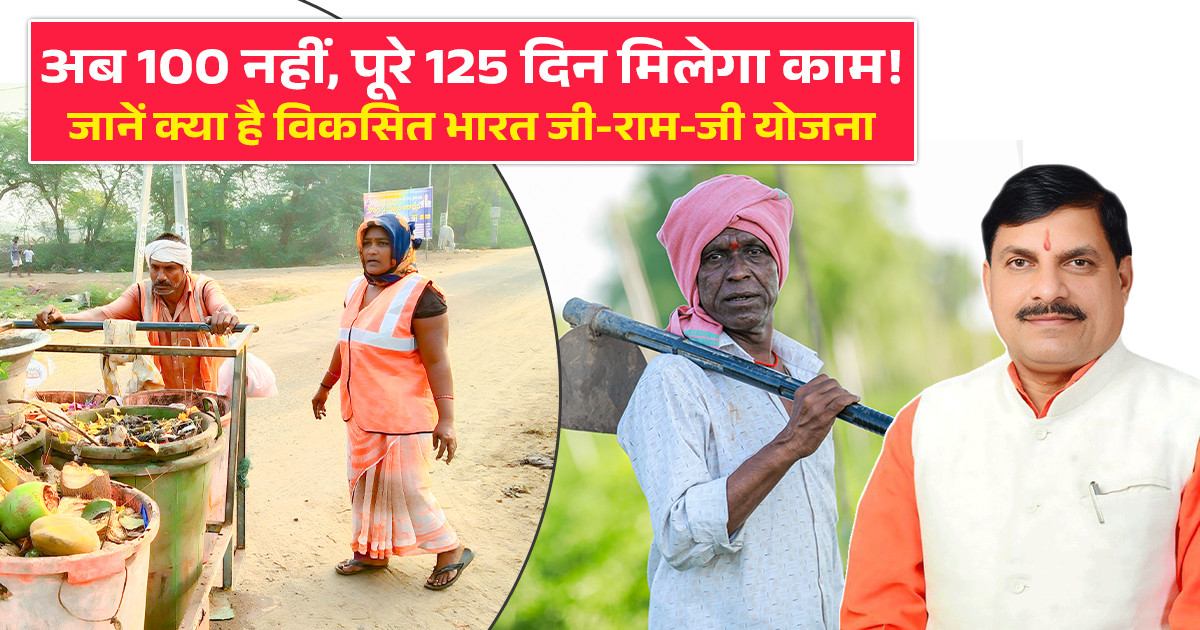
Dr. Yadav explained that the Viksit Bharat Guarantee for Employment and Livelihood Mission (Rural)—popularly known as the VB G-RAM-G Act, 2025—has been implemented by the central government to provide employment at the village level to needy rural families across the country. Under this scheme, each rural household is now legally guaranteed 125 days of employment, compared to the earlier limit of 100 days under MGNREGA. The scheme is expected to prove highly beneficial for farmers, agricultural labourers, and poor families, while also strengthening overall rural development.
The G-RAM-G scheme includes provisions to ensure adequate availability of agricultural labour during peak farming seasons such as sowing and harvesting. States have been empowered to notify up to 60 days in a financial year specifically to address labour requirements during critical crop production periods, helping farmers avoid labour shortages when they need it most.
The Chief Minister said the state government is preparing a detailed action plan to ensure effective implementation of the scheme. The focus will be on promoting cattle rearing, natural farming, rural markets, local stalls, and the sale of indigenous products. Arrangements will be made in every district to make farmers’ natural and locally produced goods accessible to the general public.
To improve accountability and transparency, the administrative workforce involved in the scheme has been increased from 6 percent to 9 percent, ensuring smoother execution and better monitoring.
Dr. Yadav highlighted that the Act includes provisions for an unemployment allowance. If a rural family does not receive work within the stipulated time despite submitting a demand, the state government will be required to provide unemployment allowance as per prescribed norms. Similarly, if there is any delay in wage payments after the completion of work, labourers will be entitled to additional compensation in the form of delayed wages.
The Act, priority will be given to Scheduled Castes, Scheduled Tribes, economically weaker sections, women-headed households, persons with disabilities, and small and marginal farmers. Clear responsibilities have been assigned to Panchayati Raj Institutions from Gram Sabha to District Panchayat.
Transparency will be ensured through geo-tagging of works, digital record-keeping, biometric payment systems, and social audits conducted by Gram Sabhas. The scheme also includes a time-bound grievance redressal mechanism and penal provisions, supported by a digital grievance management system to ensure effective monitoring and accountability.
Q1. What is the Viksit Bharat G-RAM-G Scheme?
It is a rural employment guarantee scheme providing 125 days of assured work to rural households.
Q2. How is it different from MGNREGA?
It increases guaranteed employment from 100 to 125 days and focuses more on agriculture-linked livelihoods.
Q3. Who will get priority under the scheme?
SCs, STs, women-headed households, disabled persons, and small farmers.
Q4. What happens if wages are delayed?
Workers are entitled to compensation for delayed wage payments.
Q5. How is transparency ensured?
Through geo-tagging, biometric payments, digital records, and social audits, as reported by Khetivyapar.