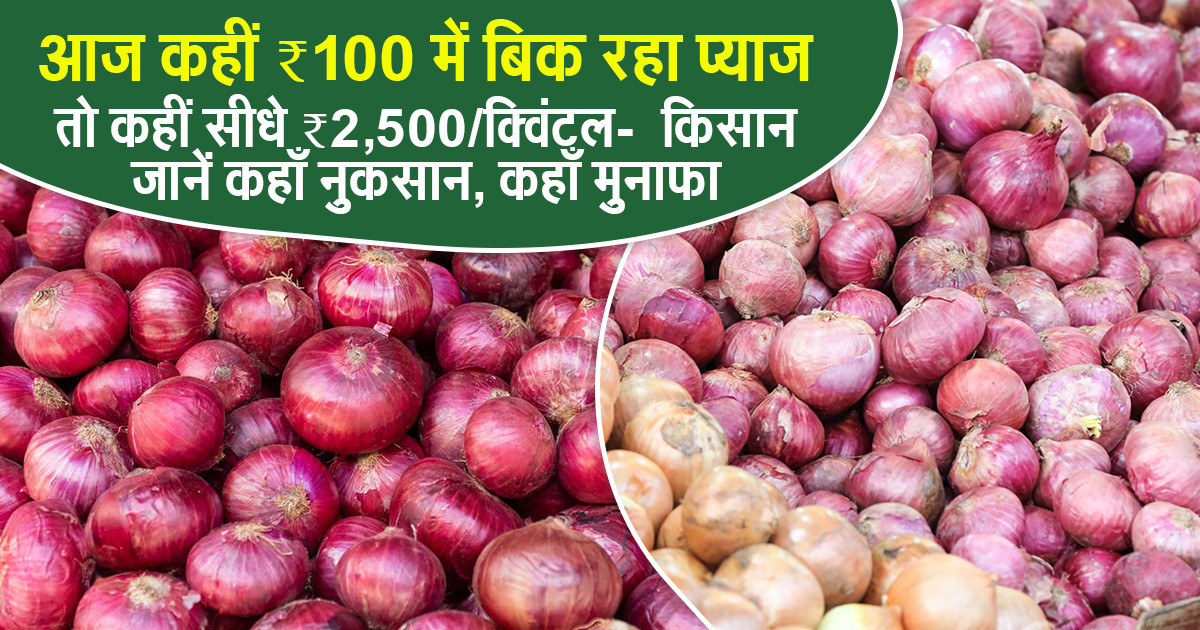
The picture emerging from today’s major onion mandis across India is truly shocking for both farmers and traders. In some markets, record arrivals pushed onion prices down to throwaway levels, while in others, tight supply and strong demand sent prices soaring.
Several mandis of Madhya Pradesh, onions crashed to as low as ₹100 per quintal, whereas in Maharashtra and Delhi, the same onion fetched prices as high as ₹2,500 per quintal.
Such a volatile market, the big question is:
Why are onion prices so different today? Where are farmers facing losses, and where is the opportunity for profit?
In this mandi report, we bring you state-wise latest onion prices, arrival trends, and market analysis in a clear and simple format—so you can take better selling decisions.
If you are a farmer choosing the right mandi or a trader tracking market trends, this report is essential reading.
| State / Mandi | Arrivals (Tonnes) | Variety | Min Price (₹/Quintal) | Max Price (₹/Quintal) |
| Madhya Pradesh | ||||
| Ashta APMC | 32.3 | Onion | 100 | 230 |
| Badnagar APMC | 54.5 | Other | 160 | 175 |
| Badnawar APMC | 13.28 | Onion | 400 | 500 |
| Bhopal APMC | 18.02 | Onion | 500 | 1000 |
| Garhakota APMC | 24 | Onion | 550 | 600 |
| Garoth APMC | 61.03 | Onion | 867 | 1145 |
| Maharashtra | ||||
| Akola APMC | 35 | Other | 600 | 2000 |
| Amravati (F&V) | 38.9 | Red | 600 | 2200 |
| Bhusawal APMC | 4 | Other | 700 | 1000 |
| Chandrapur (Ganjwad) | 27 | Other | 1700 | 2500 |
| Chandwad APMC | 1500 | Red | 530 | 2254 |
| Devala APMC | 600 | Red | 200 | 2125 |
| Delhi (NCT) | ||||
| Azadpur APMC | 1365.7 | Onion | 500 | 2250 |
| Ghazipur APMC | 330.95 | Onion | 1400 | 1800 |
| Keshopur APMC | 157.43 | Onion | 1000 | 2200 |
Biggest price crash was seen in Madhya Pradesh.
Ashta, onion sold for just ₹100–₹230 per quintal, while Badnagar saw prices at ₹160–₹175, mainly due to continuous heavy arrivals.
Garoth and Garhakota, prices were relatively stable, ranging between ₹600 and ₹1,145.
Maharashtra mandis showed stronger prices overall.
Chandrapur, onions traded between ₹1,700 and ₹2,500, while Amravati and Akola recorded highs of ₹2,000–₹2,200.
However, Chandwad and Devala, despite high maximum prices, saw very low minimum rates (₹200–₹530) due to massive arrivals (1,500 and 600 tonnes).
Delhi mandis remained strong despite heavy arrivals.
Even with over 1,365 tonnes arriving in Azadpur, prices stayed between ₹500 and ₹2,250.
Ghazipur and Keshopur recorded prices up to ₹1,800–₹2,200, indicating strong consumer demand.
Advice for Farmers:
Farmers in Madhya Pradesh should avoid selling in low-price mandis for now and opt for storage if possible.
Farmers with good-quality onions can get better profits in Maharashtra and Delhi mandis at present.
Mandis with excessive arrivals (Ashta, Chandwad, Devala) may continue to face price pressure.
Prices may improve in the coming days as demand picks up—avoid distress selling of the entire produce at once.
Frequently Asked Questions (FAQs):
Q1: Why are onion prices so different across states?
A1: Price differences are mainly due to supply-demand dynamics and the volume of arrivals in each mandi.
Q2: Which mandis currently offer the best price for onions?
A2: Maharashtra’s Chandrapur and Amravati, and Delhi’s Ghazipur and Keshopur mandis offer comparatively higher prices.
Q3: Should farmers sell immediately or wait?
A3: Farmers in low-price mandis should consider storage and avoid distress selling; prices may improve soon.
Q4: How can traders benefit from this volatile market?
A4: Traders should monitor mandi arrivals and prices closely to buy low in high-arrival mandis and sell high in low-arrival markets.
Q5: Where can I find daily updates on onion prices?
A5: Khetivyapar regularly publishes mandi reports and price updates to help farmers and traders stay informed.