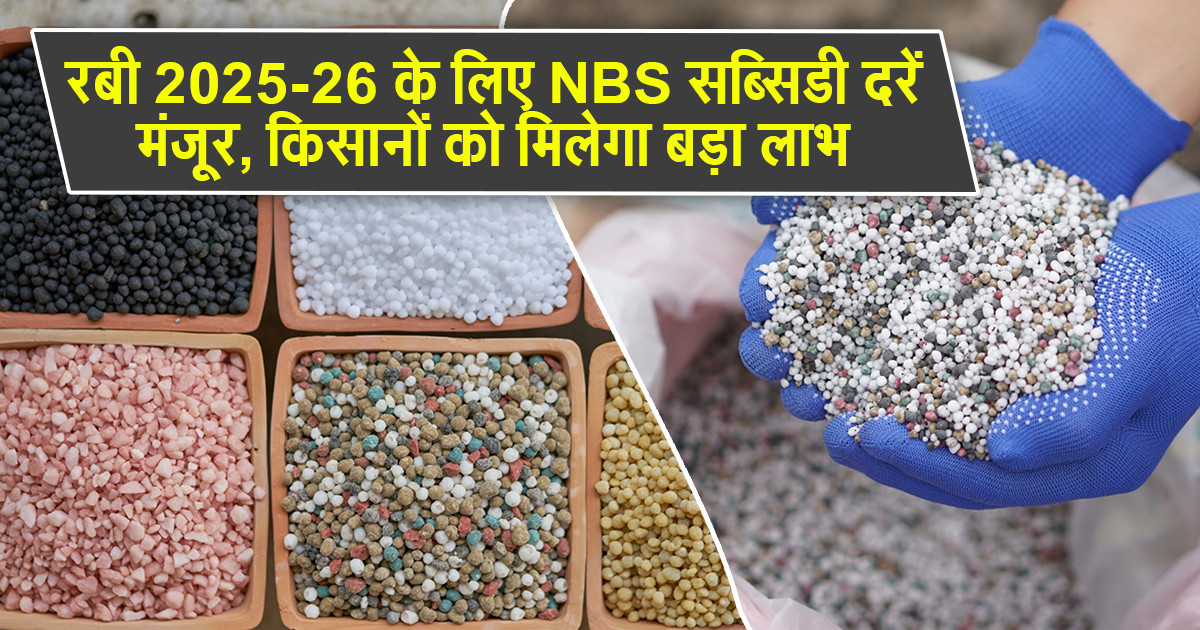
To promote balanced fertilizer use and maintain soil health, the Central Government has approved the Nutrient-Based Subsidy (NBS) rates for the Rabi season 2025–26. These revised subsidy rates will be effective from October 1, 2025, to March 31, 2026, and will apply to Phosphatic and Potassic (P&K) fertilizers, including DAP and NPKS grades.
For the Rabi 2025–26 season, the government has made a tentative budgetary provision of approximately ₹37,952 crore under the NBS scheme. This amount is about ₹736 crore higher than the allocation for the Kharif 2025 season, indicating sustained financial support to ensure fertilizers remain affordable for farmers.
Notably, more than ₹2.04 lakh crore has been spent on NBS subsidies between 2022–23 and 2024–25, reflecting the government’s continued commitment to agricultural input support.
The Nutrient-Based Subsidy (NBS) scheme was introduced by the Government of India on April 1, 2010, marking a major policy reform in the fertilizer sector. The objective of the scheme is to make fertilizers available to farmers at reasonable and affordable prices, while encouraging their balanced and judicious use.
The scheme, subsidies are fixed based on the nutrient content of fertilizers Nitrogen (N), Phosphorus (P), Potassium (K), and Sulphur (S). This allows farmers to select fertilizers according to soil and crop requirements and helps address long-standing issues of nutrient imbalance and soil degradation.
The NBS scheme has also positively impacted domestic fertilizer production. Production of P&K fertilizers such as DAP and NPKS increased from 112.19 lakh metric tonnes in 2014 to 168.55 lakh metric tonnes in 2025 (up to December 30)—a growth of over 50 percent during this period.
Key Features of the NBS Scheme:
From Kharif 2024, three additional fertilizer grades were included:
Farmers now have access to 28 types of P&K fertilizers at subsidized rates.
How Farmers Benefit: Under the NBS scheme, the P&K fertilizer sector operates under a decontrolled pricing system, allowing companies to fix the Maximum Retail Price (MRP) within reasonable limits. Government monitoring ensures that the benefit of subsidies is passed directly to farmers, keeping fertilizer prices affordable.
Considering trends in international and domestic fertilizer markets and raw material prices, the government has approved new NBS rates for Rabi 2025–26. Subsidies will be provided to fertilizer companies at notified rates to ensure timely availability of fertilizers at affordable prices for farmers.
Overall, the NBS scheme continues to play a crucial role in reducing input costs, improving soil fertility, and promoting sustainable and productive agriculture.
Rabi 2025–26: NBS Subsidy Rates for P&K Fertilizers
|
S. No. |
Fertilizer Name |
Grade (N-P-K-S) |
Subsidy Rate (₹/MT) |
|
1 |
DAP |
18-46-0-0 |
29,805 |
|
2 |
MOP |
0-0-60-0 |
1,428 |
|
3 |
SSP |
0-16-0-11 |
7,408 |
|
4 |
NPS |
20-20-0-13 |
18,569 |
|
5 |
NPK |
10-26-26-0 |
17,390 |
|
6 |
NP |
20-20-0-0 |
18,196 |
|
7 |
NPK |
15-15-15 |
14,004 |
|
8 |
NP |
24-24-0-0 |
21,835 |
|
9 |
Ammonium Sulphate (AS) |
20.5-0-0-23 |
9,479 |
|
10 |
NP |
28-28-0-0 |
25,474 |
|
11 |
NPK |
17-17-17 |
15,871 |
|
12 |
NPK |
19-19-19 |
17,738 |
|
13 |
NPK |
16-16-16-0 |
14,938 |
|
14 |
NPS |
16-20-0-13 |
16,848 |
|
15 |
NPK |
14-35-14 |
23,142 |
|
16 |
MAP |
11-52-0-0 |
29,671 |
|
17 |
TSP |
0-46-0-0 |
22,062 |
|
18 |
NPK |
12-32-16 |
20,890 |
|
19 |
NPK |
14-28-14 |
19,785 |
|
20 |
NPKS |
15-15-15-09 |
14,262 |
|
21 |
NP |
14-28-0-0 |
19,452 |
|
22 |
PDM |
0-0-14.5-0 |
345 |
|
23 |
Urea-SSP Complex |
5-15-0-10 |
9,088 |
|
24 |
NPS |
24-24-0-8 |
21,835 |
|
25 |
NPK |
8-21-21 |
14,013 |
|
26 |
NPK |
9-24-24 |
15,953 |
|
27 |
NPK |
11-30-14 |
19,453 |
|
28 |
SSP (Fortified) |
0-16-0-11 |
7,408 |
Major Increase in DAP Subsidy: For Rabi 2025–26, the subsidy on Di-Ammonium Phosphate (DAP) has been raised sharply to ₹29,805 per metric tonne, compared to ₹21,911 per metric tonne in Rabi 2024–25, providing direct relief to farmers using this widely consumed fertilizer.
Ammonium Sulphate Included Under NBS: Both domestic and imported Ammonium Sulphate have been brought under the NBS scheme for Rabi 2025–26, offering relief to farmers in sulphur-deficient regions.
Extra Incentives for Micronutrient-Fortified Fertilizers: P&K fertilizers fortified or coated with Boron or Zinc, as per the Fertilizer Control Order, will continue to receive subsidies. Additionally, such fertilizers will be eligible for extra subsidy per metric tonne, encouraging the use of micronutrients along with primary nutrients.
Q1. What is the NBS subsidy for Rabi 2025–26?
It is government support on P&K fertilizers to keep prices affordable and promote balanced nutrition.
Q2. Is DAP included under the NBS scheme?
Yes, DAP receives a subsidy of ₹29,805 per metric tonne for Rabi 2025–26.
Q3. When will the new NBS rates be applicable?
From 1 October 2025 to 31 March 2026.
Q4. How many fertilizers are covered under NBS now?
A total of 28 P&K fertilizer grades are covered.
Q5. Who benefits most from the NBS scheme?
Farmers benefit through lower fertilizer prices and improved soil health.