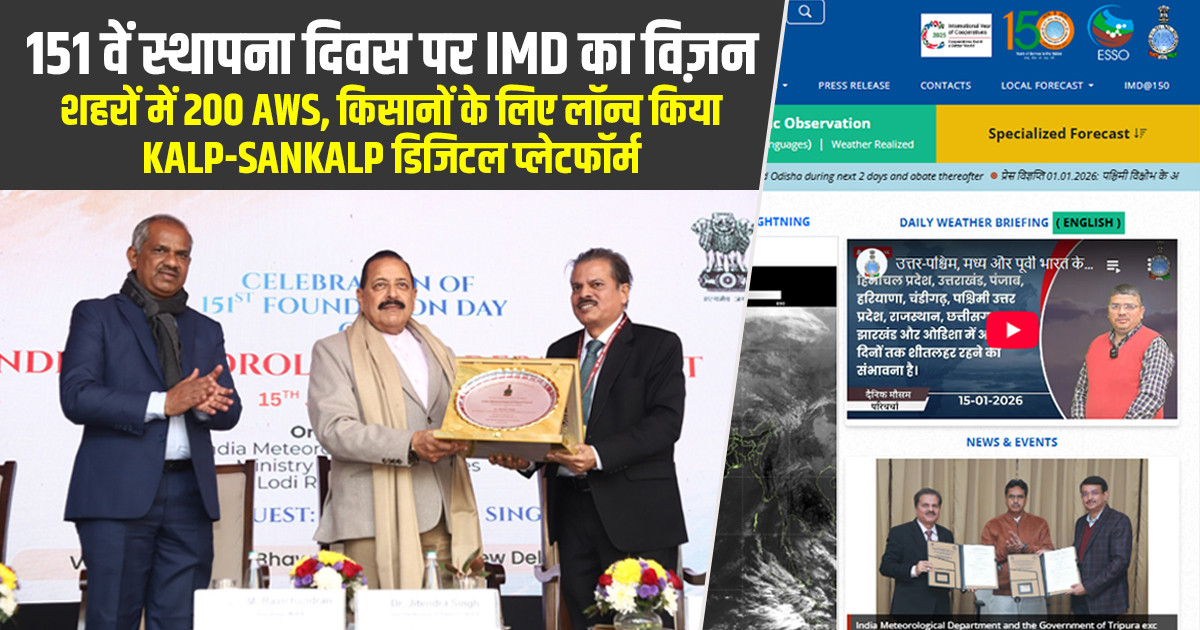
On the 151st Foundation Day of the India Meteorological Department (IMD), Union Minister of State (Independent Charge) for Science & Technology and Earth Sciences, Dr. Jitendra Singh, described IMD as the backbone of India’s disaster preparedness and public safety system. Reflecting on its 150-year legacy, he said that after celebrating the milestone year, IMD has entered a new phase with a strong focus on advanced, data-driven and technology-enabled weather services.
Dr. Jitendra Singh (Science & Technology and Earth Sciences) announced that in 2026, IMD will install 200 Automatic Weather Stations (AWS) across four major metropolitan cities—Delhi, Mumbai, Chennai and Pune, with 50 stations in each city. This expansion aims to strengthen hyper-local and real-time weather forecasting in densely populated urban areas, enabling more accurate decision-making for disaster management, transport, aviation and public safety.
Dr. M. Mohapatra, Director General of IMD, said that IMD’s focus is no longer limited to traditional forecasting. The department is now working towards hyper-local, real-time and impact-based weather services to deliver precise and actionable information to citizens and farmers. He added that the expansion of automated networks and adoption of new technologies will further strengthen India’s weather warning and early alert systems.
Dr. M. Ravichandran, Secretary, Ministry of Earth Sciences, highlighted that IMD has significantly enhanced India’s weather and disaster warning capabilities through science, technology and innovation. He noted that the growing emphasis on urban and hyper-local forecasting will make India’s climate services more resilient and better prepared to address future climate risks.
Dr. Jitendra Singh (Science & Technology and Earth Sciences) pointed out that cyclone forecast accuracy has improved by 35–40%, while errors in monthly and seasonal forecasts have reduced to nearly 2.5%. He also stated that India is emerging as a regional leader by providing weather and disaster warning services to neighbouring countries, reinforcing trust in IMD and strengthening regional cooperation.
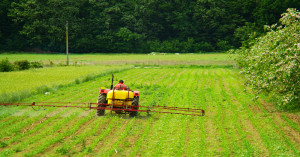
On the same occasion, IMD launched KALP (Krishi Advisory based on Location-specific Weather Prediction)—a smart digital tool designed for farmers. KALP provides location-specific weather forecasts and crop advisory services, enabling farmers to access precise information at the village or field level, rather than district-wide data. This helps farmers take better decisions related to sowing, irrigation and harvesting. The platform has been launched in integration with SANKALP to promote a digitally empowered and high-tech agricultural ecosystem.
SANKALP: A Digital Weather Companion for Farmers:
IMD also launched SANKALP (Systematic Agrometeorological Analytics, Knowledge and Advisory Enabling Platform) on 15 January 2026. Designed as a “digital weather companion” for farmers, SANKALP converts weather data such as rainfall and temperature into actionable, farm-level advisories. Its key strength lies in providing block-level accuracy, combining real-time data, historical weather records and future forecasts to support informed and timely farm decisions.
FAQs:
1. What is the significance of IMD’s 151st Foundation Day?
It marks IMD’s 150+ years of service and launch of new technology initiatives like AWS, KALP, and SANKALP for improved weather forecasting.
2. What are Automatic Weather Stations (AWS) and their role?
AWS are automated sensors collecting real-time weather data to enhance hyper-local forecasts, crucial for urban and agricultural planning.
3. How does the KALP platform help farmers?
KALP provides location-specific weather forecasts and crop advice at the village or field level, enabling smarter agricultural decisions.
4. What is the SANKALP platform?
SANKALP offers block-level agrometeorological analytics by combining real-time data with historical and forecast information to support farmers.
5. How has IMD improved forecast accuracy recently?
Cyclone forecasts have improved by 35-40%, and errors in monthly and seasonal forecasts have been reduced to around 2.5%.