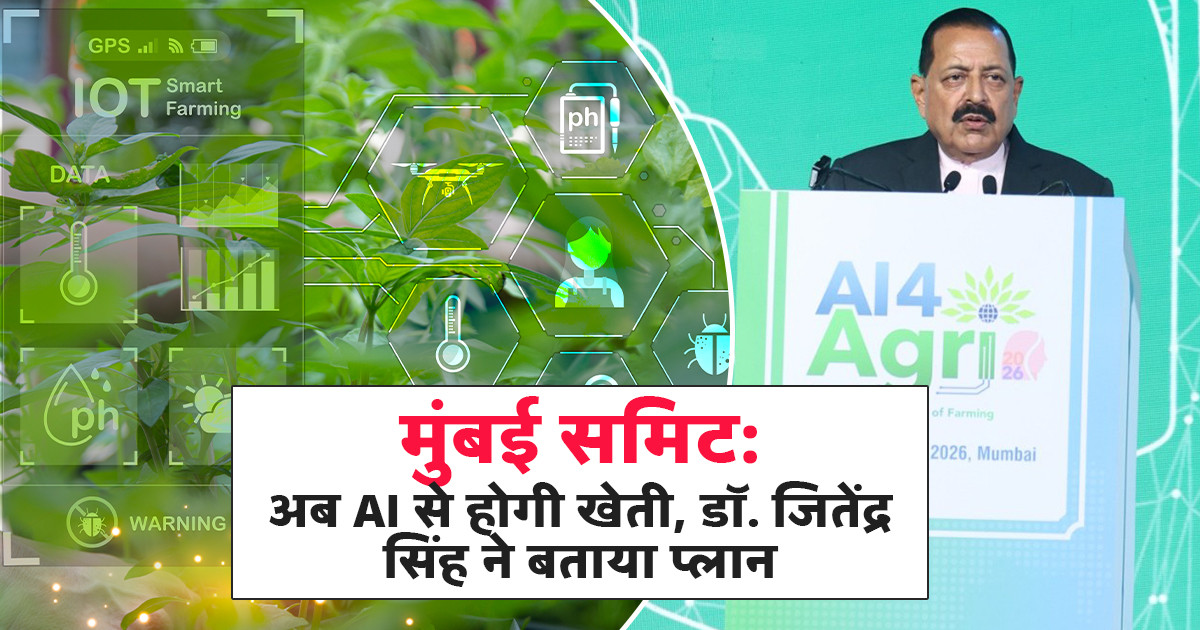
Speaking at the inaugural session of a global Agri-AI conference in Mumbai, Union Minister Dr. Jitendra Singh said that artificial intelligence will form the backbone of India’s next agricultural revolution. He emphasized that in the coming years, AI will become central to farm policy, research, and investment planning, as it offers scalable solutions to long-standing structural challenges such as unpredictable weather, limited access to timely information, and fragmented markets.
The Minister noted that even a modest 10% increase in productivity among nearly 600 million farmers across the Global South could represent one of the largest poverty-reduction opportunities of this century. Citing India’s 140 million farm holdings, he added that if AI-based advisory services help each farmer save ₹5,000 annually through better decision-making, the cumulative economic value could reach nearly ₹70,000 crore.
The government is repositioning agriculture as a strategic growth sector rather than a traditional one. To support this transition, large-scale computing infrastructure, data platforms, and a startup ecosystem are being developed. According to the Minister, multilingual AI models are also in the pipeline, enabling farmers to receive guidance in their native languages—whether Marathi, Bhojpuri, Kannada, or others—ensuring wider accessibility and inclusion.
Department of Science and Technology is building an open and interoperable AI framework to allow agricultural AI solutions developed anywhere in the country to integrate seamlessly into a national system. Meanwhile, the Anusandhan National Research Foundation is supporting advanced research in collaboration with institutions such as IITs, IISc, and ICAR to accelerate deep-tech and AI innovations tailored to agriculture.
The government is also integrating drone and satellite mapping technologies to generate verified land and soil data, helping farmers make precise and informed decisions. By combining meteorological science with AI, early warning systems are being strengthened so that farmers can plan proactively instead of reacting to crises. In addition, biotechnology research is being encouraged to develop disease-resistant and climate-resilient crop varieties.
Towards a National Agri-AI Research Network: Referring to Maharashtra’s Agri-AI policy as a model, the Minister said the Centre aims to scale such state-level initiatives nationwide. Plans are underway to establish a National Agri-AI Research Network that will bring together Indian and global institutions, including ICRISAT, to build India-specific datasets on crops, soil, and climate conditions.
FAQs:
1. What is Agri-AI?
Agri-AI refers to the use of artificial intelligence in agriculture for crop advisory, weather forecasting, soil analysis, and market insights.
2. How can Agri-AI increase farmer income?
By improving productivity, reducing input costs, and providing timely market information, Agri-AI helps farmers make profitable decisions.
3. Will Agri-AI support regional languages?
Yes, multilingual AI models are being developed to assist farmers in their native languages.
4. How are drones and satellites connected to Agri-AI?
They provide real-time land, crop, and soil data that enhances precision farming through AI analysis.
5. How is Khetivyapar related to Agri-AI?
Khetivyapar promotes modern agricultural insights and supports awareness about Agri-AI innovations for farmers.