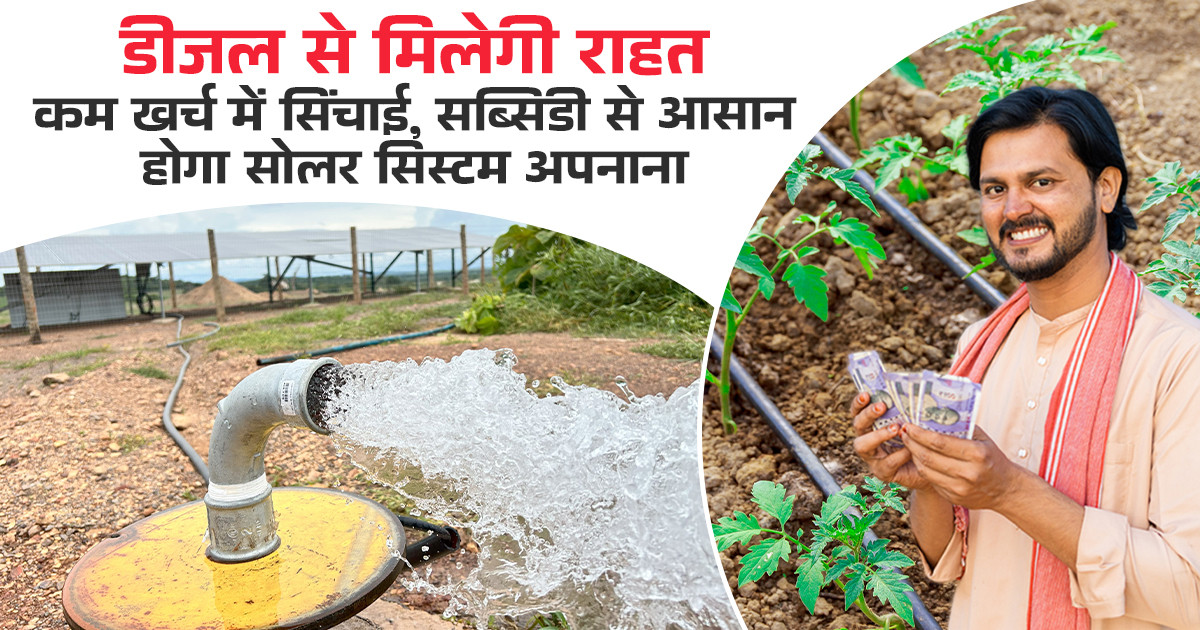
Rising irrigation expenses have long been a major concern for farmers across the country. Those relying on diesel pumps, in particular, face significant seasonal costs, pushing up overall cultivation expenses year after year. In this scenario, solar-powered irrigation systems are emerging as a practical and cost-effective alternative.
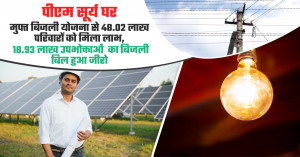
The Government of India’s PM-KUSUM scheme is playing a crucial role in reducing farmers’ dependence on diesel while promoting affordable and eco-friendly irrigation. Under this initiative, farmers are provided with solar pumps, enabling them to irrigate their fields without incurring fuel costs.
For decades, diesel pumps have been the primary source of irrigation for many farmers. However, with rising fuel prices, this method has become increasingly expensive. Small and medium farmers often spend thousands of rupees each season solely on irrigation. Additionally, diesel pumps contribute to environmental pollution and require higher maintenance. In contrast, solar pumps offer a long-term solution. Once installed, they operate with minimal recurring costs, directly reducing the financial burden on farmers.
The PM-KUSUM scheme aims to integrate farmers with solar energy and promote clean power usage in agriculture. It offers substantial subsidies to support the installation of solar pumps. Typically, a major portion of the total cost is covered by the government, while farmers pay only a limited share. This makes the technology accessible even to small and marginal farmers.
Although the upfront cost of solar pumps may seem high, government subsidies significantly reduce the financial burden. In many states, subsidies range between 60% and 75%, with some states offering additional support. As a result, farmers can adopt modern irrigation systems with relatively low investment, improving their financial stability.
Lower Costs, Higher Income:
One of the biggest advantages of solar pumps is the elimination of diesel and electricity expenses. Farmers can irrigate their fields throughout the day using free solar energy, leading to substantial annual savings. Moreover, in certain cases, surplus electricity generated by solar systems can be sold back to the grid, providing farmers with an additional source of income. This not only reduces costs but also enhances overall earnings.
Rapid Expansion across States:
The adoption of solar irrigation is gaining momentum in states such as Haryana, Rajasthan, and Madhya Pradesh. Governments are actively raising awareness and simplifying application procedures to ensure wider participation. Overall, solar-powered irrigation is proving to be a game-changer for Indian agriculture offering reduced costs, sustainable practices, and new income opportunities. In the coming years, it is expected to play a key role in making farming more profitable and environmentally responsible.
FAQs:
1. What is the PM-KUSUM scheme?
The PM-KUSUM scheme is a government initiative that promotes solar energy use in agriculture by providing subsidies on solar pumps.
2. How much subsidy is available under PM-KUSUM?
Farmers can get subsidies between 60% to 75%, depending on the state government policies.
3. Are solar pumps better than diesel pumps?
Yes, solar pumps reduce fuel costs, require less maintenance, and are environmentally friendly.
4. Can farmers earn income from solar pumps?
Yes, in some cases, surplus electricity generated can be sold to the grid for extra income.
5. Who can apply for the PM-KUSUM scheme?
All eligible farmers, including small and marginal farmers, can apply through their state government portals.