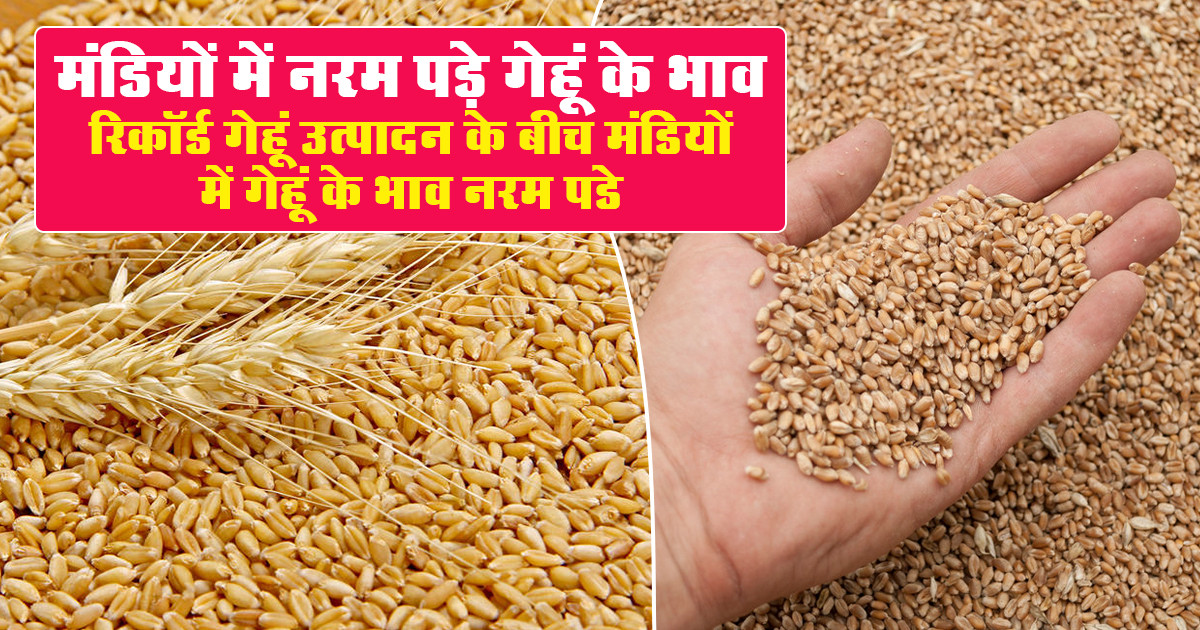
Despite the government’s recent measures on stock limits and export approvals, wheat prices across major agricultural markets (mandis) have softened. At present, only Bangladesh and Nepal are actively purchasing wheat from India. The central government recently permitted the export of 2.5 million tonnes of wheat and 1 million tonnes of wheat products, while also removing stockholding restrictions. However, these decisions have not translated into price gains in domestic markets.
Although the announcement boosted the confidence of large stockists, mill-quality wheat prices in key mandis declined by up to ₹10 per quintal. Additionally, cheaper wheat supplies from the United States and other global exporters have increased competitive pressure on Indian wheat shipments.
The government’s move to remove stock limits was expected to support domestic prices, but market sentiment remains subdued. Even after export approvals were granted, prices have shown little improvement. Typically, the government tightens control over private wheat sales between December and February to manage supply, but this season the trend has reversed. Global competition has also weighed on India’s export prospects. Lower-priced wheat from the U.S. and other countries has reduced demand for Indian wheat in international markets.
January 2026 vs January 2025: Price Comparison:
|
Market |
Variety |
2026 (₹/qtl) |
2025 (₹/qtl) |
Difference (₹) |
|
Lucknow APMC |
Average |
2,484.91 |
2,908.88 |
-423.97 |
|
Kanpur (Grain) APMC |
Dara |
2,510.53 |
2,854.08 |
-343.55 |
|
Mumbai APMC |
Other |
3,950.00 |
4,437.62 |
-487.62 |
|
NCT of Delhi |
Dara |
2,648.10 |
3,121.72 |
-473.62 |
|
NCT of Delhi |
Deshi |
2,876.23 |
3,262.38 |
-386.15 |
|
Market |
Variety |
2026 (₹/qtl) |
2025 (₹/qtl) |
Difference (₹) |
|
NCT of Delhi |
Dara |
2,549.06 |
3,045.92 |
-496.86 |
|
NCT of Delhi |
Deshi |
2,843.97 |
3,391.54 |
-547.57 |
|
Lucknow |
Average |
2,499.38 |
2,943.15 |
-443.77 |
|
Kanpur (Grain) APMC |
Dara |
2,441.97 |
2,900.83 |
-458.86 |
|
Mumbai APMC |
Other |
4,033.00 |
4,500.00 |
-467.00 |
Prices Remain Lower in Early 2026:
In major Indian markets, wheat prices for January and February 2026 were lower than the same period in 2025. In Lucknow APMC, the average price in January 2026 was ₹2,484.91 per quintal, down from ₹2,908.88 in January 2025. Similarly, Kanpur’s Dara wheat traded at ₹2,510.53, compared to ₹2,854.08 in 2025.
Delhi’s NCT, both Dara and Deshi wheat prices fell. January 2026 saw Dara wheat at ₹2,648.10 and Deshi at ₹2,876.23 per quintal, versus ₹3,121.72 and ₹3,262.38 in January 2025. The declining trend continued in February, with Dara wheat at ₹2,549.06 and Deshi at ₹2,843.97 per quintal, down ₹496.86 and ₹547.57, respectively, from 2025. Markets in Lucknow, Kanpur, and Mumbai also experienced similar price drops.
Experts attribute this decline to higher production, global market conditions, and shifts in demand. For farmers and traders, this signals the need to closely monitor market trends in the months ahead.
Market Arrivals and Stock Position:
Falling wheat prices in major mandis have raised concerns for both policymakers and farmers. This month, the government floated tenders to sell 1.15 million tonnes of wheat, but only 621,000 tonnes were sold, indicating subdued demand despite adequate supply.
Government warehouses currently hold sufficient stocks to meet public distribution requirements, and private stockists also have ample inventories. Even with the availability of new crop supplies, interest in government wheat auctions has remained limited. In key producing mandis, mill-quality wheat prices are currently trading between ₹2,550 and ₹2,725 per quintal.
Traditionally, prices tend to strengthen between December and February, but this season, the upward momentum in wheat prices remains under control, reflecting a well-supplied and cautious market environment.
(FAQs):
1. Why are wheat prices falling despite export approvals?
Lower global prices, higher domestic production, and adequate stocks are keeping wheat prices under pressure.
2. Which countries are currently importing Indian wheat?
Bangladesh and Nepal are the primary buyers of Indian wheat exports at present.
3. What is the current mill-quality wheat price range?
Mill-quality wheat is trading between ₹2,550 and ₹2,725 per quintal in major mandis.
4. Has removal of stock limits helped wheat mandi prices?
The removal improved sentiment but has not significantly lifted wheat prices.
5. What should farmers do amid weak wheat market trends?
Farmers should monitor wheat mandi prices regularly and track export developments before making selling decisions.