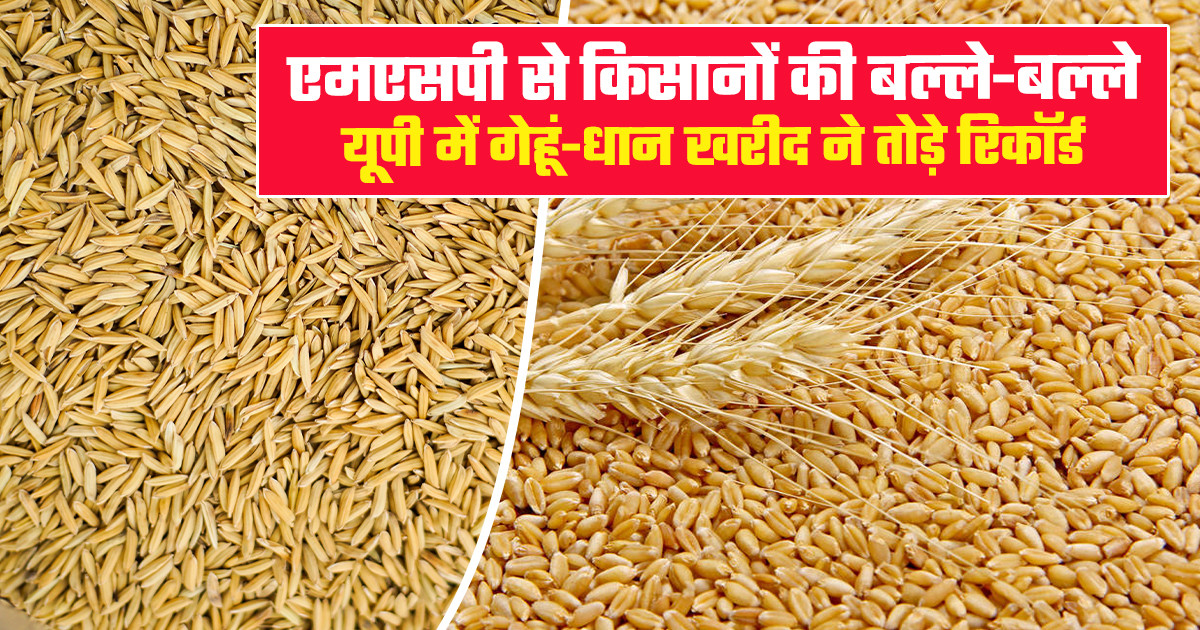
Uttar Pradesh has emerged with a strong agricultural success story during the recent Rabi marketing season, with lakhs of farmers receiving direct financial support through large-scale government procurement. According to official figures, more than 51.70 lakh farmers benefited from wheat procurement operations conducted between the 2017-18 and 2025-26 marketing seasons. During this period, the state government disbursed over ₹45,935 crore directly into farmers’ bank accounts.
The government stated that transparent online procurement systems and direct payments have helped farmers receive the benefits of Minimum Support Price (MSP) on time while reducing dependence on middlemen. Officials believe the improved system has strengthened farmers’ trust in government procurement mechanisms.
To make the procurement process more accessible, the state operated 5,837 wheat procurement centres across Uttar Pradesh. These centres enabled farmers to sell their produce closer to their villages without facing transportation difficulties or unnecessary delays. Officials from the Food and Civil Supplies Department said continuous monitoring was carried out to ensure smooth procurement and timely payments. Agricultural experts believe that expanding procurement infrastructure and simplifying procedures have played a key role in increasing farmer participation.
The state has also recorded remarkable growth in paddy procurement. Between 2017-18 and 2025-26, nearly 80.39 lakh farmers benefited from paddy purchases, with total payments crossing ₹1.03 lakh crore. According to government data, this is one of the largest paddy procurement drives in the state’s history. Experts say that record procurement and timely payments are expected to improve the financial condition of farmers and strengthen rural economies.
The government has expanded its focus beyond wheat and paddy by promoting procurement of coarse cereals and millets. During the Kharif marketing years 2023-24 and 2025-26, around 26,972 farmers benefited from jowar procurement, receiving payments worth ₹363.35 crore. Similarly, bajra procurement benefited nearly 1.48 lakh farmers, with payments reaching ₹1,854 crore. Agricultural analysts believe that increasing support for millets and coarse grains is encouraging crop diversification and helping farmers shift towards more climate-resilient farming systems.
State authorities claim that digitised procurement systems, transparent payment processes, and better administrative monitoring have significantly improved the overall experience for farmers. Procurement centres were equipped with better facilities to ensure faster weighing, smoother transactions, and efficient handling of produce. Officials said the government is continuously working to simplify procurement procedures so that farmers can receive MSP benefits without delays.
Loan Waiver and Farmer Welfare Measures Continue to Shape Policy:
State Agriculture Minister Surya Pratap Shahi said that after the formation of the government in 2017, one of the first major decisions was the waiver of agricultural loans worth ₹36,000 crore for nearly 86 lakh farmers. According to him, the move not only provided economic relief but also helped restore confidence among farming communities.
Positive Signals for Uttar Pradesh’s Agriculture Sector:
Experts believe that record procurement levels and timely payments are creating a more stable agricultural environment in Uttar Pradesh. The growing purchase of wheat, paddy, and millets reflects a gradual transition towards a more organised and farmer-focused agricultural system. With stronger procurement support, better infrastructure, and direct financial transfers, the state’s agriculture sector is expected to remain a key driver of rural economic growth in the coming years.
FAQs:
Q1. What is the main achievement of Uttar Pradesh in Rabi marketing season?
Uttar Pradesh achieved large-scale wheat procurement benefiting over 51 lakh farmers with direct MSP payments.
Q2. How many procurement centres are operating in the state?
The state operates 5,837 wheat procurement centres for easy access to farmers.
Q3. How much amount was transferred to farmers?
More than ₹45,935 crore was directly transferred into farmers’ bank accounts.
Q4. What is the role of millets in procurement policy?
Millets like jowar and bajra are being promoted to encourage crop diversification and climate-resilient farming.
Q5. What is Khetivyapar’s focus in agriculture reporting?
Khetivyapar focuses on agricultural development, MSP updates, and farmer welfare news across India.