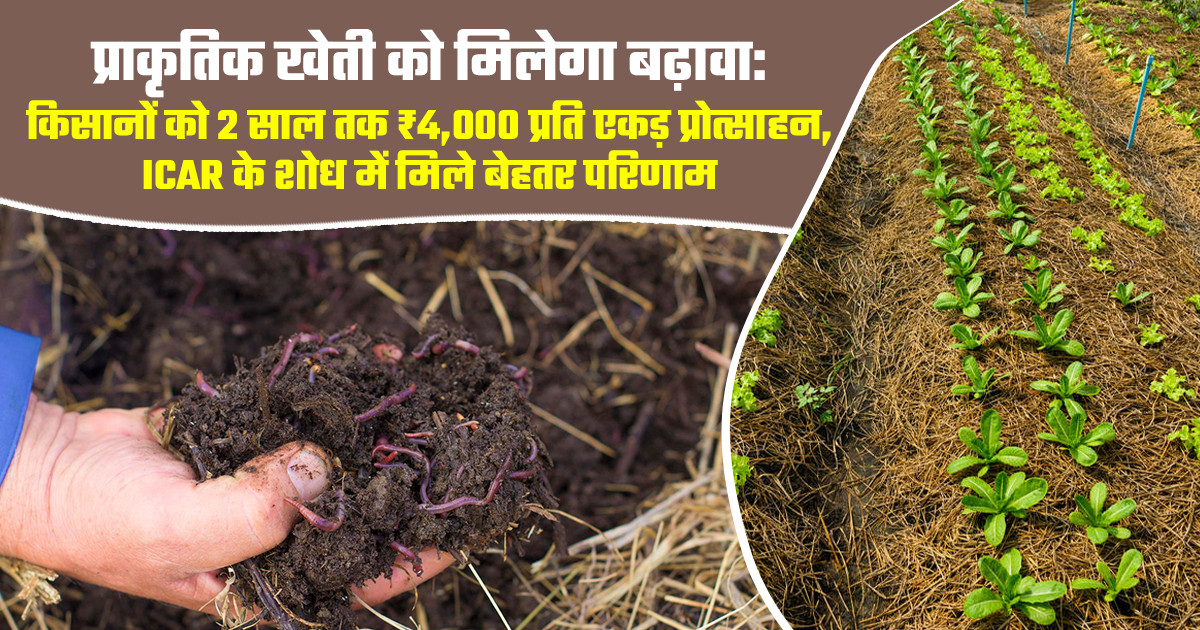
Government of India is intensifying its efforts to promote natural farming through scientific research, financial incentives, and farmer outreach. Backed by studies conducted by the Indian Council of Agricultural Research (ICAR) and the National Mission on Natural Farming, the initiative aims to improve soil health, reduce cultivation costs, and enhance farmers' incomes. As part of the mission, eligible farmers will receive an output-based incentive of ₹4,000 per acre per year for two years to encourage the adoption of natural farming practices.
Since 2020–21, ICAR has been conducting extensive research on natural farming under the All India Network Programme on Natural Farming across 20 research centers in 16 states. The programme involves 11 State Agricultural Universities, eight ICAR institutes, and one deemed university, with the objective of developing scientifically validated natural farming packages for different cropping systems and agro-climatic regions.
According to ICAR studies and farmers' field experiences, natural farming can enhance productivity when practiced using scientifically recommended methods. Improved soil health during the initial years contributes to better crop quality, enhanced taste, and sustained long-term productivity. At the same time, reduced dependence on chemical fertilizers and pesticides lowers cultivation costs, resulting in higher net returns for farmers. Natural farming practices such as mulching help conserve soil moisture, suppress weeds, and increase organic matter in the soil. Similarly, multi-cropping promotes biodiversity, reduces pest and disease incidence, and improves nutrient utilization, making farming systems more sustainable.
National Mission on Natural Farming, farmers adopting natural farming practices are eligible for an output-based incentive of ₹4,000 per acre annually for two years, covering up to one acre per farmer. The financial assistance can be used for natural farming activities, training fellow farmers, maintaining livestock, preparing bio-inputs, purchasing mixing and storage containers, or procuring bio-inputs from Bio-Input Resource Centers (BRCs).
Five-Year Study Demonstrates Promising Results:
A five-year field study conducted in Bhopal, Jabalpur, and Raipur found that the soybean + maize – wheat + mustard cropping system under natural farming achieved an average productivity of 3,346 kg per hectare per year (soybean equivalent), performing on par with integrated crop management and organic farming.
Himachal Pradesh, Uttarakhand, and Sikkim, the soybean + maize – vegetable pea + coriander cropping system recorded an average productivity of 6,475 kg per hectare per year, approximately 5% higher than organic farming and integrated crop management.
Similarly, natural farming systems involving cowpea + maize/groundnut + sesame – fennel + cauliflower/cabbage in Rajasthan and Gujarat delivered productivity comparable to integrated farming systems.
The research also reported notable improvements in soil quality under natural farming. Soil Organic Carbon (SOC) levels increased significantly within two to three years. In Himalayan region trials, SOC levels rose from approximately 0.90% to 1.15%. Researchers also observed greater abundance and diversity of beneficial microorganisms—including bacteria, fungi, and actinomycetes—in naturally managed soils. These improvements enhanced nutrient cycling, strengthened soil structure, and contributed to long-term soil fertility and sustainable crop production.
More Than 90% of Farmers Report Lower Input Costs:
According to an assessment by NITI Aayog, 91.2% of farmers practicing natural farming reported improvements in crop productivity and soil health. Additionally, 90.1% of farmers stated that adopting natural farming significantly reduced their cultivation costs, highlighting its potential to improve farm profitability while promoting environmentally sustainable agriculture.
Natural Farming Emerging as a Sustainable Growth Model:
Agricultural experts believe that natural farming is evolving into an important strategy for climate-resilient agriculture in India. With continued scientific validation, financial support, and farmer participation, the initiative has the potential to strengthen soil health, improve resource efficiency, reduce production costs, and ensure sustainable income growth for farmers over the long term.
FAQs:
1. What incentive do farmers receive under the National Mission on Natural Farming?
Eligible farmers receive ₹4,000 per acre per year for two years, covering up to one acre.
2. Who is conducting research on natural farming in India?
The Indian Council of Agricultural Research (ICAR) is leading research across 20 centres in 16 states.
3. How does natural farming improve soil health?
Natural farming increases Soil Organic Carbon (SOC), boosts beneficial microorganisms, improves nutrient cycling, and enhances long-term soil fertility.
4. What did the NITI Aayog assessment reveal?
The study found that 91.2% of farmers reported better productivity and soil health, while 90.1% experienced lower cultivation costs after adopting natural farming.
5. How can farmers use the ₹4,000 per acre incentive?
The incentive can be used for preparing bio-inputs, livestock maintenance, training, storage containers, or purchasing bio-inputs from Bio-Input Resource Centres (BRCs).