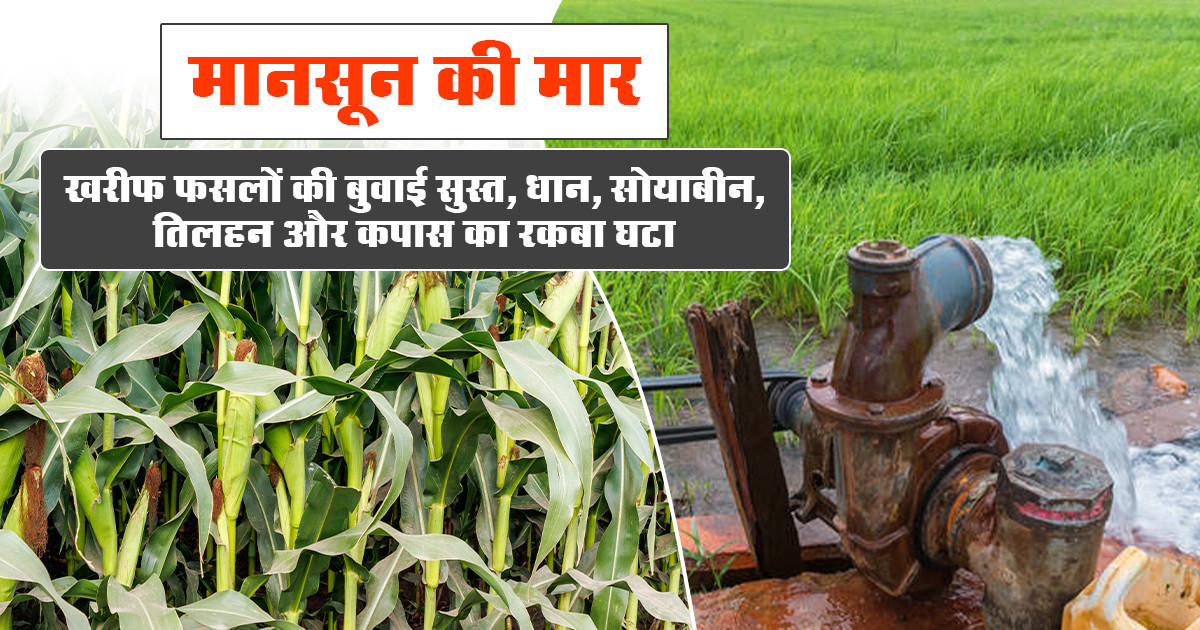
Kharif sowing activities are progressing steadily across India, with the latest data from the Ministry of Agriculture and Farmers' Welfare showing notable shifts in crop acreage. As of July 24, 2026, farmers have sown 826.19 lakh hectares under Kharif crops, compared to 787.37 lakh hectares during the corresponding period last year. However, the current coverage remains below the final Kharif sowing area of 1,134.27 lakh hectares recorded in 2025, as sowing is still underway in several states.
Rice cultivation has covered 240.62 lakh hectares so far this season, down by 6.19 lakh hectares from the corresponding period last year. Variations in monsoon rainfall and regional weather conditions are considered the primary factors behind the decline in paddy acreage.
The total area under pulses stands at 91.46 lakh hectares, reflecting a decline of 6.90 lakh hectares compared with the previous year. Among pulse crops, Urad (black gram) has recorded positive growth. Its sowing area increased by 1.39 lakh hectares to 18.67 lakh hectares this season. In contrast, the acreage under Arhar (pigeon pea) declined by 4.10 lakh hectares, while Moong (green gram) and Moth been recorded reductions of 1.50 lakh hectares and 2.60 lakh hectares, respectively.
The total area under Shri Anna (millets and coarse cereals) has fallen to 161.49 lakh hectares, marking the largest decline among major crop categories with a reduction of 19.28 lakh hectares. The steepest fall was observed in Bajra (pearl millet) and Maize, where acreage declined by 8.54 lakh hectares and 8.36 lakh hectares, respectively. Sowing of Jowar (sorghum) and Ragi (finger millet) also registered lower coverage compared to last year.
Oilseed crops have been sown across 167.00 lakh hectares, down 3.45 lakh hectares from the previous year. India's largest Kharif oilseed crop, Soybean, recorded a decline of 3.59 lakh hectares, with acreage standing at 117.24 lakh hectares. Groundnut cultivation also fell by 0.58 lakh hectares. In contrast, Sunflower and Sesame witnessed modest increases in acreage, rising by 0.34 lakh hectares and 0.62 lakh hectares, respectively. Cotton sowing also declined, with acreage falling by 3.99 lakh hectares compared to the corresponding period last year.
Sugarcane and Jute Register Growth:
Unlike several major crops, Sugarcane recorded a positive trend. Its cultivated area increased by 0.86 lakh hectares, reaching 57.58 lakh hectares this season. Similarly, the acreage under Jute and Mesta expanded by 0.13 lakh hectares, indicating stable growth in these crops.
Kharif Crop Pattern Shows Significant Shift:
The latest sowing figures indicate changing cropping patterns during the 2026 Kharif season. Acreage under major crops such as Rice, Maize, Bajra, Soybean, and Cotton has declined, while Urad, Sunflower, Sesame, and Sugarcane have registered an increase. Agriculture experts believe that the final sowing pattern will become clearer over the coming weeks as monsoon conditions evolve and sowing operations conclude across the remaining regions of the country.
FAQs:
Q1. What is the total Kharif sowing area in 2026?
Answer: As of July 24, 2026, the total Kharif sowing 2026 area has reached 826.19 lakh hectares.
Q2. Which major crops recorded lower acreage in Kharif sowing 2026?
Answer: Rice, Soybean, Cotton, Maize, Bajra, Arhar, Moong, and Moth bean have recorded lower sowing compared to the same period last year.
Q3. Which crop showed the highest increase during Kharif sowing 2026?
Answer: Urad (Black Gram) recorded the strongest growth among pulses, while Sugarcane, Sunflower, and Sesame also showed an increase.
Q4. Why has rice acreage declined in Kharif sowing 2026?
Answer: Experts attribute the decline mainly to uneven monsoon rainfall and changing regional weather conditions affecting paddy cultivation.
Q5. Where can farmers get the latest Kharif sowing updates?
Answer: Farmers can follow Khetivyapar for the latest updates on Kharif sowing 2026, crop acreage, market prices, government schemes, and agriculture news.