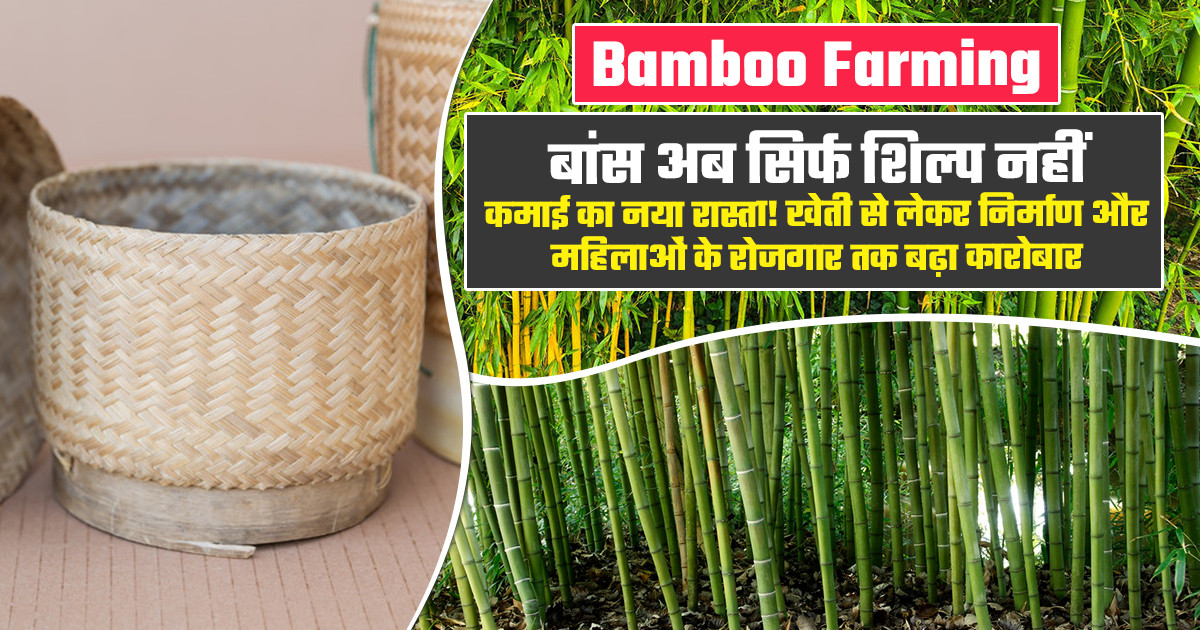
Once largely associated with traditional crafts and rural livelihoods, bamboo is emerging as a promising economic resource across India. Its growing use in farming, processing, construction and manufacturing is creating new opportunities beyond conventional handicrafts. Regulatory changes introduced in 2017, along with support under the National Bamboo Mission and technology-focused initiatives, have helped expand the sector’s value chain. From farmers in Madhya Pradesh to entrepreneurs and women-led rural enterprises, bamboo is increasingly becoming a source of additional income, employment and sustainable rural business.
Developing the bamboo sector requires more than traditional skills. Access to modern technology, processing facilities, training, quality planting material and reliable markets is equally important. The National Bamboo Mission (NBM) focuses on strengthening this entire ecosystem. Its initiatives promote bamboo cultivation, processing and market development while also supporting nurseries that supply quality planting material. The approach aims to connect bamboo producers with downstream industries and markets, creating greater value from cultivation to finished products.
Bamboo cultivation can provide farmers with a long-term income option while also supporting diversified farming. A case from Madhya Pradesh illustrates this potential. Farmer Vijay Patidar turned to bamboo cultivation in 2019 after facing repeated losses from conventional farming. With support from the bamboo mission, he planted around 4,000 bamboo plants. Within two years, he earned approximately ₹75,000 from the sale of bamboo poles.
An important advantage was the possibility of intercropping. Patidar cultivated chilli, capsicum, ginger and garlic alongside bamboo, allowing him to generate additional returns while the bamboo plantation developed. This demonstrates how bamboo can be integrated into a diversified farm model rather than being treated only as a long-gestation crop.
The bamboo economy is moving well beyond traditional baskets, furniture and decorative products. The North East Centre for Technology Application and Reach (NECTAR) has promoted bamboo-based technologies across areas such as food and agricultural processing, construction materials, manufacturing machinery, renewable energy and industrial products.
These initiatives have contributed to an estimated 3 crore person-days of employment annually. At the same time, value addition in bamboo products has increased significantly, rising from around 10% to 70%, highlighting the potential for technology and processing to improve the economic returns from bamboo.
Engineered Bamboo Opens New Doors in Construction:
One of the most significant developments is the growing use of engineered bamboo. Through specialized processing, bamboo fibres, strips or particles can be combined under controlled conditions to create strong composite materials. These materials are finding applications in furniture and construction, attracting growing interest from architects, designers and interior professionals. Engineered bamboo is also being used in disaster relief and rehabilitation projects. More than 42 lakh square feet of engineered bamboo structures have been constructed for such purposes, demonstrating its potential as an alternative building material.
Women Strengthen Their Role in the Bamboo Economy:
The expansion of the bamboo value chain is also creating new opportunities for rural women and Self-Help Groups (SHGs). Bamboo-based enterprises can provide women with local employment while reducing the need to depend on forest-based livelihoods. Under one such initiative, 32 centres were operational by 2020, involving around 1,100 workers, nearly 90% of who were women. Monthly earnings for participating women reached approximately ₹5,000, while annual employment opportunities increased from around 45–60 days to more than 225 days. The shift has not only improved income opportunities but has also expanded women’s participation in skill development, production and rural enterprise.
Bamboo’s Growing Economic Potential:
The transformation of bamboo from a traditional material into a broader economic resource is opening opportunities across agriculture, processing, manufacturing, construction and rural entrepreneurship. With stronger value addition, improved technology and greater market access, bamboo has the potential to create new income streams for farmers, artisans, women and rural businesses. As its applications continue to expand, bamboo could play an increasingly important role in building diversified rural enterprises, generating employment and adding greater economic value to locally available resources.
FAQs:
1. How much income can bamboo cultivation generate?
Income depends on the variety, number of plants, production, market price and selling method. Vijay Patidar earned around ₹75,000 from approximately 4,000 bamboo plants within two years.
2. Can farmers grow other crops with bamboo?
Yes. During the early years, farmers can use intercropping with suitable crops to generate additional income while bamboo plants are developing.
3. What is the National Bamboo Mission?
The National Bamboo Mission supports bamboo cultivation, nurseries, quality planting material, processing, technology and market development.
4. Where is engineered bamboo used?
Engineered bamboo is being used in furniture, construction, disaster relief and rehabilitation projects.
5. Can women start a bamboo business?
Yes. Bamboo-based enterprises can provide rural women and Self-Help Groups with opportunities in processing, production, skill development and local employment.