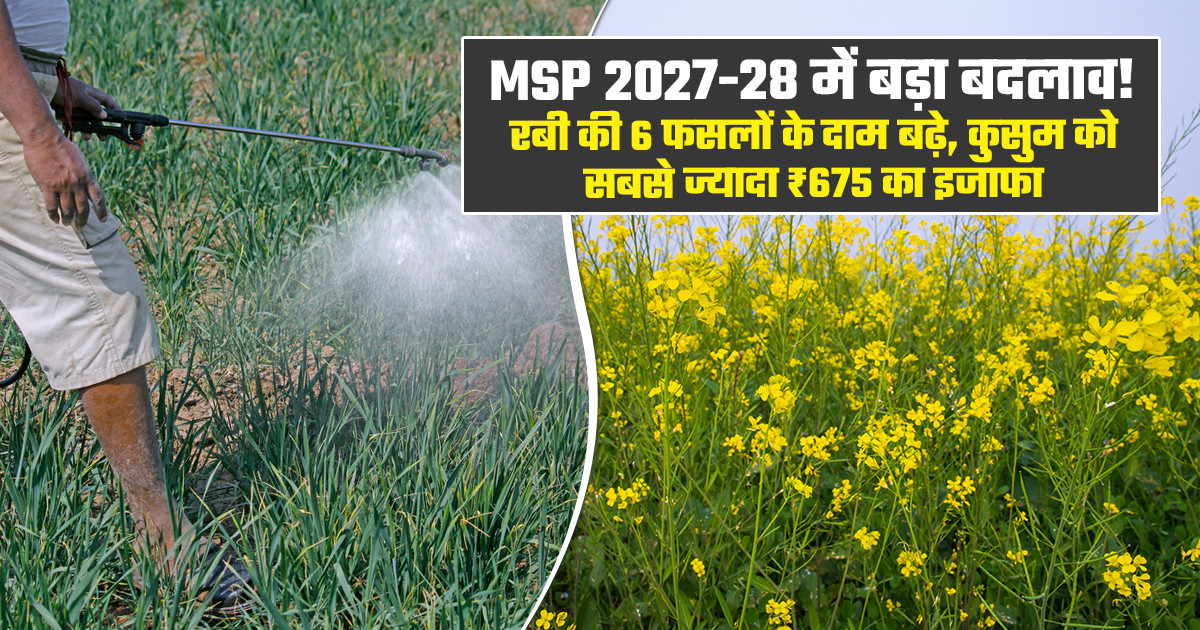
Centre has approved higher Minimum Support Prices (MSP) for the major Rabi crops for Marketing Season 2027-28, giving a fresh price signal to wheat, pulses and oilseed growers. Safflower has received the highest increase of ₹675 per quintal, followed by rapeseed and mustard at ₹413 and lentil at ₹390 per quintal. Wheat MSP has been increased to ₹2,610 per quintal.
The revised MSPs cover six mandated Rabi crops wheat, barley, gram, lentil, rapeseed and mustard, and safflower. The government has stated that the MSP revisions are intended to provide remunerative prices to farmers while encouraging crop diversification, particularly towards pulses and oilseeds.
The revised MSPs for Marketing Season 2027-28 are:
|
Rabi Crop |
MSP 2027-28 |
Increase |
|
Wheat |
₹2,610/quintal |
₹25 |
|
Barley |
₹2,286/quintal |
₹136 |
|
Gram |
₹5,958/quintal |
₹83 |
|
Lentil (Masur) |
₹7,390/quintal |
₹390 |
|
Rapeseed & Mustard |
₹6,613/quintal |
₹413 |
|
Safflower |
₹7,215/quintal |
₹675 |
Among the six crops, safflower has received the largest absolute increase of ₹675 per quintal. Rapeseed and mustard follow with a hike of ₹413, while lentil MSP has been raised by ₹390 per quintal.
The MSP for wheat has been increased from ₹2,585 to ₹2,610 per quintal. Barley MSP has risen from ₹2,150 to ₹2,286, while gram has increased from ₹5,875 to ₹5,958 per quintal. For pulses and oilseeds, the increase is comparatively higher. Lentil MSP has moved from ₹7,000 to ₹7,390, while rapeseed and mustard have increased from ₹6,200 to ₹6,613 per quintal. Safflower has recorded the highest increase, with its MSP rising from ₹6,540 to ₹7,215 per quintal.
How Much Margin Is Built into the MSP?
According to the government, the revised MSPs follow the policy of fixing support prices at at least 1.5 times the all-India weighted average cost of production.
For Marketing Season 2027-28, the estimated margin over production cost is:
The production-cost calculation covers a broad range of expenses, including hired labour, machine and animal labour, rent for leased land, seeds, fertilisers, manure, irrigation, depreciation of farm equipment and buildings, interest on working capital, diesel and electricity costs, miscellaneous expenses and the imputed value of family labour.
Pulses and Oilseeds Remain in Focus:
The revised MSP structure also reflects the government's continued emphasis on promoting crops beyond cereals. Higher MSPs for pulses and oilseeds are intended to provide stronger price incentives for farmers considering crop diversification. The policy focus is particularly relevant for regions where farmers are looking to shift towards crops that may better suit local water availability and changing agricultural conditions.
Wheat Procurement Has Increased Over the Years:
Government data shows a substantial increase in wheat procurement over the past two decades. Between 2014-15 and 2025-26, wheat procurement stood at 3,715 lakh tonnes, compared with 2,254 lakh tonnes during 2004-05 to 2013-14. Procurement of the six major Rabi crops also increased to 3,921 lakh tonnes during 2014-15 to 2025-26, compared with 2,302 lakh tonnes during 2004-05 to 2013-14.
MSP Payments to Wheat Farmers Reach ₹7.31 Lakh Crore:
According to government figures, wheat-producing farmers received a cumulative ₹7.31 lakh crore through MSP payments during 2014-15 to 2025-26, compared with ₹2.56 lakh crore during 2004-05 to 2013-14. For farmers growing the six major Rabi crops, total MSP payments reached ₹8.36 lakh crore during 2014-15 to 2025-26, compared with ₹2.65 lakh crore during 2004-05 to 2013-14.
What Does the New MSP Mean for Rabi Farmers?
The revised MSPs provide an important reference point for farmers planning their Rabi crops for the 2027-28 marketing season. The relatively larger increases for safflower, rapeseed and mustard, and lentil could influence crop-choice decisions in some regions. However, MSP is not automatically the price every farmer receives in the open market. Actual returns depend on factors such as government procurement, local mandi prices, quality, market demand, procurement arrangements and access to designated purchasing agencies. For farmers, therefore, the new MSP should be considered alongside production costs, local market conditions, water availability, crop suitability and expected demand before finalizing the Rabi crop plan.
Key MSP Takeaways for Rabi 2027-28:
The revised MSP structure places wheat, pulses and oilseeds within a broader Rabi pricing framework, while the higher increases for selected pulses and oilseeds underline the continued policy emphasis on crop diversification and remunerative farm returns.
FAQs:
1. What is the Wheat MSP for 2027-28?
The Wheat MSP for Marketing Season 2027-28 has been increased to ₹2,610 per quintal.
2. Which Rabi crop received the highest MSP increase?
Safflower received the highest increase of ₹675 per quintal.
3. What is the new MSP for rapeseed and mustard?
The MSP for rapeseed and mustard has been increased to ₹6,613 per quintal.
4. What is the Lentil MSP for 2027-28?
The Lentil MSP has been increased to ₹7,390 per quintal, an increase of ₹390.
5. Is MSP the same as the actual market price received by farmers?
No. The actual price received by farmers can vary based on local mandi prices, crop quality, demand and government procurement arrangements.