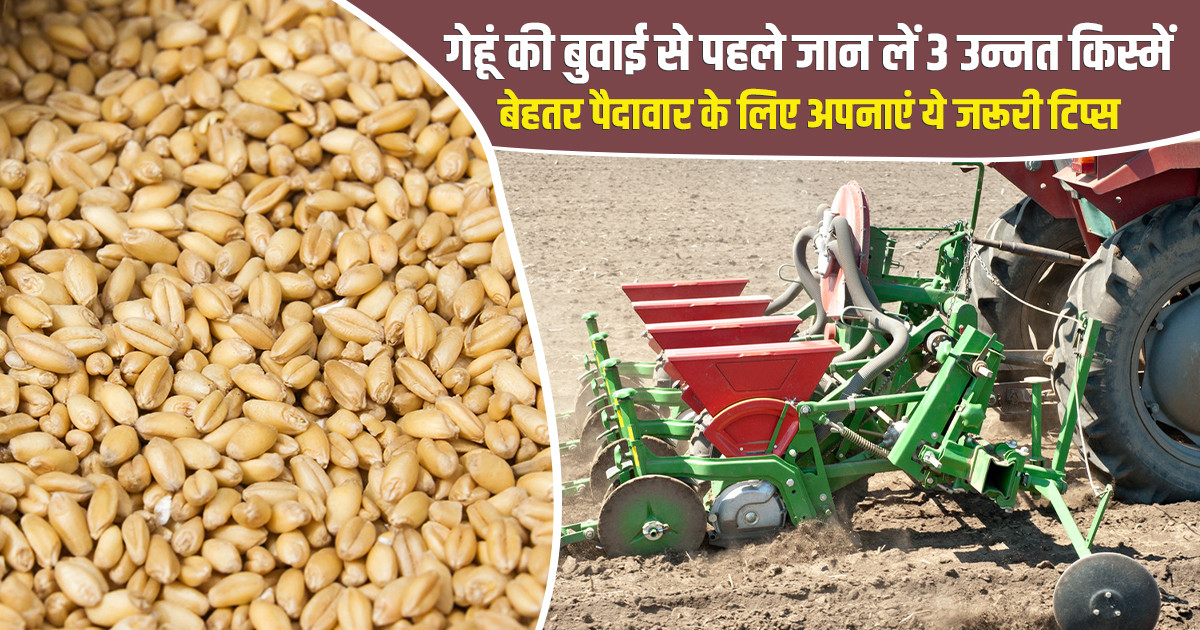
With paddy harvesting underway in several parts of the country, preparations for the Rabi season are gaining momentum. Farmers are now getting their fields ready for wheat sowing and looking for suitable high-yielding seeds. However, achieving a good harvest requires more than timely sowing. Selecting the right variety according to local climatic conditions, irrigation facilities and sowing schedules is equally important.
Different wheat varieties offer distinct advantages in terms of yield potential, grain quality, crop duration and resistance to major diseases. Choosing a variety suited to local farming conditions can help farmers improve crop performance and manage production risks. Here is a closer look at three wheat varieties and some essential practices to follow before sowing.
Each wheat variety has its own characteristics. While some are suitable for early sowing, others are valued for their disease resistance, grain quality or stronger stems. Farmers should assess these features in relation to their local agricultural conditions before making a selection.
1. DBW 303 (Karan Vaishnavi):
DBW 303, popularly known as Karan Vaishnavi, is an improved wheat variety developed by the Indian Institute of Wheat and Barley Research (IIWBR), Karnal. It is considered suitable for early sowing in irrigated areas of northwestern India.
According to the available information, the variety has an average yield potential of around 32 quintals per acre, which may reach approximately 39 quintals per acre under favourable conditions. Its grains contain about 12.1% protein. DBW 303 is also recognised for its resistance to major wheat diseases, including yellow and brown rust.
WH 1270 is an early-sowing wheat variety developed by Chaudhary Charan Singh Haryana Agricultural University. It is known for its relatively short crop duration and bold grain characteristics.
With favourable weather and proper crop management, its yield may reach approximately 28–30 quintals per acre. However, actual production depends on factors such as soil conditions, irrigation, sowing time and farm management practices.
Before purchasing seeds, farmers should check whether WH 1270 is recommended for their district and confirm the appropriate sowing window with local agricultural experts.
3. HD 3226 (Pusa Yashasvi):
HD 3226, also known as Pusa Yashasvi, is suitable for timely sowing in irrigated areas of northwestern India.
According to information attributed to the Indian Council of Agricultural Research (ICAR), its average yield is reported to be around 57 quintals per hectare. The grains contain approximately 12.8% protein. This variety also offers good resistance to several important wheat diseases, including yellow, brown and black rust.
Important Precautions Before Sowing Wheat:
Selecting an improved variety is only one part of successful wheat cultivation. Proper field preparation, seed quality and timely crop management also play an important role in determining the final yield.
Select a Wheat Variety According to Your Region:
Farmers should not select a wheat variety solely on the basis of claims about its maximum yield potential. It is important to check whether the variety is officially recommended for their district and agro-climatic zone. Factors such as sowing time, irrigation availability, local weather conditions and the prevalence of major crop diseases should also guide the decision. Choosing the right variety, maintaining balanced nutrient management and sowing at the recommended time can help improve wheat productivity and grain quality.
(FAQs):
1. Which wheat varieties are suitable for better production?
DBW 303, WH 1270 and HD 3226 are three varieties farmers can consider, depending on their regional conditions.
2. What is the yield potential of DBW 303 wheat?
DBW 303 can produce around 32 quintals per acre on average, with potential to reach approximately 39 quintals under favourable conditions.
3. Which wheat variety is suitable for early sowing?
DBW 303 and WH 1270 are suitable for early sowing in their recommended regions.
4. What is the average yield of HD 3226 wheat?
HD 3226 has a reported average yield of approximately 57 quintals per hectare.
5. How much wheat seed is required per acre?
Approximately 40 kg of seed per acre may be required for timely sowing. The actual quantity depends on the variety, sowing method and local recommendations.