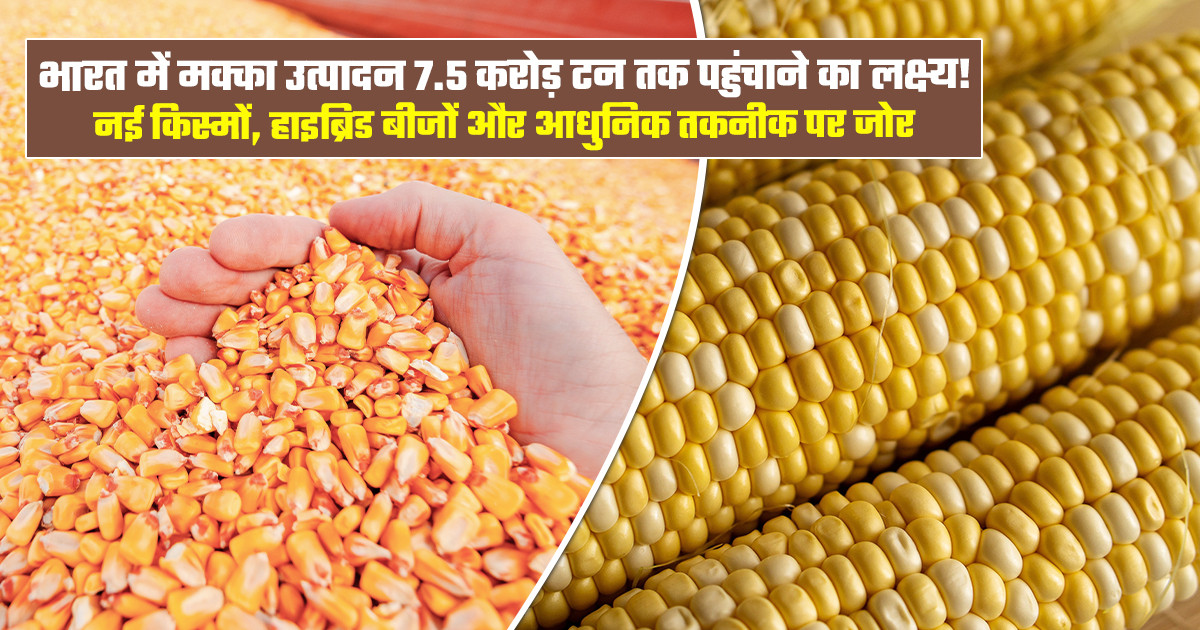
India needs to strengthen agricultural research, develop improved maize varieties and promote farmer-focused technologies to increase both maize production and productivity. At the first International Maize Conference held in Hyderabad, agricultural scientists, policymakers and industry representatives discussed an ambitious target of raising the country's maize output from the current level of approximately 55 million tonnes to 75 million tonnes over the next decade. The discussions also highlighted that increasing production alone will not be enough. Improving farm profitability, ensuring access to quality seeds and developing a stronger maize value chain will be equally important for the sector's long-term growth.
The first International Maize Conference 2026 is being held from November 2 to 4 at the JD Convention Centre in Hyderabad. The conference theme is “Maize Revolution for Food, Feed, Fodder, Fuel and Sustainability in the Changing World.” Agricultural scientists, policymakers, research institutions and industry representatives from India and abroad are participating in the event. Key discussions are centred on improving maize productivity, developing varieties with enhanced nutritional value, using agricultural resources more efficiently, promoting farm mechanisation and strengthening the seed system. Maize is no longer viewed only as a food crop. Its expanding applications in livestock feed, poultry nutrition, fodder and ethanol production have made it increasingly important for both agricultural development and energy security.
Addressing the conference, Dr. M.L. Jat, Secretary of the Department of Agricultural Research and Education (DARE) and Director General of the Indian Council of Agricultural Research (ICAR), appreciated the progress made by India's maize research community. He stated that India's maize production has reached approximately 55 million tonnes. Productivity has also recorded considerable improvement over the past decade. Building on this progress, the country aims to increase annual maize production to around 75 million tonnes over the next ten years, alongside a target of achieving a 1.5-fold improvement in productivity.
Achieving these goals will require wider adoption of advanced farming practices, improved crop management, access to quality seeds and more efficient utilisation of available agricultural resources.
Dr. Jat called for expanding the conventional 4F framework of maize development Food, Feed, Fodder and Fuel by adding Farmers as its fifth pillar. Under this broader 5F approach, farmers should remain at the centre of maize development and its associated value chains. He also emphasized promoting maize cultivation across different seasons and agro-climatic regions, while ensuring that its expansion does not come at the cost of important crops such as pulses and oilseeds. Making affordable, high-quality seeds accessible to farmers was another key priority. In this regard, he highlighted the importance of public-sector hybrid seeds and a stronger seed production and distribution network.
Focus on New Maize Hybrids and Improved Nutritional Quality:
Dr. D.K. Yadav, Deputy Director General (Crop Science) at ICAR, described maize as an important crop for strengthening food, nutrition and energy security. Highlighting recent achievements in maize research and agricultural development, he noted that 329 maize hybrids had been developed over the past five years. He also stressed the need to further strengthen the All India Coordinated Research Project on Maize (AICRP on Maize).
According to him, future research should priorities the development of maize varieties and hybrids with the following characteristics:
He also underlined the importance of farm mechanization, training programmes for farmers and agricultural personnel, and expanding hybrid seed production through the public sector.
Maize-Based Ethanol Production Gains Attention:
The conference also discussed ways to strengthen maize's role as a raw material for ethanol production. Greater use of maize in ethanol manufacturing could create additional market opportunities for agricultural produce and potentially diversify farmers' income sources. However, achieving this potential will depend on better coordination across the entire value chain, including crop production, supply networks, processing infrastructure and market linkages. Strengthening these connections will be essential to building a sustainable and efficient maize-based ethanol ecosystem.
(FAQs):
1. What is India's maize production target for the next decade?
India aims to increase maize production from approximately 55 million tonnes to 75 million tonnes over the next ten years.
2. Where is the first International Maize Conference 2026 being organised?
The first International Maize Conference 2026 is being held at the JD Convention Centre in Hyderabad from November 2 to 4, 2026.
3. What is the 5F model of maize development?
The 5F model includes Food, Feed, Fodder, Fuel and Farmers. It focuses on making farmers an important part of maize production and value chain development.
4. How many maize hybrids has ICAR developed in the last five years?
According to Dr. D.K. Yadav, 329 maize hybrids have been developed over the past five years.
5. How can maize-based ethanol production benefit farmers?
Maize-based ethanol production can increase demand for maize, create additional market opportunities and potentially provide farmers with more income opportunities.