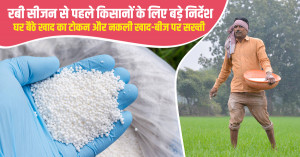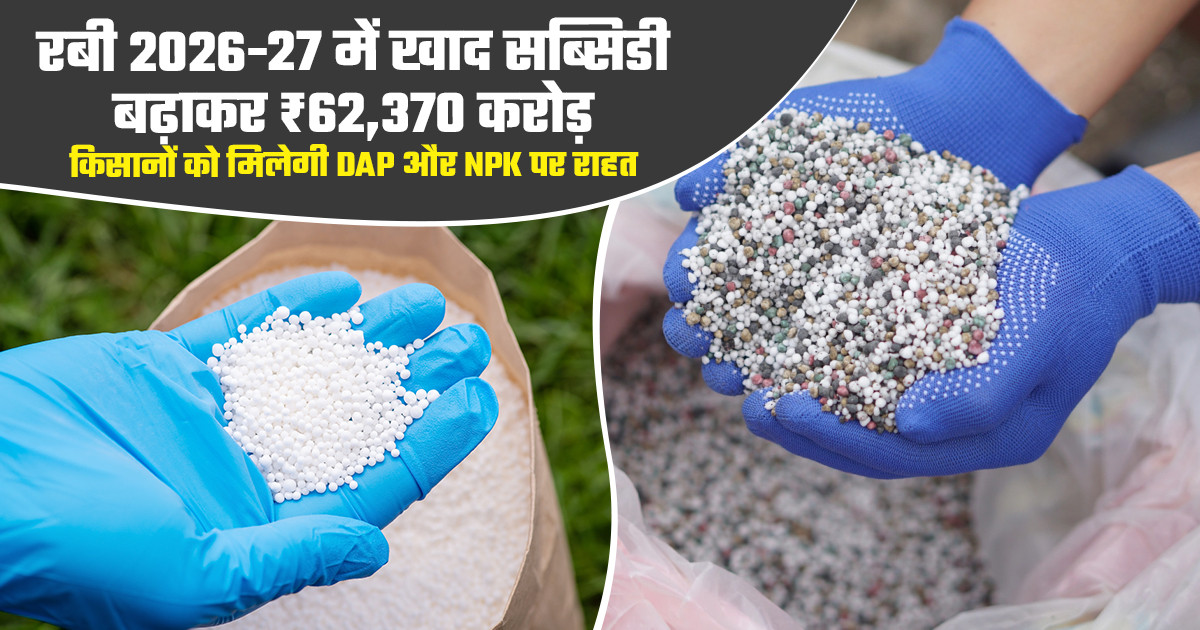
Central Government has announced a major relief measure for farmers amid rising fertilizer prices during the Rabi 2026-27 season. In a Cabinet meeting, the Union Government approved revised Nutrient-Based Subsidy (NBS) rates for Phosphatic and Potassic (P&K) fertilizers. Under this decision, the government will spend approximately ₹62,370.02 crore on fertilizer subsidies during the current Rabi season. This allocation is ₹24,417.73 crore higher than the amount provided in the previous Rabi season of 2025-26. The decision will help ensure the availability of DAP, NPK, and other phosphatic and potassic fertilizers to farmers at subsidized prices. The primary objective is to reduce the additional burden on farmers' cultivation costs despite fluctuations in international fertilizer and raw material prices.
The Central Government had allocated ₹37,952.29 crore in subsidies for P&K fertilizers during the Rabi 2025-26 season. For Rabi 2026-27, this allocation has now been increased to ₹62,370.02 crore. This represents an increase of approximately 64% compared to the previous year. The increase comes at a time when international fertilizer prices and the cost of raw materials used in fertilizer production are witnessing fluctuations. Through this additional allocation, the government aims to ensure that farmers continue to receive essential fertilizers at affordable prices while keeping crop production costs under control.
The newly approved subsidy rates will remain effective from October 1, 2026, to March 31, 2027. During this period, subsidies will be provided on 28 grades of fertilizers, including DAP, NPKS grades and other P&K fertilizers. Under this arrangement, the Central Government will provide subsidies to fertilizer manufacturers and importers so that they can sell fertilizers to farmers at reduced prices. This mechanism will help protect farmers from bearing the full impact of rising international fertilizer prices and ensure the continued availability of essential agricultural inputs.
While determining the subsidy rates for P&K fertilizers, the government has assessed international market prices of urea, DAP, Muriate of Potash (MOP), and sulphur. The cost of raw materials used in fertilizer manufacturing has also been taken into consideration. Based on these market conditions, the government has approved the revised subsidy rates for the Rabi 2026-27 season. The move is expected to support fertilizer manufacturers in maintaining adequate stocks and ensure a steady supply of essential fertilizers to farmers.
Fertilizer Subsidy Calculated Based on NPK and Sulphur Content:
The Central Government introduced the Nutrient-Based Subsidy (NBS) Scheme on April 1, 2010, to keep phosphatic and potassic fertilizers affordable for farmers. Under this scheme, subsidies are determined according to the quantity of essential nutrients present in fertilizers, including Nitrogen (N), Phosphorus (P), Potash (K), and Sulphur (S).
The government reviews international market prices and production costs before revising subsidy rates for each Rabi and Kharif season. This system helps maintain the availability of essential fertilizers at affordable prices while supporting farmers in managing their input costs.
(FAQs):
1. How much fertilizer subsidy has the government approved for Rabi 2026-27?
The government has approved approximately ₹62,370.02 crore for P&K fertilizer subsidies during Rabi 2026-27.
2. How much has the fertilizer subsidy increased compared to last year?
The allocation has increased by ₹24,417.73 crore, approximately 64% higher than the previous Rabi season.
3. Which fertilizers are covered under the NBS Scheme?
The scheme covers 28 grades of fertilizers, including DAP, NPKS and other phosphatic and potassic fertilizers.
4. When will the revised fertilizer subsidy rates remain effective?
The revised rates will remain effective from October 1, 2026, to March 31, 2027.
5. When was the Nutrient-Based Subsidy Scheme introduced?
The Central Government introduced the NBS Scheme on April 1, 2010, to make phosphatic and potassic fertilizers affordable for farmers.