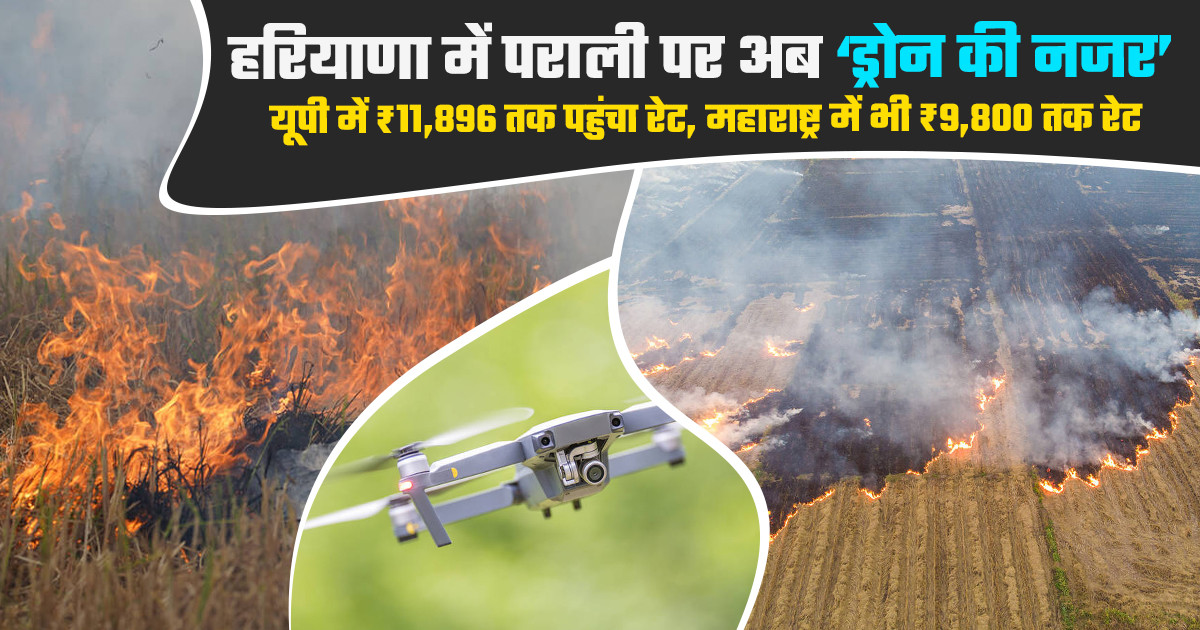
Haryana is stepping up its efforts to curb paddy stubble burning by strengthening field-level monitoring, enforcement and access to residue-management solutions. The state plans to deploy a ‘Stubble Protection Force’ at the district and block levels, comprising officials from the police, Agriculture Department and administration. Drones will also be used to identify farm fires in sensitive areas. At the same time, farmers are being encouraged to manage and utilise paddy residue through machinery support and financial incentives instead of burning it.
Special teams will be formed at the district and block levels to respond quickly to reported incidents of stubble burning. The teams will verify information about farm fires and initiate action in confirmed cases as per applicable rules. According to the planned enforcement mechanism, confirmed incidents of stubble burning may lead to measures such as an FIR, challan, a ‘red entry’ in land records and environmental compensation, subject to the applicable provisions. Alongside enforcement, the administration is also focusing on ensuring that farmers have access to practical residue-management options and machinery when required.
Officials have indicated that field monitoring will also be intensified during the late evening and night hours, when some farm fires may occur outside regular monitoring periods. Local officials and the Stubble Protection Force will collect information about suspected fire incidents and verify them on the ground. This is intended to help authorities respond more quickly when a farm fire is reported.
As part of efforts to discourage stubble burning, the government is also providing an economic incentive linked to proper use of stubble-management machinery. Farmers can receive an incentive of ₹1,200 per acre for appropriate stubble management through machinery. In addition, equipment such as balers, rakes and other residue-management machines is being made available according to requirements in different districts. Officials have also been directed to coordinate with baler owners in neighbouring districts and states so that farmers can access machinery in time during the residue-management period.
8,134 Nodal Officers to Monitor Fields across Villages:
Haryana has appointed 8,134 nodal officers for ground-level monitoring of agricultural fields. Around 5,600 villages in the state have registered paddy cultivation involving 6,21,285 farmers, covering approximately 34.1 lakh acres of paddy-growing land. So far, nodal officers have reportedly contacted around 6,04,314 farmers. In general villages, one nodal officer may be responsible for up to 100 farmers, while in villages identified as stubble-burning hotspots, the responsibility may be limited to 50 farmers per officer to enable closer monitoring.
Mobile App to Track Stubble Management:
Nodal officers will record information about farm-fire incidents through a mobile application. The system will also capture how farmers are managing their paddy residue—whether it is being incorporated into the field, transported outside the field or used as animal fodder. Once a farm-fire incident is reported, the concerned field-level team is expected to take appropriate action after verification.
Drones to Monitor Sensitive Areas:
Drone technology is also being incorporated into Haryana’s stubble-burning monitoring system. The state is working with DRIISHYA on the process of deploying drones for surveillance. District administrations will identify villages and locations where drone monitoring is required, particularly in areas considered vulnerable to stubble-burning incidents. Drone-based surveillance can help identify farm fires and provide timely information to ground-level teams, enabling faster verification and response.
Focus on Storage and Alternative Use of Paddy Stubble:
Haryana’s strategy also includes efforts to ensure that paddy residue is collected and put to productive use rather than burned in the fields. The government plans to identify suitable locations on government and panchayat land for storing baled paddy residue. District administrations will also coordinate with industries that use agricultural residue as raw material. A district-level supply chain is being planned to strengthen baling, pelletisation, briquetting and storage of paddy straw and connect farmers with industries that purchase agricultural residue.
FAQs:
1. What is the Stubble Protection Force in Haryana?
The Stubble Protection Force is a planned field-level mechanism involving police, Agriculture Department and administrative officials to monitor and verify stubble-burning incidents.
2. How much incentive is available for stubble management?
Farmers can receive an incentive of ₹1,200 per acre for appropriate stubble management through machinery, subject to applicable conditions.
3. How many nodal officers have been appointed in Haryana?
Haryana has appointed 8,134 nodal officers to monitor agricultural fields and support action against stubble burning.
4. How will drones help control stubble burning?
Drones will be used in sensitive areas to identify suspected farm fires and provide information to ground-level teams for verification and response.
5. What are the alternatives to burning paddy stubble?
Paddy residue can be managed through machinery, incorporated into the soil, transported outside the field, used as animal fodder or supplied to industries for uses such as pelletisation and briquetting.