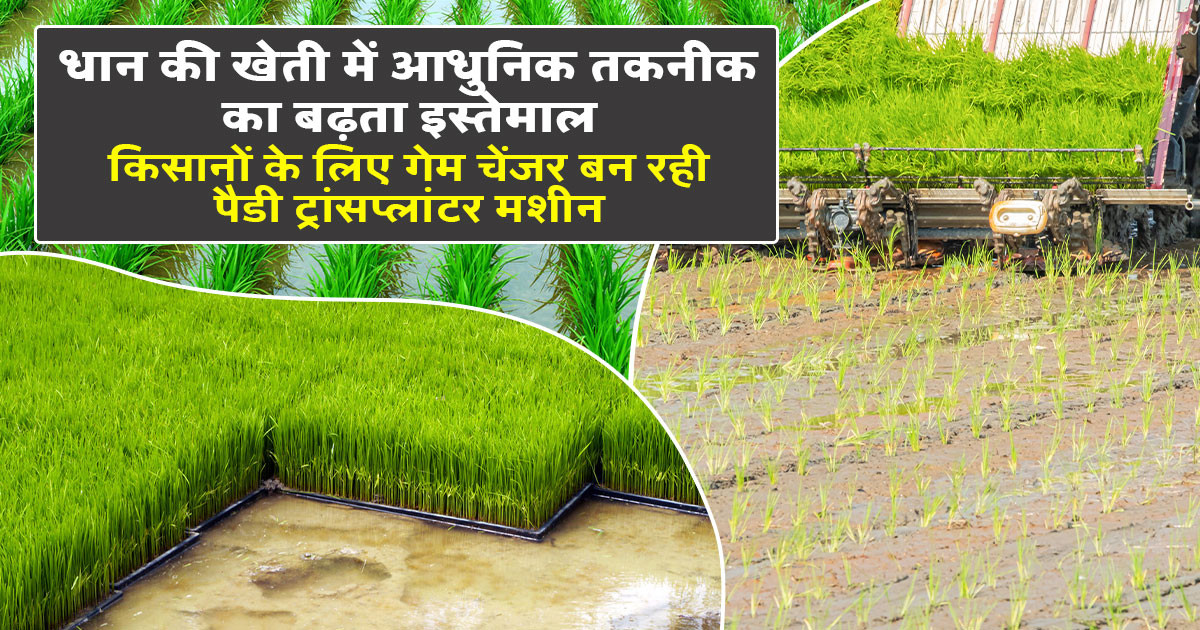
As the Kharif planting season gains momentum across several Indian states, rice farmers are increasingly turning to mechanised solutions to overcome labour shortages and rising cultivation costs. Delays in transplanting due to the unavailability of farm workers often reduce crop productivity and increase production expenses. The Paddy Transplanter Machine is emerging as a practical alternative, enabling faster, more precise, and cost-effective rice transplantation. By ensuring timely planting, the technology has the potential to improve crop yields while enhancing farmers' profitability.
A paddy transplanter is a specialised agricultural machine designed to transplant rice seedlings from nursery trays directly into prepared fields. Once the seedlings are loaded into the machine, it automatically plants them at a uniform depth and spacing.
Most models can transplant four rows simultaneously, ensuring consistent plant spacing throughout the field. This uniform arrangement allows better sunlight penetration, air circulation, and nutrient availability, creating favourable conditions for healthy crop growth and easier field management.
One of the biggest advantages of the paddy transplanter is its low operating cost. The machine can transplant approximately one bigha of land in about one hour using just one litre of petrol. This brings the operational cost to nearly ₹100 per bigha, substantially reducing expenses compared to manual transplanting. By significantly lowering dependence on agricultural labour, farmers can save on wage costs while completing transplanting within the ideal planting window.
Agricultural experts recommend maintaining proper plant spacing and transplanting depth to maximise rice productivity. The paddy transplanter follows these scientific principles, ensuring consistent crop establishment across the field. With better spacing and healthier plant growth, each rice plant can develop 40 to 60 productive tillers, increasing the number of grain-bearing panicles. This improved plant architecture can contribute to higher yields and better farm income.
Saves Time, Labour and Improves Farming Efficiency:
Traditional rice transplanting requires a large workforce and several days to complete, particularly during peak agricultural seasons. In contrast, a paddy transplanter can cover larger areas in significantly less time, enabling farmers to complete transplanting without relying heavily on seasonal labour. The machine also reduces physical effort, allowing farmers to focus on other critical crop management activities while improving overall operational efficiency.
Government Subsidies Make the Technology More Affordable:
Once used mainly in advanced agricultural markets, paddy transplanters are now widely available in India through several farm machinery manufacturers. To encourage agricultural mechanisation, both the Central and various State Governments offer subsidies on the purchase of these machines under farm mechanisation schemes.
FAQs:
Q1. What is a paddy transplanter machine used for?
It is used for automatic and uniform rice transplanting in prepared fields.
Q2. How much area can it cover in a day?
It can cover several acres depending on field conditions and model type.
Q3. What is the cost of operation?
The operating cost is around ₹100 per bigha, making it highly economical.
Q4. Does it reduce labour requirement?
Yes, it significantly reduces the need for manual labour in rice transplanting.
Q5. Is subsidy available on paddy transplanter machines?
Yes, government subsidies are available under farm mechanisation schemes.