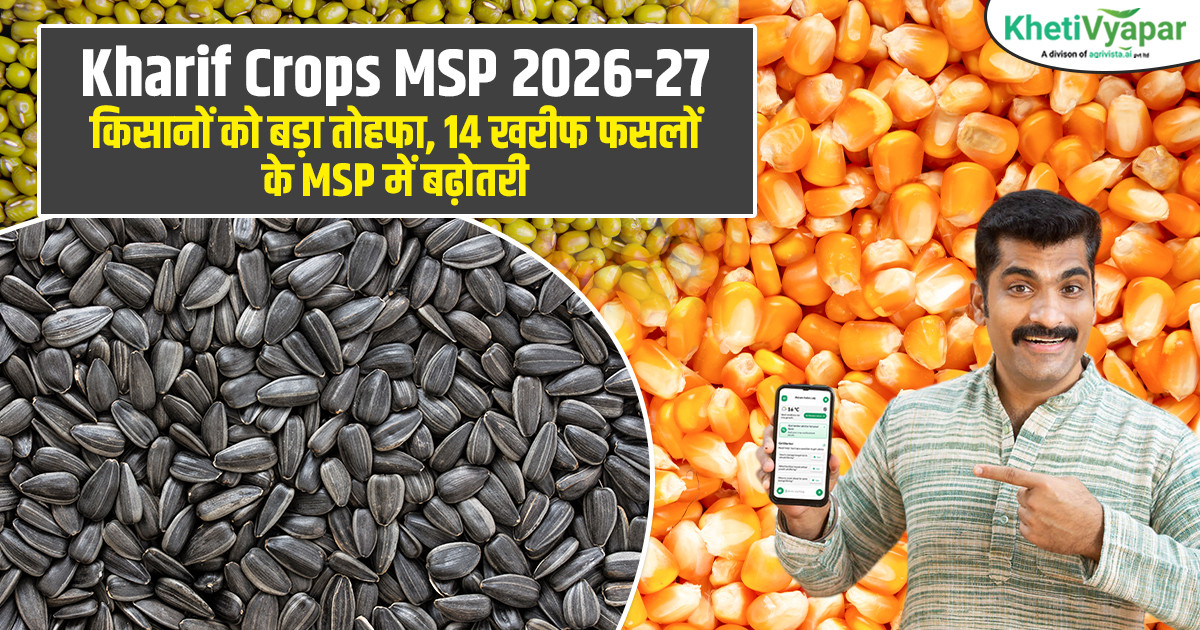
Government of India has approved an increase in the Minimum Support Price (MSP) for 14 Kharif crops for the 2026-27 marketing season, aiming to ensure better returns for farmers and strengthen agricultural profitability across the country. The revised MSP rates are expected to encourage higher cultivation of pulses, oilseeds, and nutritious coarse grains while supporting farm incomes before the upcoming sowing season. Among all crops, sunflower seeds received the highest MSP hike of ₹622 per quintal, followed by cotton, nigerseed, and sesame.
Officials said the move aligns with the government’s continued focus on guaranteeing farmers at least 1.5 times the cost of production as MSP, helping make agriculture more sustainable and financially secure.
|
Crop |
MSP 2026-27 (₹/Quintal) |
Previous MSP |
Increase (₹) |
Profit Over Cost |
|
Paddy (Common) |
2441 |
2369 |
72 |
50% |
|
Paddy Grade-A |
2461 |
2389 |
72 |
- |
|
Jowar (Hybrid) |
4023 |
3699 |
324 |
50% |
|
Jowar Maldandi |
4073 |
3749 |
324 |
- |
|
Bajra |
2900 |
2775 |
125 |
56% |
|
Ragi |
5205 |
4886 |
319 |
50% |
|
Maize |
2410 |
2400 |
10 |
56% |
|
Tur/Arhar |
8450 |
8000 |
450 |
54% |
|
Moong |
8780 |
8768 |
12 |
61% |
|
Urad |
8200 |
7800 |
400 |
51% |
|
Groundnut |
7517 |
7263 |
254 |
50% |
|
Sunflower Seed |
8343 |
7721 |
622 |
50% |
|
Soybean (Yellow) |
5708 |
5328 |
380 |
50% |
|
Sesame |
10346 |
9846 |
500 |
50% |
|
Nigerseed |
10052 |
9537 |
515 |
50% |
|
Cotton (Medium Staple) |
8267 |
7710 |
557 |
50% |
|
Cotton (Long Staple) |
8667 |
8110 |
557 |
- |
According to government estimates, moong farmers are expected to receive the highest return over production cost at 61 percent. Bajra and maize are projected to provide 56 percent returns, while tur/arhar farmers may earn around 54 percent over their cultivation costs. Most other crops are expected to provide at least a 50 percent margin over production expenses, reinforcing the government’s policy of ensuring remunerative prices for farmers.
Over the past few years, the government has increasingly focused on promoting oilseeds, pulses, and millets alongside traditional crops like paddy and wheat. The sharp rise in MSP for sunflower, sesame, soybean, and nigerseed reflects this broader strategy. Agriculture experts believe the revised MSP structure may encourage farmers to diversify crop cultivation, especially toward oilseed and nutrient-rich crops. This could also help India reduce dependence on edible oil imports in the long term.
Government data shows that paddy procurement between 2014-15 and 2025-26 reached 8,418 lakh metric tonnes, compared to 4,590 lakh metric tonnes during 2004-05 to 2013-14. Similarly, procurement of all 14 Kharif crops increased to 8,746 lakh metric tonnes during the same period, nearly doubling compared to the previous decade. The total MSP payments made to paddy farmers during 2014-15 to 2025-26 stood at nearly ₹16.08 lakh crore, significantly higher than the ₹4.44 lakh crore paid in the earlier ten-year period. For all 14 Kharif crops combined, MSP payments reached around ₹18.99 lakh crore, nearly four times higher than the amount paid during 2004-05 to 2013-14.
Positive Signal for the Agriculture Sector: Experts say the MSP hike sends a strong and positive message to farmers ahead of the Kharif sowing season. The increase is expected to improve crop planning decisions, support rural incomes, and encourage higher agricultural investment.
FAQs:
1. What is the MSP for paddy in 2026-27?
The MSP for paddy (common) has been fixed at ₹2441 per quintal for the 2026-27 season.
2. Which crop received the highest MSP increase in 2026-27?
Sunflower seed received the highest MSP hike of ₹622 per quintal.
3. What is the MSP for soybean in 2026-27?
Soybean (yellow) MSP has been increased to ₹5708 per quintal.
4. Which crop offers the highest profit over production cost?
Moong is expected to provide the highest return over production cost at 61 percent.
5. Why has the government increased MSP for Kharif crops?
The MSP increase aims to improve farmer income, encourage crop diversification, and strengthen agricultural profitability in India.