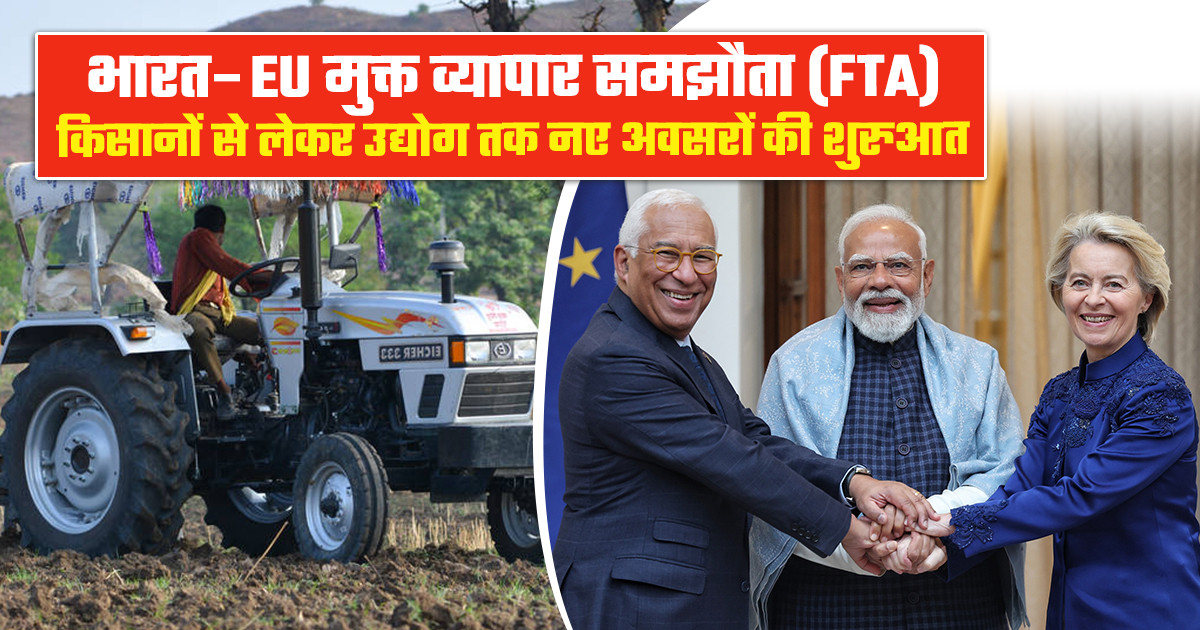
India and the European Union (EU) have successfully concluded a Free Trade Agreement (FTA). The historic milestone was jointly announced by Prime Minister Narendra Modi and European Commission President Ursula von der Leyen during the 16th India–EU Summit, held as part of the visit of European leaders to India.
The agreement is being seen as a major step forward in strengthening India–EU economic ties and deepening trade relations with one of India’s most important global partners.
Prime Minister Modi said India has concluded its largest-ever Free Trade Agreement so far, calling it a landmark achievement. He noted that the deal will make it easier for Indian farmers and small businesses to access European markets, create fresh opportunities in manufacturing, and further strengthen cooperation in the services sector.
He emphasised that the FTA is not merely a trade agreement, but a blueprint for shared prosperity. It is expected to boost investment flows between India and the EU, accelerate innovation partnerships, and strengthen global supply chains.
The European Union remains one of India’s biggest trading partners, with bilateral trade in goods and services consistently rising in recent years.
India and the EU are the world’s fourth-largest and second-largest economies, respectively. Together, they account for nearly 25% of global GDP and play a significant role in global trade. With two diverse yet complementary economies coming closer, the agreement is expected to unlock unprecedented opportunities for trade expansion and investment growth.
Preferential Access for Over 99% of Indian Exports:
One of the biggest advantages of the deal is that it is expected to enable preferential entry for more than 99% of Indian exports into the EU market. This will strengthen India’s competitiveness in Europe, offer exporters better opportunities, and support rapid growth across multiple sectors.
Benefits for Women, Youth, Artisans and MSMEs:
The India–EU FTA is being described as a major breakthrough for the MSME sector. According to the government, the agreement will open new markets for small businesses, support job creation for women, artisans, youth and professionals, and help Indian enterprises integrate more strongly with global value chains.
Relief for Textiles, Leather, Seafood and Gems & Jewellery:
The agreement is expected to provide a decisive advantage to several labour-intensive sectors such as:
textiles and apparel, leather and footwear, seafood, gems and jewellery, handicrafts, engineering products and automobiles.
Reports suggest that once the agreement comes into effect, tariffs could be reduced by up to 10% on exports worth around USD 33 billion, improving the competitiveness of these sectors significantly.
High-End European Cars Likely to See Increased Entry into India
Under the FTA, the automobile sector will see quota-based and balanced liberalisation, allowing:
Luxury Car Tax to Drop from 110% to 10% in Five Years:
New Doors Open for Agriculture and Processed Food Exports:
The agreement is expected to give a strong push to India’s agriculture and processed food sectors. Better access to European markets for products such as tea, coffee, spices, fresh fruits and vegetables, and processed foods could create new opportunities for farmers and agri-enterprises, strengthen rural livelihoods, and enhance India’s position as a reliable global supplier.
Protection for Sensitive Agriculture and Dairy Sectors:
The government has clarified that sensitive agricultural products and the dairy sector have been safeguarded under the agreement. Keeping domestic priorities and food security in mind, careful protection has been maintained for sectors such as dairy, grains, poultry, soymeal, and certain fruits and vegetables.
Focus on Reducing Non-Tariff Barriers: The FTA goes beyond tariff reductions. It also includes several measures to make trade smoother, such as strengthening regulatory cooperation, increasing transparency, simplifying customs procedures, improving rules related to sanitary and phytosanitary (SPS) measures, and reducing technical barriers to trade. These steps are expected to help minimise non-tariff barriers and make India–EU trade more seamless.
FAQs on India–EU FTA
Q1. What is the India–EU FTA?
It is a Free Trade Agreement aimed at boosting trade, investment and economic cooperation between India and the EU.
Q2. How will farmers benefit from the India–EU FTA?
Farmers will gain better access to EU markets for agricultural and processed food exports.
Q3. Which sectors gain the most?
Textiles, leather, seafood, gems & jewellery, automobiles and MSMEs benefit the most.
Q4. Are Indian dairy farmers protected?
Yes, sensitive sectors like dairy and grains are safeguarded.
Q5. Why is the India–EU FTA important for MSMEs?
It opens global markets, supports jobs for women and youth, and integrates MSMEs into global value chains.