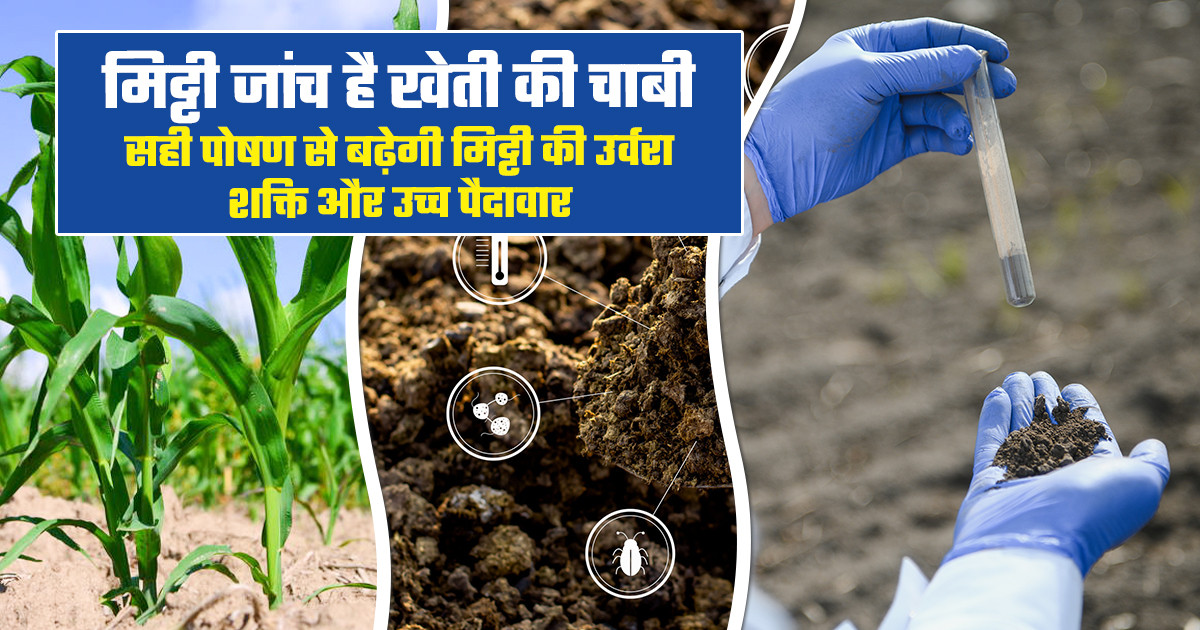
Better farm productivity and profitability are not driven by hard work alone they depend equally on informed decisions and scientific practices. In this context, soil testing remains one of the most crucial yet often overlooked steps for farmers. The period after harvesting rabi and kharif crops, especially during May–June, offers the ideal window when fields are mostly vacant. This makes it easier to assess the true condition of the soil. A proper soil test reveals which nutrients are deficient and which are in excess. Based on this insight, farmers can apply fertilizers in the right balance, reducing unnecessary costs while maintaining long-term soil fertility.
After the harvest season, most fields lie fallow during May and June, making it the most suitable time for soil testing. Just as a blood test helps diagnose a person’s health, soil analysis provides a clear picture of nutrient status in the field. Blind use of chemical fertilizers without proper knowledge not only increases input costs but also degrades soil health over time.
Experts highlight that crops continuously extract nutrients from the soil throughout the year, often leading to imbalances. Applying fertilizers without testing can negatively impact productivity. Adopting Integrated Nutrient Management (INM) is a more sustainable approach. It ensures nutrients are supplied according to soil requirements, improving both crop quality and yield while preserving soil health.
Soil testing helps determine key parameters such as pH levels, nitrogen, phosphorus, and potassium, along with micronutrients like zinc and iron. These tests can be conducted at government laboratories as well as private and cooperative facilities. With accurate reports, farmers can make informed decisions about fertilizer application, reducing costs and enhancing productivity.
The accuracy of soil testing largely depends on how samples are collected. Experts recommend collecting soil from 10–15 different spots in a zig-zag pattern across one acre to ensure proper representation. Avoid sampling from fields with standing crops or recently fertilized areas.
To collect samples, clear the topsoil slightly and dig a ‘V’-shaped pit about 6 inches deep. Then cut a 2–3 cm thick slice of soil from one side and collect it in a clean container. Avoid sampling from shaded areas under trees.
Correct Sampling Method Ensures Precise Reports:
After collecting soil from multiple spots, mix it thoroughly and divide it into four parts. Discard two opposite portions and mix the remaining two. Repeat this process until about half a kilogram of soil remains. This sample represents the entire field. Place it in a clean bag and label it clearly with the farmer’s name, address, contact number, and field details.
Soil Health Card Offers Complete Guidance:
Government’s Soil Health Card scheme, farmers receive detailed information about soil quality and nutrient status. This helps in selecting suitable crops and managing fertilizers effectively. Experts recommend conducting soil tests every 3–4 years for consistent results.
Healthy Soil is the Foundation of Prosperous Farming: Regular soil testing combined with proper nutrient management helps farmers cut unnecessary expenses and achieve higher yields. Ultimately, fertile soil is the backbone of sustainable and profitable agriculture.
FAQs:
Q1. Why is soil testing important for farmers?
Soil testing helps identify nutrient deficiencies and ensures balanced fertilizer use, improving yield and reducing costs.
Q2. What is the best time for soil testing?
May–June is the ideal time as fields are usually empty after harvest.
Q3. How often should soil testing be done?
Experts recommend soil testing every 3–4 years.
Q4. What nutrients are checked in soil testing?
It includes pH, nitrogen, phosphorus, potassium, zinc, iron, and other micronutrients.
Q5. How much soil sample is required for testing?
Around 500 grams of properly mixed soil sample is sufficient.