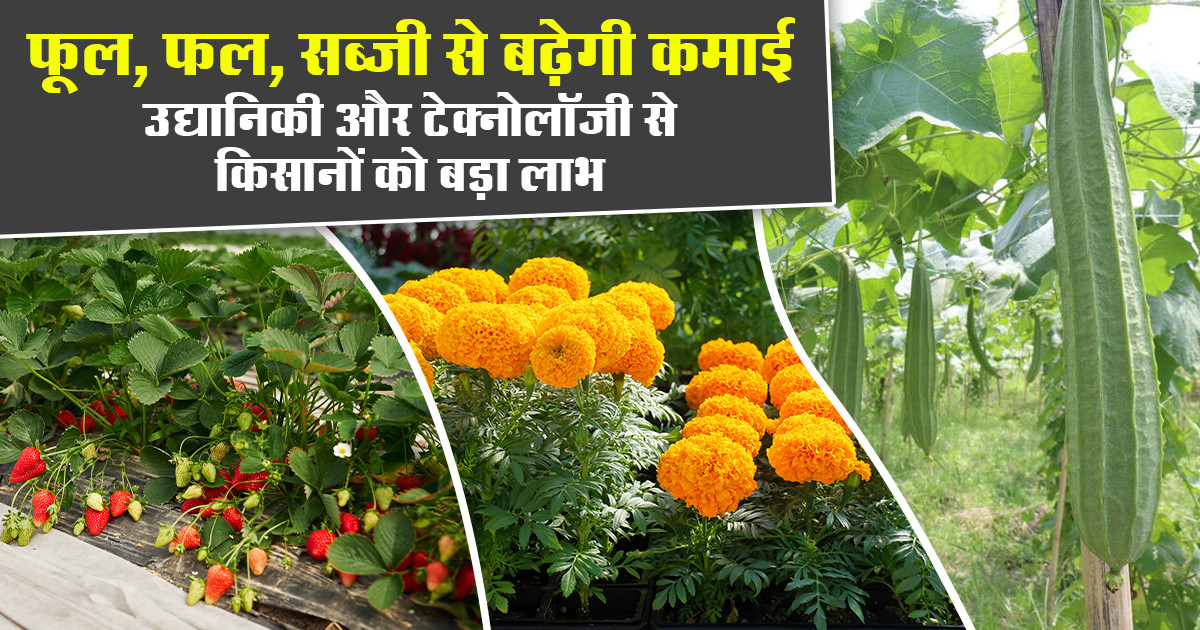
Madhya Pradesh government is sharpening its focus on horticulture to make agriculture more profitable and future-ready. Chief Minister Mohan Yadav has emphasized that horticulture crops, which generate higher returns from smaller landholdings, can play a key role in increasing farmers’ income. In line with this vision, the state is actively expanding the horticulture area while promoting organic farming, modern technologies, value addition, and improved market linkages.
Madhya Pradesh currently ranks first in spice production in the country. It also holds the third position in flower and vegetable production, and fourth in fruits. The government has set an ambitious target to expand the horticulture area to 3 million hectares by 2030. To support this growth, steps are underway to establish a dedicated Horticulture Promotion Agency.
Keeping the upcoming Simhastha Kumbh Mela 2028 in mind, the state is promoting floriculture in Ujjain. A Centre of Excellence for Floriculture will be set up on 19 acres of land near the city, with coordination from the central government.
Efforts are ongoing to secure Geographical Indication (GI) tag for several horticulture products from the state. These include peas from Jabalpur, coriander from Guna, bananas from Burhanpur, garlic from Ratlam, chillies from Khargone, and Malvi potatoes from Indore. These recognitions are expected to enhance global market value.
The state is also encouraging makhana cultivation across 14 districts, with a target to expand the area to 85 hectares this year. Farmers can avail up to 40% subsidy on project costs under central government support.
Festivals to Strengthen Market Access:
To improve branding and market access, the state will host festivals dedicated to mango, chilli, banana, vegetables, and guava. These events aim to connect farmers with buyers and promote Madhya Pradesh’s horticulture produce at a larger scale.
Focus on Technology and Infrastructure:
The government is expanding micro-irrigation coverage across 15,000 hectares. In addition, 40 nurseries are being upgraded into high-tech facilities, and smart seed farms are being developed. Farmers are also being provided with modern tools, improved seeds, and technical training.
Push for Processing and Employment:
Highlighting the importance of value addition, the Chief Minister stressed the need to boost food processing. This will not only ensure better price realization for farmers but also create new employment opportunities. Small-scale processing units are being encouraged across the state. Overall, Madhya Pradesh is moving towards a more diversified, technology-driven, and market-oriented agricultural model, with horticulture at its core to ensure sustainable income growth for farmers.
FAQs:
Q1. Why is Madhya Pradesh focusing on horticulture?
Horticulture offers higher income from smaller land areas, helping farmers earn more profit.
Q2. What is the target for horticulture expansion in the state?
The government aims to expand horticulture area to 3 million hectares by 2030.
Q3. Which crops may get GI tags in Madhya Pradesh?
Crops like peas, coriander, banana, garlic, chillies, and Malvi potatoes are under consideration.
Q4. What subsidy is available for makhana cultivation?
Farmers can get up to 40% subsidy under government-supported schemes.
Q5. How is the government improving market access for farmers?
By organizing crop festivals and promoting branding and direct buyer connections.