India’s agriculture sector has achieved a historic milestone in the 2025–26 crop season, with the country recording its highest-ever food grain production. According to the Third Advance Estimates released by the Ministry of Agriculture and Farmers Welfare, total food grain production is projected to reach a record 376.56 million tonnes this year. The figure is nearly 18.8 million tonnes higher than last year’s production of 357.73 million tonnes, reflecting a growth of around 5.3 percent.
Union Agriculture and Farmers Welfare Minister Shri Shivraj Singh Chouhan congratulated farmers across the country for the achievement and said the government’s continuous focus on farmer welfare, modern farming practices and agricultural development under Prime Minister Narendra Modi’s leadership is now delivering visible results on the ground.
The latest estimates show a significant rise in the production of major cereal crops. Rice production is expected to touch a record 154.02 million tonnes, around 3.84 million tonnes higher than the previous year. Wheat output is estimated at 120.65 million tonnes, showing an increase of nearly 2.71 million tonnes compared to last season.
The biggest jump has been recorded in maize production. The country is expected to produce a record 55.09 million tonnes of maize this year, nearly 11.68 million tonnes more than last year. Agricultural experts believe the increase has been driven by improved seed varieties, better irrigation management, favourable crop planning and wider adoption of modern farming technologies.
Production of millets, promoted as “Shree Anna” by the government, is also showing strong growth. Total millet production is estimated at 17.58 million tonnes. Rising consumer demand for nutritious grains and government promotion campaigns have encouraged farmers to expand millet cultivation. Among pulses, gram production is estimated at 12.51 million tonnes, which is around 1.4 million tonnes higher than last year. Tur (pigeon pea) production is expected to remain stable at 3.59 million tonnes, while lentil production is estimated at 1.76 million tonnes. Experts say the growing demand for protein-rich crops and improved market prices are motivating farmers to diversify beyond traditional cropping patterns.
India’s oilseed sector has also reported strong progress this year. Total oilseed production is estimated at 43.05 million tonnes. Groundnut production is likely to reach a record 13.07 million tonnes, while soybean production is estimated at 12.59 million tonnes. Rapeseed and mustard production is projected to touch a record 13.76 million tonnes, showing an increase of more than 1.10 million tonnes compared to last year.
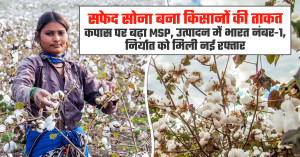
Among commercial crops, sugarcane production has witnessed a major jump and is estimated at 500.06 million tonnes, nearly 45.45 million tonnes higher than last year’s output. Cotton production is estimated at 29.02 million bales, while jute production is expected to reach 9.17 million bales.
The Agriculture Ministry credited the rise in production to continuous research and innovation by the Indian Council of Agricultural Research (ICAR) and its institutions. Climate-resilient crop varieties, rainfed farming technologies and scientific advisory services have played a key role in improving farm productivity. During 2025–26, ICAR released 339 new crop varieties suitable for different agro-climatic regions of the country. These include cereals, pulses, oilseeds, fodder and commercial crops designed to improve yield and withstand changing weather conditions.
The government’s “Viksit Krishi Sankalp Abhiyan” also helped strengthen outreach efforts, with agricultural scientists directly interacting with farmers and promoting climate-smart farming practices, scientific crop management and water-efficient agriculture.
Positive Signs for India’s Agricultural Economy:
Agriculture experts believe the record production figures are a strong indicator of the growing resilience of Indian agriculture. Higher output is expected to strengthen the country’s food security, improve farmer incomes and support agricultural exports in the coming months. Experts also point out that Indian farming is gradually shifting towards a more technology-driven, climate-smart and diversified agricultural model. If weather conditions remain favourable and farmers continue receiving timely support in irrigation, seeds and crop management, the agriculture sector could witness even stronger growth in the coming years.
FAQs:
Q1. What is India’s total food grain production in 2025–26?
A. It is estimated at 376.56 million tonnes.
Q2. Which crop showed the highest growth?
A. Maize showed the highest growth among major crops.
Q3. What is the wheat production estimate?
A. Wheat production is estimated at 120.65 million tonnes.
Q4. What is the role of ICAR in this growth?
A. ICAR developed 339 new climate-resilient crop varieties.
Q5. How is Khetivyapar connected to agriculture growth?
A. Khetivyapar supports farmers with agricultural insights, market awareness, and digital farming information.