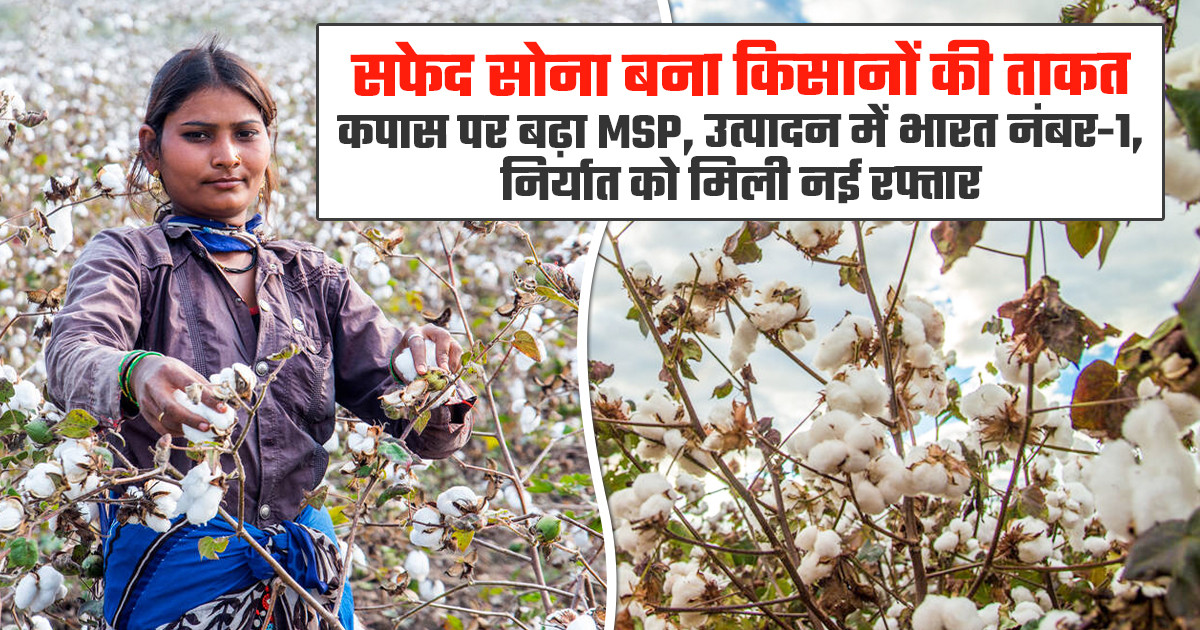
Cotton, often referred to as "White Gold", remains one of India's most valuable commercial crops, supporting millions of farmers while serving as the backbone of the country's textile and export industries. With a higher Minimum Support Price (MSP), continued policy support, and initiatives to improve productivity and quality, the government is aiming to make India's cotton sector more competitive, climate-resilient, and profitable for farmers.
Cotton plays a crucial role in India's rural economy, connecting farms to textile mills, garment manufacturers, and international markets. Nearly 6 million farmers cultivate cotton across the country, while an estimated 40–50 million people earn their livelihoods through ginning, spinning, textile manufacturing, processing, and cotton trade. Recognizing the crop's strategic importance, the government has introduced several initiatives, including the Mission for Cotton Productivity, Kasturi Cotton Bharat, and regular MSP revisions, to improve productivity, fibre quality, and farmers' income.
India continues to be the world's largest country in terms of cotton cultivation area, with approximately 11.484 million hectares under the crop, accounting for nearly 38% of the global cotton area. The country also ranks second globally in both cotton production and consumption, reflecting the strength of its agricultural base and textile manufacturing sector.
During the 2024–25 cotton seasons, production was estimated at 29.724 million bales (about 5.06 million tonnes). Preliminary estimates for 2025–26 place production at 29.091 million bales (around 4.95 million tonnes), while domestic consumption is projected at approximately 32.8 million bales, highlighting strong demand from India's textile industry. Although cotton cultivation is widespread, nearly 62% of the crop is grown under rain-fed conditions, making climate-resilient farming practices increasingly important.
India remains a significant player in global cotton trade. During 2024–25, the country exported around 1.8 million bales (0.31 million metric tonnes) of cotton, accounting for roughly 3.37% of global cotton exports. Exports of cotton and cotton-based products generated an estimated US$11.49 billion during FY 2024–25, underlining the sector's growing contribution to foreign exchange earnings and strengthening India's position in international textile markets.
Higher MSP Offers Better Price Protection for Cotton Farmers:
To improve farmer returns, the Government of India has increased the Minimum Support Price (MSP) for cotton for the 2026–27 marketing season. The MSP has been revised to: Medium Staple Cotton- ₹8,267 per quintal (up from ₹7,710), Long Staple Cotton- ₹8,667 per quintal (up from ₹8,110). The ₹557 per quintal increase for both varieties is expected to provide stronger price support, safeguard farmers against market fluctuations, and encourage continued cotton cultivation.
Policy Support Aims to Build a Stronger Cotton Economy:
Agriculture experts believe that the combination of higher MSP, improved production technologies, scientific research, quality enhancement programmes, and supportive government policies will significantly strengthen India's cotton ecosystem. With greater emphasis on sustainable cultivation, productivity improvement, and value addition, the cotton sector is expected to generate higher farmer incomes while boosting the textile industry, exports, and the rural economy. These efforts are aligned with the broader goal of building a resilient and globally competitive "White Gold" economy that benefits both producers and industry alike.
FAQs:
1. Why is cotton called White Gold?
Cotton is called White Gold because of its high economic value, strong demand, and major contribution to agriculture, textiles, exports, and farmer income.
2. What is the Cotton MSP for 2026–27?
The Cotton MSP for 2026–27 is ₹8,267 per quintal for Medium Staple Cotton and ₹8,667 per quintal for Long Staple Cotton.
3. Which country has the largest cotton cultivation area?
India has the world's largest cotton cultivation area, covering around 11.484 million hectares.
4. How does cotton support the Indian economy?
The cotton sector supports millions of farmers, generates employment in textile industries, boosts exports, and contributes significantly to rural economic growth.
5. What government schemes support cotton farmers?
Major initiatives include the Mission for Cotton Productivity, Kasturi Cotton Bharat, higher Cotton MSP, and programmes focused on improving productivity, quality, and sustainable cotton cultivation.