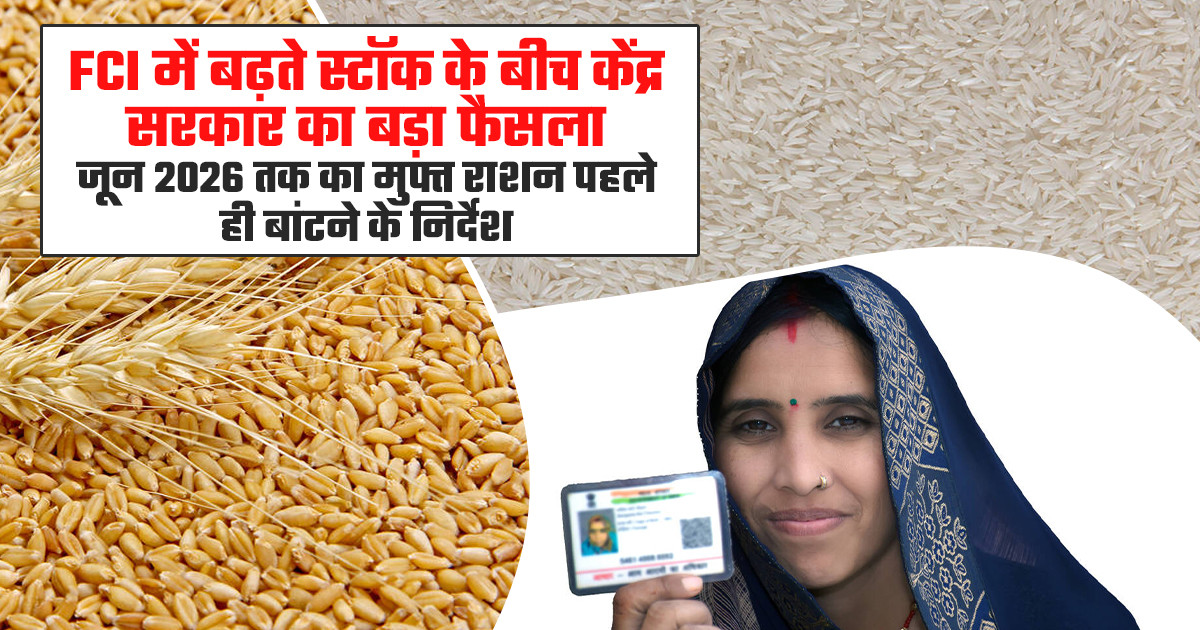
Amid rising food grain stocks in government warehouses, the central government has taken a significant step to manage storage capacity ahead of the upcoming procurement season. The Centre has directed states and Union Territories to lift and distribute free food grains allocated until June 2026 in advance from the central pool. The decision comes as warehouses of the Food Corporation of India (FCI) are already holding large quantities of rice and wheat, leaving limited space for fresh arrivals during the next procurement cycle.
Central government has instructed states and Union Territories to lift rice and wheat allocated under the National Food Security Act (NFSA) for the next three months—April to June 2026—at the earliest and distribute them immediately among eligible beneficiaries.
Communication sent to state food secretaries, the Ministry of Consumer Affairs, Food and Public Distribution stated that the decision was taken in view of the upcoming procurement season and the logistical and storage challenges that states may face. Early lifting of food grains will help create additional space in government warehouses for newly procured crops.
The ministry has also directed the Food Corporation of India (FCI) to ensure adequate availability of food grains in its warehouses and to coordinate closely with state governments for the smooth implementation of the advance lifting process. According to official data available as of Thursday, FCI was holding around 37.2 million tonnes of rice and 23.5 million tonnes of wheat. Together, the total stock of these two grains stood at nearly 60.7 million tonnes—about 185 percent higher than the required buffer norm of 21 million tonnes for April 1. This figure does not include nearly 3.9 million tonnes of rice that is yet to be received from millers.
Officials said the one-time advance distribution of free food grains to more than 800 million beneficiaries will serve two key purposes. First, it will create additional storage space for freshly procured crops. Second, it will help reduce pressure on the supply chain, especially in the current global environment. The government is also preparing to address potential supply disruptions related to fuel and transportation amid ongoing tensions in West Asia.
Government’s Open Market Sale Scheme (OMS), rice continues to be sold in the open market. Apart from this, food grains are being allocated to states, and a portion of the stock is also being supplied for ethanol production. Despite these measures, rice stocks in the central pool have continued to rise due to the open-ended procurement policy.
Food grain Production Expected to Rise:
According to the latest estimates, kharif food grain production for the 2025–26 crop years is expected to reach about 174.14 million tonnes, while Rabi food grain output is projected at around 174.51 million tonnes. This indicates a notable increase compared with the previous year. In the previous year, kharif food grain production stood at about 169.46 million tonnes, while rabi output was estimated at 169.16 million tonnes.
Higher Output of Rice and Wheat Anticipated:
The second advance estimates also indicate improved performance in rice production. Kharif rice output is projected at around 123.93 million tonnes, higher than last year’s level. Meanwhile, rabi rice production is estimated at about 16.72 million tonnes. Wheat production is also expected to increase, with the crop projected at around 120.21 million tonnes, surpassing last year’s output.
FAQs:
1. Why did the government order advance distribution of food grains?
The decision was taken to create storage space in warehouses before the upcoming procurement season.
2. Which scheme distributes these food grains?
The distribution is done under the National Food Security Act (NFSA).
3. Which organization manages the storage of rice and wheat?
The Food Corporation of India (FCI) manages the procurement and storage of these grains.
4. How much stock is currently available with FCI?
FCI holds over 60 million tonnes of rice and wheat combined.
5. Who benefits from this distribution?
More than 800 million beneficiaries under NFSA receive subsidized or free food grains.