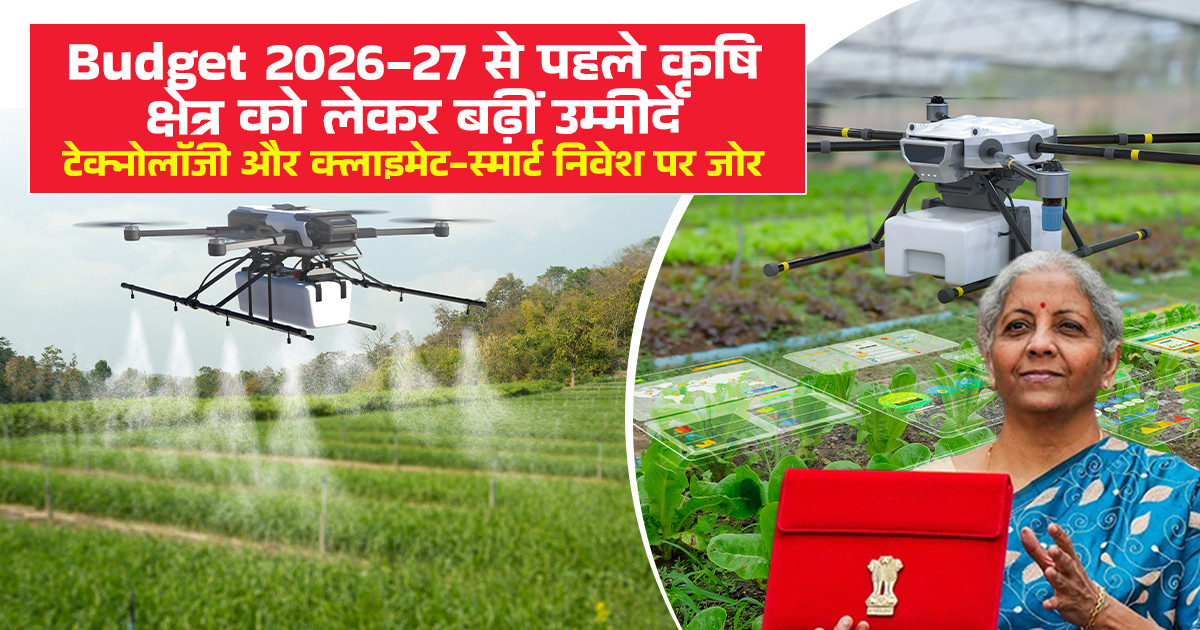
Ahead of Budget 2026–27, expectations from the agriculture sector have intensified, with industry players and experts urging the government to rethink its approach. They believe that farming can no longer be treated as a sector driven only by subsidies and welfare schemes. To increase farmers’ income and bring agriculture into the mainstream of economic growth, large-scale investments in technology, digital systems, and climate-smart infrastructure are essential.
Before the presentation of the FY27 budget, industry experts have begun outlining their priorities and policy agenda for the government. Their view is clear—agriculture should no longer be seen merely as a social welfare activity, but as a powerful engine of economic growth. Strengthening digital infrastructure, promoting technology-led farming, and investing in climate-resilient systems are being seen as key focus areas.
Currently, nearly 45 percent of India’s population depends on agriculture and allied sectors for livelihood, yet the sector contributes only about 18 percent to the country’s Gross Value Added (GVA).
According to Amit Vatsyayan, Leader – Agriculture, Livelihoods and Social Sector at EY India, agriculture has moved beyond being just a welfare-driven sector. With the right policies and targeted investments, it has the potential to improve productivity, generate employment, strengthen rural demand, and ensure long-term food security.
The dairy sector has also shared strong expectations from the upcoming budget. Brahmani Nara, Executive Director at Heritage Foods, noted that following GST simplification in September 2025, the organised dairy market has seen a sharp rise in demand for high-protein and health-focused products such as paneer, cheese, ghee, and butter.
Through initiatives like the National Gokul Mission and the National Digital Livestock Mission, more than 300,000 farmers have already been integrated into the organised dairy ecosystem. In this context, the dairy
Experts have emphasized that in the era of climate change, investment in micro-irrigation, watershed management, groundwater recharge, and renewable energy–based agricultural assets has become critical. Such measures can protect farming from climate shocks while also bringing income stability to farmers.
They have also highlighted the need to strengthen public-private partnerships (PPP) in storage, logistics, and agricultural research to reduce post-harvest losses. Additionally, investments in robust seed systems have been considered vital to achieve self-reliance in pulses and nutrition-oriented crops.
Push for Digitisation and Precision Agriculture:
Agri-tech companies are strongly advocating for the digitisation of agriculture. According to Swapnil Jadhav, Founder and CEO of MapMyCrop, technologies such as drones, IoT sensors, and AI-driven analytics can transform Indian farming.
These technologies can boost crop yields, enable efficient use of water and fertilisers, and provide better climate-risk protection to over 140 million farms across the country. He suggested that the government should introduce targeted subsidies, strong PPP models, and tax incentives for R&D, enabling these technologies to integrate with national platforms such as e-NAM and Agmarknet.
Q1. What are the key expectations from Budget 2026–27 for agriculture?
A shift from welfare to growth-oriented investments in technology, digitisation, and climate-smart infrastructure.
Q2. Why is technology important for Indian agriculture?
Technology improves productivity, reduces costs, manages climate risks, and increases farmers’ income.
Q3. What does the dairy sector want from the upcoming budget?
Support for fodder, veterinary infrastructure, and higher subsidies for small and women-led dairy units.
Q4. How can digitisation help farmers?
Digital tools provide better market access, precision farming, and transparent pricing through platforms like Khetivyapar.
Q5. What role will green infrastructure play in farming?
It protects agriculture from climate shocks while ensuring long-term income stability and sustainability.