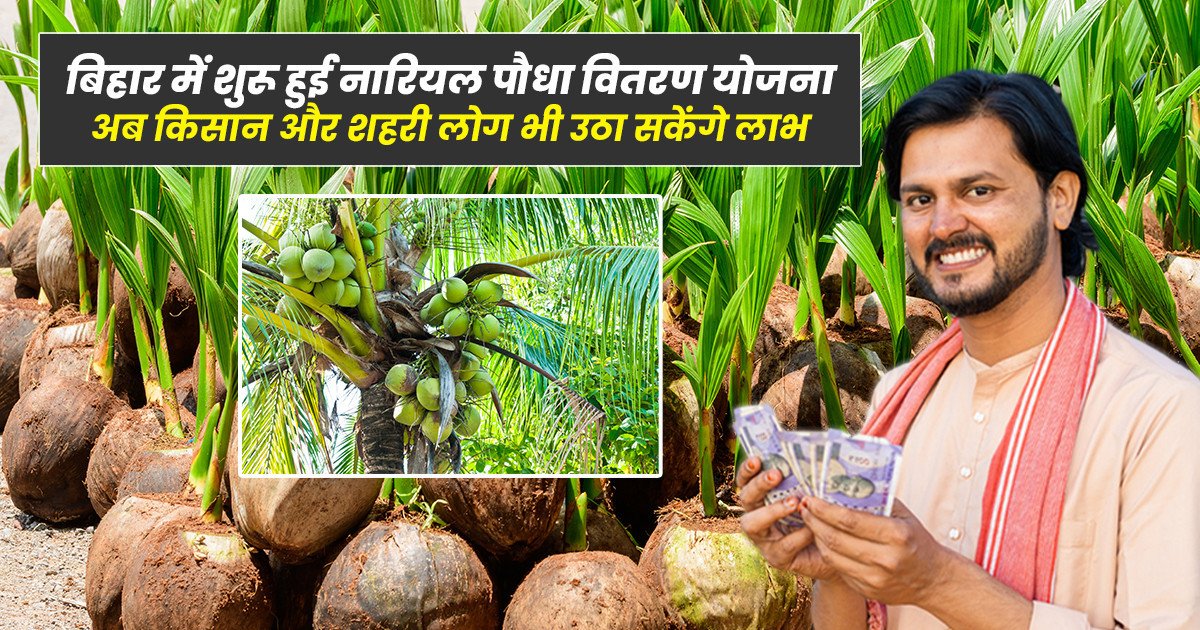
The Bihar government has launched the Coconut Plant Distribution Scheme 2026-27 under the state scheme to promote coconut cultivation and plantation across the state. Under this programme, farmers and other eligible individuals can get coconut plants at a subsidised rate.
A major highlight of the scheme is that it will be implemented across all 38 districts of Bihar. The government has fixed the unit cost of one coconut plant at ₹115, which includes ₹100 as production cost and ₹15 as district transportation cost.
Under the scheme, beneficiaries will receive a 75% subsidy, equivalent to ₹86.25 per plant. This significantly reduces the amount that beneficiaries have to pay for each subsidised coconut plant.
The unit cost of a coconut plant has been fixed at ₹115 under the Coconut Plant Distribution Scheme. The government will provide a 75% subsidy on this cost.
Under the scheme, one beneficiary can receive a minimum of 5 plants and a maximum of 712 plants at the subsidised rate.
The maximum number has been fixed on the basis of 178 plants per hectare. Accordingly, a beneficiary can get up to 712 plants under the scheme.
The district-wise availability of coconut plants will be arranged through the Coconut Development Board, Bihar, Patna, and made available to the Assistant Director of Horticulture. Plants will then be distributed among beneficiaries according to the prescribed rules.
The benefits of the Coconut Plant Distribution Scheme are not restricted only to traditional agricultural land. Interested beneficiaries can plant coconut trees around their homes, on available land, in gardens, kitchen gardens or on farms.
People living in urban areas can also benefit from the scheme, provided they meet the land-related conditions prescribed under the programme.
Land Revenue Receipt Is Mandatory:
To receive coconut plants at the subsidised rate, distribution will be made on the basis of land ownership or a land revenue receipt. A land revenue receipt has been made mandatory for the scheme.
If the applicant's name is not clearly mentioned in the land ownership records or revenue receipt, they will also have to submit a genealogy document (Vanshavali) along with the revenue receipt.
How Will Coconut Plants Be Made Available?
The availability of coconut plants in the concerned district will be ensured through the Assistant Director of Horticulture. The arrangement will be made with the support of the Coconut Development Board, Patna.
Plant availability will be ensured after receiving the beneficiary's share. Following this, the plants will be distributed according to the prescribed procedure.
Scheme to Be Implemented in All 38 Districts of Bihar:
The state government's Coconut Plant Distribution Scheme will be implemented across all 38 districts of Bihar. The objective is to promote coconut plantation in Bihar, which is considered a non-traditional coconut-growing region.
Coconut, scientifically known as Cocos nucifera, is considered one of the world's most useful trees, with different parts being used in various ways. Keeping this utility in mind, the state government has prepared the Coconut Plant Distribution Programme under the state scheme.
FAQs:
1. What is the subsidy on coconut plants in Bihar?
The Bihar government provides a 75% subsidy, equal to ₹86.25 per plant.
2. What is the cost of one coconut plant?
The government has fixed the unit cost at ₹115 per plant.
3. How many coconut plants can a beneficiary get?
A beneficiary can receive between 5 and 712 plants, depending on the prescribed eligibility and land area.
4. Is a land revenue receipt required?
Yes. A land revenue receipt or land ownership document is mandatory for availing the subsidy.
5. In how many districts will the scheme be implemented?
The Coconut Plant Distribution Scheme 2026-27 will be implemented in all 38 districts of Bihar.