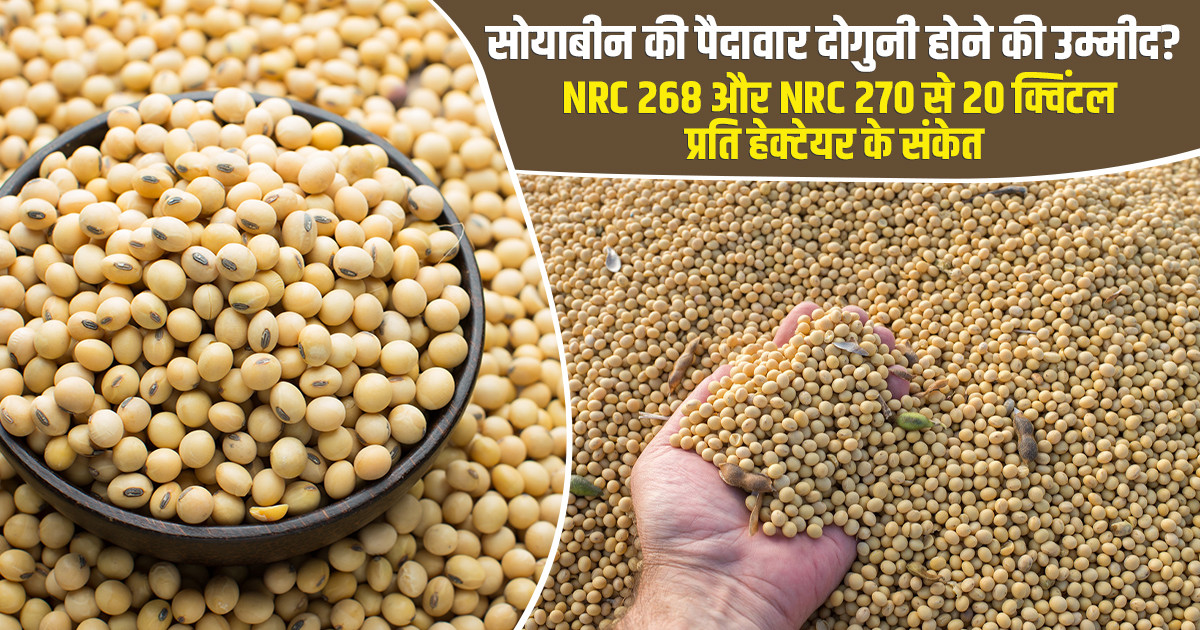
Soybean Farming: Improved soybean varieties and scientific farming practices could play a key role in raising India's soybean productivity. Early yield assessments of NRC 268 and NRC 270, developed by the ICAR–National Soybean Research Institute in Indore, Madhya Pradesh, have indicated a yield of around 20 quintals per hectare, even under unfavorable weather conditions. The preliminary findings were assessed during the institute's Soybean Harvest Day on October 9, 2026. While the results have generated optimism about the potential of these varieties, further scientific analysis and multi-season evaluations will be necessary to establish their performance across different agro-climatic conditions.
The ICAR–National Soybean Research Institute, Indore, operating under the Indian Council of Agricultural Research (ICAR), organized the Soybean Harvest Day to assess the yield potential of its improved soybean varieties. During the programme, crop yields were assessed from one acre under each variety, and preliminary data indicated production of approximately 20 quintals per hectare. The initial performance is noteworthy because India's average soybean productivity is estimated at around 10–11 quintals per hectare.
However, these early findings should not be interpreted as a guaranteed yield for every farmer. Performance under commercial cultivation will need to be evaluated across different locations, seasons, and farming conditions. If subsequent trials confirm the results, NRC 268 and NRC 270 could contribute to efforts to improve soybean productivity.
Research and field trials conducted across India by the ICAR–National Soybean Research Institute and the All India Coordinated Research Project on Soybean (AICRP on Soybean) indicate that yields of 15–20 quintals per hectare may be achievable by combining improved varieties with appropriate agricultural practices. Under favorable growing conditions, soybean yields could potentially reach 22–25 quintals per hectare. Actual production, however, depends on several factors, including soil health, rainfall, temperature, sowing time, seed quality, nutrient management, weed control and crop protection. For farmers, therefore, higher productivity depends not only on selecting a suitable variety but also on following scientific cultivation practices suited to local conditions.
ICAR Director General Calls Preliminary Findings Encouraging:
Dr M. L. Jat, Secretary of the Department of Agricultural Research and Education (DARE) and Director General of ICAR, described the initial findings as encouraging. He emphasized the importance of improved varieties and scientific production technologies in raising soybean productivity in India. The preliminary yield indications from NRC 268 and NRC 270, despite unfavorable weather conditions, offer an encouraging starting point for further evaluation. A detailed scientific analysis of the collected data will help researchers understand the varieties' performance and identify priorities for future soybean research and productivity improvement.
Multi-Year Trials Will Help Establish Actual Yield Potential:
According to the institute, the objective of Soybean Harvest Day extends beyond recording the crop's yield in a single season. Systematic data collection across multiple years, locations, varieties, and production conditions is essential to understand the consistency and actual yield potential of soybean varieties. Long-term assessments can help researchers determine how much productivity improvement can be achieved through improved seeds and modern agricultural practices. They can also help evaluate the effectiveness of research outcomes and the dissemination of agricultural technologies to farmers. Regular yield assessment programmes are intended to strengthen the evidence base for soybean research and help farmers access information about improved varieties and scientific crop management.
What Do These Findings Mean for Soybean Farmers?
Higher soybean productivity could create opportunities to improve farm output and potentially increase income per hectare. The early results from NRC 268 and NRC 270 are promising, but farmers should avoid making large-scale planting decisions based on preliminary yield estimates alone.
Before selecting either variety, farmers should verify:
FAQs:
1. What are NRC 268 and NRC 270?
NRC 268 and NRC 270 are improved soybean varieties developed by the ICAR–National Soybean Research Institute in Indore, Madhya Pradesh.
2. What is the reported yield potential of NRC 268 and NRC 270?
Preliminary assessments indicated around 20 quintals per hectare. Further trials are needed to confirm their performance.
3. What is India's average soybean productivity?
India's average soybean productivity is estimated at around 10–11 quintals per hectare, although it varies by region and season.
4. How can farmers increase soybean productivity?
Farmers can improve yields through suitable varieties, timely sowing, balanced nutrient management, weed control, and appropriate pest and disease management.
5. Should farmers immediately switch to NRC 268 or NRC 270?
No. Farmers should first verify official recommendations, local suitability, seed availability, and results from trials conducted under comparable growing conditions.