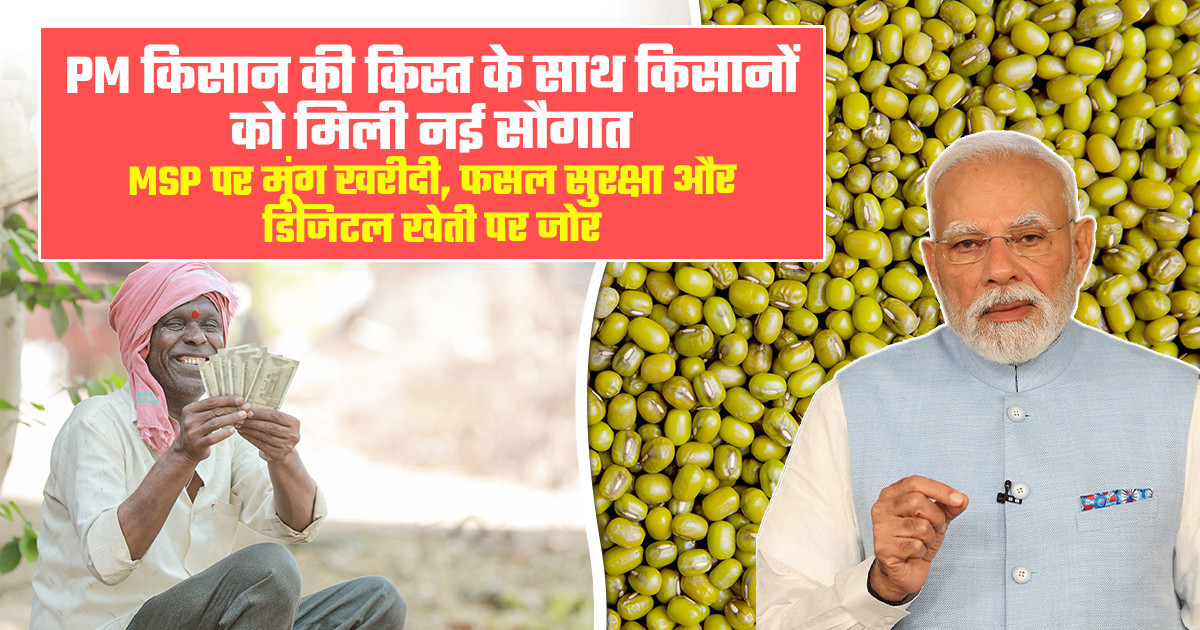
Farmers in Madhya Pradesh have received a significant boost following the approval of moong procurement under the Minimum Support Price (MSP) system. The announcement was made by Union Agriculture and Farmers Welfare Minister Shivraj Singh Chouhan during a farmers’ programme held in Raisen district, where he assured growers of better price support and stronger market access.
The development coincided with the release of the latest installment under the PM-Kisan income support scheme, reinforcing the government’s focus on improving farm incomes and strengthening agricultural resilience.
PM-Kisan scheme, financial assistance was transferred directly to the bank accounts of millions of farmers through the Direct Benefit Transfer (DBT) mechanism. The scheme continues to serve as an important source of support for farming households by helping them manage cultivation expenses and improve financial stability. During the programme in Raisen, the Union Agriculture Minister participated virtually in the national event and announced several initiatives aimed at benefiting farmers across the state.
Moong cultivation has expanded considerably in Madhya Pradesh in recent years, making it one of the state's important cash crops. The introduction of MSP procurement is expected to provide farmers with assured prices and protection against market fluctuations. Officials believe that strengthening procurement systems will improve transparency and provide farmers with reliable channels for selling their produce, ultimately helping to increase farm incomes.
The government has encouraged farmers to participate in crop insurance programmes and make greater use of institutional credit facilities. Schemes such as crop insurance and farmer credit programmes are considered essential tools for managing risks arising from unpredictable weather and changing market conditions. Expanding access to affordable credit and risk management services remains a key priority in strengthening the agricultural sector.
Preparedness Measures for Possible Rainfall Deficit:
With concerns over below-normal rainfall in some regions, both central and state authorities are working on contingency plans to reduce the impact of adverse weather conditions. Farmers are expected to receive timely guidance on crop selection, improved seeds, moisture conservation techniques, and water management practices. These preparedness measures aim to minimize production risks and help farmers adapt to changing climatic conditions.
Digital Agriculture and Natural Farming Receive Push:
The government is also accelerating efforts to promote digital agriculture and natural farming practices. Data-driven agricultural services, digital farmer platforms, and natural farming clusters are being developed to improve access to information and reduce production costs. Experts believe that these initiatives can improve resource efficiency, encourage sustainable farming methods, and support long-term agricultural growth.
Rural Infrastructure Development Remains a Priority:
Alongside agricultural reforms, the government continues to focus on strengthening rural infrastructure. Improved roads, market connectivity, and transportation facilities are expected to help farmers access markets more efficiently and reduce post-harvest challenges. New rural infrastructure projects are likely to enhance access to agricultural services and create better marketing opportunities for farming communities.
Government Focuses on Increasing Farmer Incomes: Agricultural experts believe that MSP procurement, crop protection measures, digital farming initiatives, and rural infrastructure development can collectively play a major role in increasing farmer incomes and strengthening the agricultural economy.
FAQs:
Q1. What is the benefit of moong MSP procurement in Madhya Pradesh?
It ensures farmers receive a guaranteed minimum price, reducing the risk of market price fluctuations.
Q2. How does the PM-Kisan scheme support farmers?
It provides direct financial assistance to farmers’ bank accounts to help manage farming expenses.
Q3. Why is crop insurance important for farmers?
It protects farmers from losses caused by weather uncertainty, pests, and natural disasters.
Q4. What is the role of digital agriculture in farming?
It helps farmers access real-time data, improve productivity, and reduce input costs.
Q5. How will rural infrastructure development help farmers?
It improves market access, reduces transportation costs, and minimizes post-harvest losses.