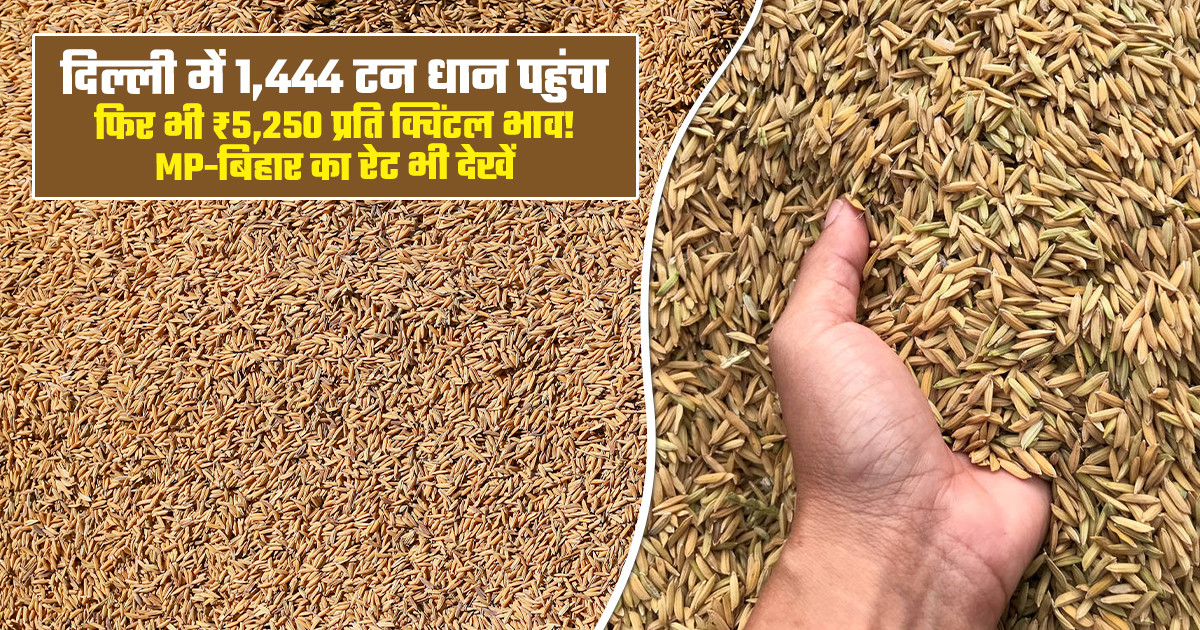
Paddy Mandi Bhav 31 October 2026: Farmers preparing to sell their paddy crop should check the latest mandi prices across Delhi, Bihar, and Madhya Pradesh before making a decision. According to the latest mandi price data for October 31, 2026, the maximum paddy price reached ₹5,250 per quintal at Narela Mandi in Delhi. In Madhya Pradesh, the maximum price stood at ₹5,005 per quintal in Waraseoni and ₹5,000 per quintal in Vidisha.
In terms of arrivals, Narela Mandi in Delhi recorded 1,444.90 tonnes of paddy, while Vidisha Mandi in Madhya Pradesh received 1,090.88 tonnes. The Minimum Support Price (MSP) for common-grade paddy has been fixed at ₹2,441 per quintal. However, market prices varied significantly, and several mandis recorded prices below this benchmark.
Let's look at the minimum and maximum paddy prices across the listed mandis in Delhi, Bihar, and Madhya Pradesh.
|
State |
Market |
Arrivals (Tonnes) |
Variety |
Minimum Price (₹/Quintal) |
Maximum Price (₹/Quintal) |
|
Delhi |
Najafgarh Market Paddy Price |
4.5 |
Paddy |
1,200 |
1,700 |
|
Delhi |
Narela Market Paddy Price |
1,444.90 |
Paddy |
3,325 |
5,250 |
|
Bihar |
Lakhisarai Market Paddy Price |
5.2 |
Medium Paddy |
2,150 |
2,200 |
|
Madhya Pradesh |
Ashoknagar Market Paddy Price |
587 |
Paddy |
1,760 |
4,655 |
|
Madhya Pradesh |
Bhopal Market Paddy Price |
5.88 |
Paddy |
4,200 |
4,400 |
|
Madhya Pradesh |
Bina Market Paddy Price |
2.61 |
Paddy |
1,630 |
3,425 |
|
Madhya Pradesh |
Dabra Market Paddy Price |
136.92 |
1847 |
2,558 |
4,050 |
|
Madhya Pradesh |
Ganjbasoda Market Paddy Price |
796.15 |
Paddy |
1,130 |
4,840 |
|
Madhya Pradesh |
Gohad Market Paddy Price |
121.54 |
Paddy |
3,250 |
3,750 |
|
Madhya Pradesh |
Jabalpur Market Paddy Price |
202.55 |
Paddy |
1,100 |
4,005 |
|
Madhya Pradesh |
Mohgaon Market Paddy Price |
6.5 |
Common |
2,370 |
2,371 |
|
Madhya Pradesh |
Morena Market Paddy Price |
35.96 |
Paddy |
2,600 |
4,205 |
|
Madhya Pradesh |
Ujjain Market Paddy Price |
122.5 |
Paddy |
2,906.35 |
3,050 |
|
Madhya Pradesh |
Waraseoni Market Paddy Price |
104.86 |
Paddy |
2,055 |
5,005 |
|
Madhya Pradesh |
Vidisha Market Paddy Price |
1,090.88 |
Paddy |
1,050 |
5,000 |
|
Madhya Pradesh |
Satna Market Paddy Price |
8.2 |
Paddy |
1,915 |
1,920 |
|
Madhya Pradesh |
Sihora Market Paddy Price |
0.41 |
Paddy |
1,900 |
1,901 |
Narela Records the Highest Paddy Price at ₹5,250:
Narela Leads in Arrivals, Followed by Vidisha:
How Do Paddy Prices Compare With the MSP?:
The Minimum Support Price (MSP) for common-grade paddy is ₹2,441 per quintal. Comparing this benchmark with the reported maximum mandi prices shows a substantial difference in some markets.
| Mandi | Maximum Price (₹/Quintal) | Difference From MSP |
|---|---|---|
| Narela, Delhi | ₹5,250 | ₹2,809 above MSP |
| Waraseoni, MP | ₹5,005 | ₹2,564 above MSP |
| Vidisha, MP | ₹5,000 | ₹2,559 above MSP |
| Ganjbasoda, MP | ₹4,840 | ₹2,399 above MSP |
| Lakhisarai, Bihar | ₹2,200 | ₹241 below MSP |
| Mohgaon, MP | ₹2,371 | ₹70 below MSP |
These comparisons are indicative because paddy varieties and quality can differ from one market to another. The common-grade MSP should not automatically be applied to every variety.
A mandi price below MSP also does not necessarily mean that the same price will be offered at a government procurement centre. Farmers should check the availability of procurement facilities, applicable eligibility conditions, and the grade of paddy accepted.
Advice for Farmers:
FAQs:
1. What is the highest Paddy Mandi Bhav today, 31 October 2026?
Narela Mandi in Delhi recorded the highest maximum paddy price at ₹5,250 per quintal.
2. What is the paddy price in Madhya Pradesh today?
Waraseoni recorded ₹2,055 to ₹5,005, Vidisha ₹1,050 to ₹5,000 and Ganjbasoda ₹1,130 to ₹4,840 per quintal.
3. What is the paddy MSP for 2026–27?
The MSP for common-grade paddy is ₹2,441 per quintal for the 2026–27 marketing season.
4. Which mandi recorded the highest paddy arrivals?
Narela Mandi in Delhi recorded the highest arrivals at 1,444.90 tonnes.
5. Why do paddy prices differ between mandis?
Paddy prices vary due to crop variety, grain quality, moisture content, local demand, arrivals and market bidding conditions.