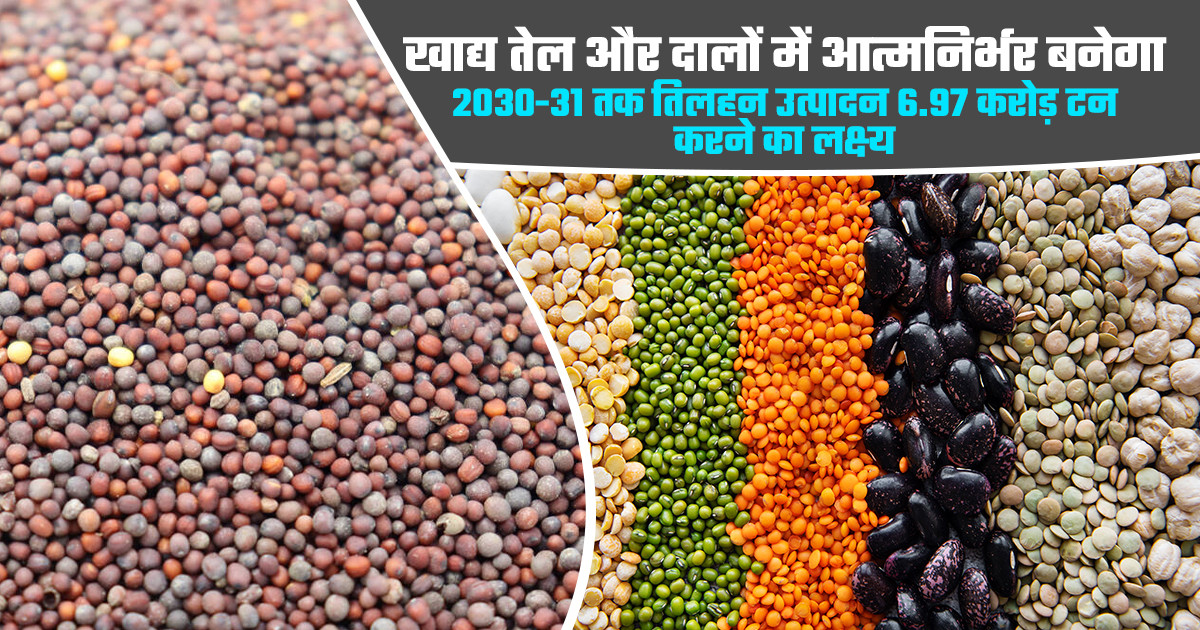
India is stepping up efforts to meet its growing domestic demand for edible oils and pulses while reducing dependence on imports. Govt has set an ambitious target of increasing oilseed production to 69.7 million tonnes and pulse production to 35 million tonnes by 2030-31. To achieve these goals, farmers are being supported through improved seed varieties, free seed distribution, scientific farming practices, field demonstrations, post-harvest infrastructure and better market linkages.
More than 600 value-chain clusters have been established across the country to strengthen oilseed production and connect farmers with the complete agricultural value chain. At the same time, the Mission for Aatmanirbharta in Pulses is focusing on increasing the production of major pulses such as tur, urad and masoor, along with assured procurement mechanisms for farmers.
National Mission on Edible Oils–Oilseeds (NMEO-OS) was approved on 3 October 2024 with the objective of increasing domestic oilseed production and moving India towards greater self-reliance in edible oils. Under the mission, primary oilseed production is targeted to increase from 39 million tonnes in 2022-23 to 69.7 million tonnes by 2030-31. The strategy includes wider access to high-yielding varieties, scientific crop management, farmer training, field demonstrations and improved post-harvest infrastructure.
The NMEO-OS is being implemented through a cluster-based approach designed to strengthen the entire production and marketing chain. More than 600 value-chain clusters are currently operational across the country. These clusters are being managed by Farmer Producer Organisations (FPOs), cooperatives and other value-chain partners. Farmers associated with the clusters are being provided access to high-quality seeds of improved and high-yielding varieties, along with training on scientific farming practices and improved crop management.
Free Seed Distribution Expands Access to Improved Varieties:
The mission is also focusing on making quality planting material more accessible to farmers. During 2025-26, free seed distribution covered 1.352 million hectares under the value-chain clusters. During the ongoing Kharif 2026 season, another 0.444 million hectares has so far been covered through free seed distribution. In addition, 60 seed hubs and 50 specialised seed storage units have been sanctioned to strengthen the production and storage of breeder seeds of newly released improved varieties.
Field Demonstrations Take New Technologies to Farmers:
To improve oilseed productivity, the Government is promoting Frontline Demonstrations (FLDs), Cluster Frontline Demonstrations (CFLDs) and Block-Level Demonstrations (BLDs). These programmes are designed to familiarise farmers with improved varieties, scientific crop management practices and modern production technologies. According to the third advance estimates for 2025-26, oilseed production increased from 41.355 million tonnes in 2022-23 to 43.059 million tonnes in 2025-26, indicating a gradual improvement in domestic production.
Domestic Edible Oil Availability Rises as Imports Decline:
The increase in oilseed production is also being accompanied by efforts to strengthen domestic availability of edible oils. According to the Directorate of Sugar and Vegetable Oils under the Department of Food and Public Distribution, domestic availability of edible oils increased from 12.423 million tonnes in 2022-23 to 12.630 million tonnes in 2024-25.During the same period, edible oil imports declined from 16.50 million tonnes to 16.072 million tonnes. The Government is aiming to further increase domestic production and processing capacity to reduce India's dependence on imported edible oils.
Pulse Production Target Raised to 35 Million Tonnes:
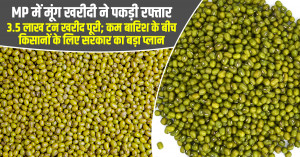
To strengthen self-reliance in pulses, the Government launched the Mission for Aatmanirbharta in Pulses on 11 October 2025. The mission aims to increase pulse production from 24.2 million tonnes in 2023-24 to 35 million tonnes by 2030-31. Farmers are being supported through certified seeds of high-yielding and climate-resilient varieties, seed production programmes, seed kits, modern crop technologies and capacity-building initiatives.
Assured Procurement of Tur, Urad and Masoor:
To provide farmers with better price security, the pulses mission supports the assured procurement of tur, urad and masoor from registered and willing farmers. Procurement is undertaken through NAFED and NCCF under the Pradhan Mantri Annadata Aay Sanrakshan Abhiyan (PM-AASHA) based on requirements submitted by the respective states.The procurement mechanism is aimed at reducing farmers' exposure to market price fluctuations and creating greater confidence in pulse cultivation.
4.79 Lakh Hectares Covered Under Pulse Demonstrations:
Pulse Production Rises While Imports Fall:
According to the Government's third advance estimates, India's pulse production increased from 24.246 million tonnes in 2023-24 to 27.409 million tonnes in 2025-26. At the same time, pulse imports declined from 7.256 million tonnes in 2024-25 to 5.964 million tonnes in 2025-26. The rise in domestic production combined with lower imports indicates progress towards greater self-reliance in pulses.
FAQs:
1. What is India’s target for oilseed production by 2030-31?
The Central Government has set a target of increasing oilseed production to 6.97 crore tonnes, or 697 lakh tonnes, by 2030-31.
2. What is the target for pulse production by 2030-31?
The government aims to increase pulse production from 242 lakh tonnes in 2023-24 to 3.50 crore tonnes, or 350 lakh tonnes, by 2030-31.
3. What is the National Mission on Edible Oils – Oilseeds (NMEO-OS)?
The National Mission on Edible Oils – Oilseeds (NMEO-OS) is a government initiative aimed at increasing domestic oilseed production and reducing India’s dependence on edible oil imports. The initiative was approved on October 3, 2024.
4. How much has pulse production increased in India?
According to the third advance estimates, pulse production increased from 242.46 lakh tonnes in 2023-24 to 274.09 lakh tonnes in 2025-26.