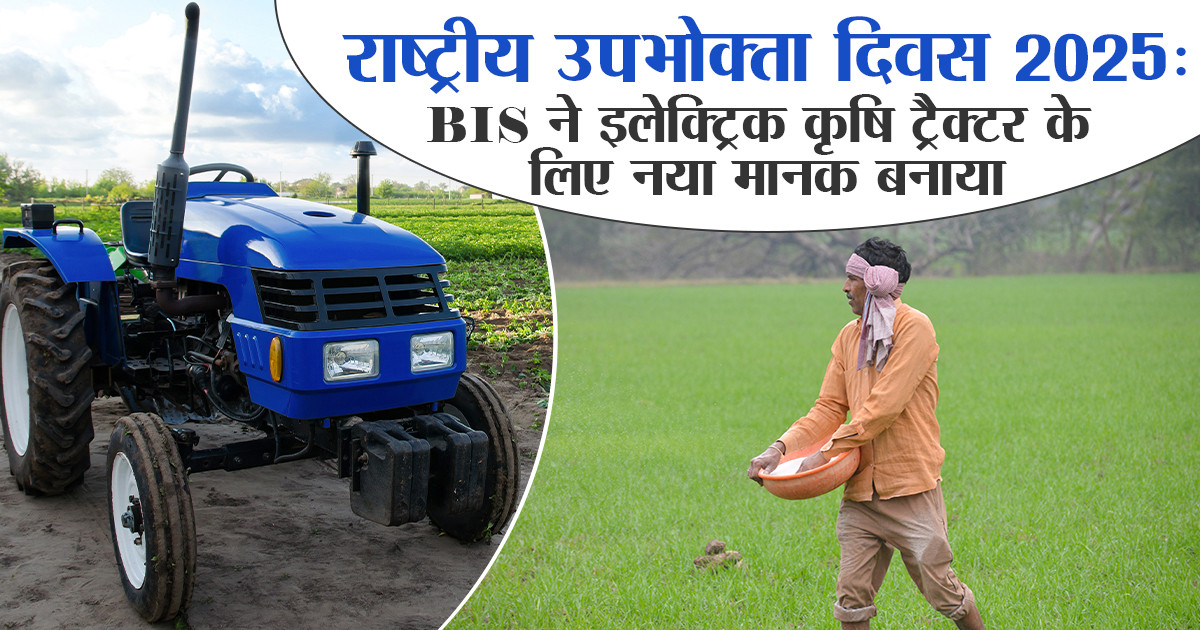
National Consumer Day 2025, Union Minister for Consumer Affairs, Food and Public Distribution, Shri Pralhad Joshi, notified a new Indian Standard for electric agricultural tractors. Developed by the Bureau of Indian Standards (BIS), this standard aims to ensure the safety, reliability, and performance of electric tractors by introducing a uniform and scientific testing framework across the country.
Under IS 19262:2025, standardized terminology, general guidelines, and technical parameters have been defined for testing electric agricultural tractors. The standard covers key performance aspects such as PTO power, drawbar power, belt-pulley performance, vibration measurement, verification of specifications, and inspection of various tractor components and assemblies. By clearly structuring testing procedures, the standard creates a common understanding among manufacturers, testing agencies, and other stakeholders.
The new standard has been developed by drawing technical inputs from IS 5994:2022 (Agricultural Tractors – Test Code) and relevant automotive industry standards related to electric vehicles, suitably adapted for agricultural applications. Effective implementation through authorized testing institutions is expected to accelerate the adoption of electric agricultural tractors in India. This will promote innovation in clean farming technologies, reduce emissions, and strengthen sustainable agricultural mechanization.
The testing procedures prescribed under IS 19262:2025 will generate reliable, science-based data for evaluating the performance and safety of electric agricultural tractors. This data will also form the foundation for developing future approval criteria and conformity assessment schemes specific to electric tractors. As a result, manufacturers will be better equipped to design safe and dependable products, while farmers and consumers will gain greater confidence in electric tractor technology.
Electric agricultural tractors are emerging as a promising alternative in India’s farm mechanization landscape. Unlike conventional diesel-powered tractors, these machines operate using battery-driven electric motors. Recent advancements in battery technology, electric motors, and power electronics have significantly improved their capacity, efficiency, and overall performance.
Lower Emissions, Reduced Costs, Better Working Conditions:
Compared to diesel tractors, electric tractors offer lower emissions, reduced operating costs, and higher energy efficiency. They completely eliminate tailpipe emissions in fields, helping reduce air pollution and carbon emissions from agricultural activities. Lower noise levels and the absence of smoke create a healthier working environment for farmers. Additionally, with fewer moving parts, maintenance requirements are simpler and more cost-effective, reducing diesel consumption and dependence on fossil fuels.
What is an electric agricultural tractor?
An electric agricultural tractor is a battery-powered tractor that uses electric motors instead of diesel engines for farm operations.
How does the new Indian Standard IS 19262:2025 help electric tractors?
It provides uniform testing guidelines to ensure safety, performance, and reliability of electric tractors.
Are electric tractors more cost-effective than diesel tractors?
Yes, electric tractors have lower fuel costs, reduced maintenance, and higher energy efficiency, making them more economical in the long run.
What are the environmental benefits of electric agricultural tractors?
They produce zero tailpipe emissions, reduce air pollution, and help lower carbon footprint in farming.
How does Khetivyapar support electric tractor adoption?
Khetivyapar offers innovative and reliable electric tractor models that meet new Indian standards, promoting clean and sustainable farming.