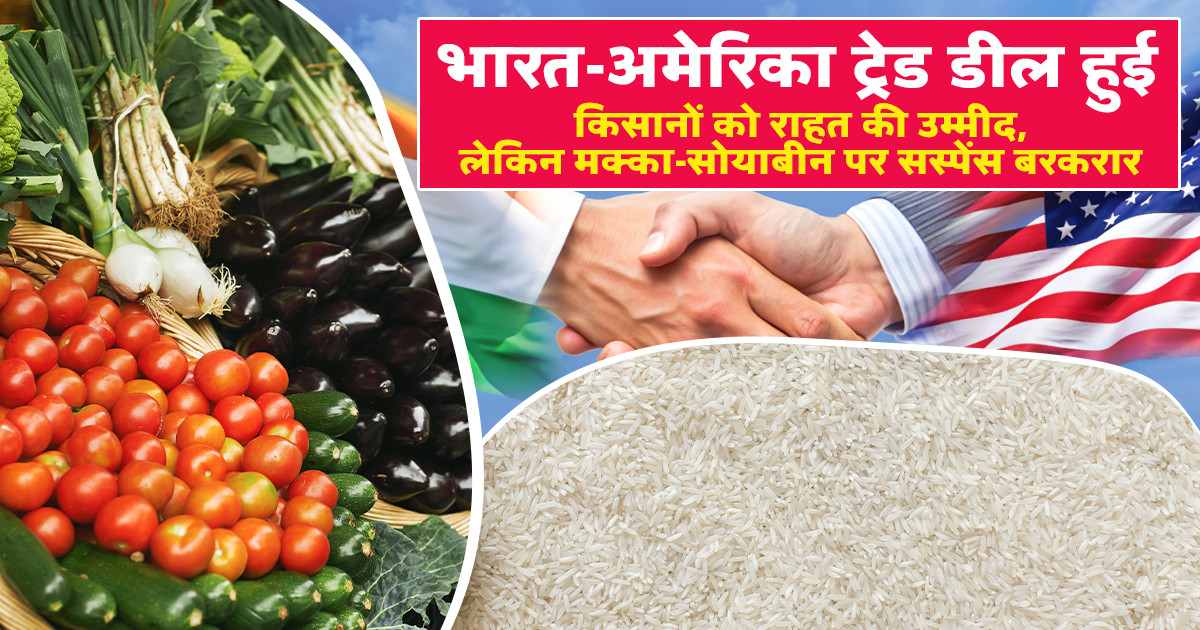
The long-awaited India–US Trade Deal has finally been concluded, marking a significant milestone for bilateral trade relations between the two countries. After years of negotiations, this agreement is expected to strengthen economic ties and create fresh opportunities for Indian industries as well as the agriculture sector. One of the biggest outcomes of the deal is that “Made in India” products will now reach the US market at more competitive prices.
Following the agreement, US President Donald Trump announced a reduction in tariffs on Indian goods from 25% to 18%. This tariff cut is being seen as a major relief for Indian exporters. Lower tariffs mean Indian products, including agricultural commodities, will become more price-competitive in the US, helping Indian companies and farmers expand their global reach.
Despite the positive momentum, concerns remain over the import of genetically modified (GM) corn, soybean, and dairy products from the United States. These items were the main sticking points that delayed the trade deal for a long time. Earlier, the Indian government had clearly stated that it would not allow the import of GM corn, soybean, and dairy products, emphasizing that there would be no compromise on farmers’ interests.
Even after the signing of the India–US Trade Deal, there is no official clarification on whether India has softened its stand on these sensitive agricultural imports. As a result, farmers and agri-industry stakeholders are closely monitoring future policy announcements.
According to data from the Directorate General of Commercial Intelligence and Statistics (DGCIS), during FY 2024–25, India’s total agricultural exports stood at ₹4,50,840 crore. Out of this, exports to the United States alone were worth ₹52,874 crore, making it India’s biggest agricultural export market.
Comparison, India’s agricultural imports from the US were around ₹18,587.54 crore. This trade imbalance highlights why the US is so crucial for India’s export-driven agricultural growth. Platforms like Khetivyapar believe that the reduction in tariffs could further boost demand for Indian farm products in the US market.
India imports several agricultural and allied products from the United States, including apples, almonds, walnuts, pistachios, cotton, ethanol, and certain dairy products. These imports play a role in meeting domestic demand but remain a sensitive issue for Indian farmers.
FAQs on India–US Trade Deal:
Q1. What is the main benefit of the India–US Trade Deal for farmers?
The tariff reduction makes Indian agricultural exports more competitive in the US market.
Q2. How much was the tariff reduced under the deal?
Tariffs on Indian goods were reduced from 25% to 18%.
Q3. Is India allowing GM corn and soybean imports from the US?
So far, there is no clear official decision on GM corn, soybean, and dairy imports.
Q4. Why is the US important for India’s agricultural exports?
The US is India’s largest agricultural export destination, accounting for ₹52,874 crore in exports.
Q5. How does Khetivyapar view this trade deal?
Khetivyapar sees the deal as a positive step that can strengthen India’s agricultural export ecosystem if farmers’ interests are protected.