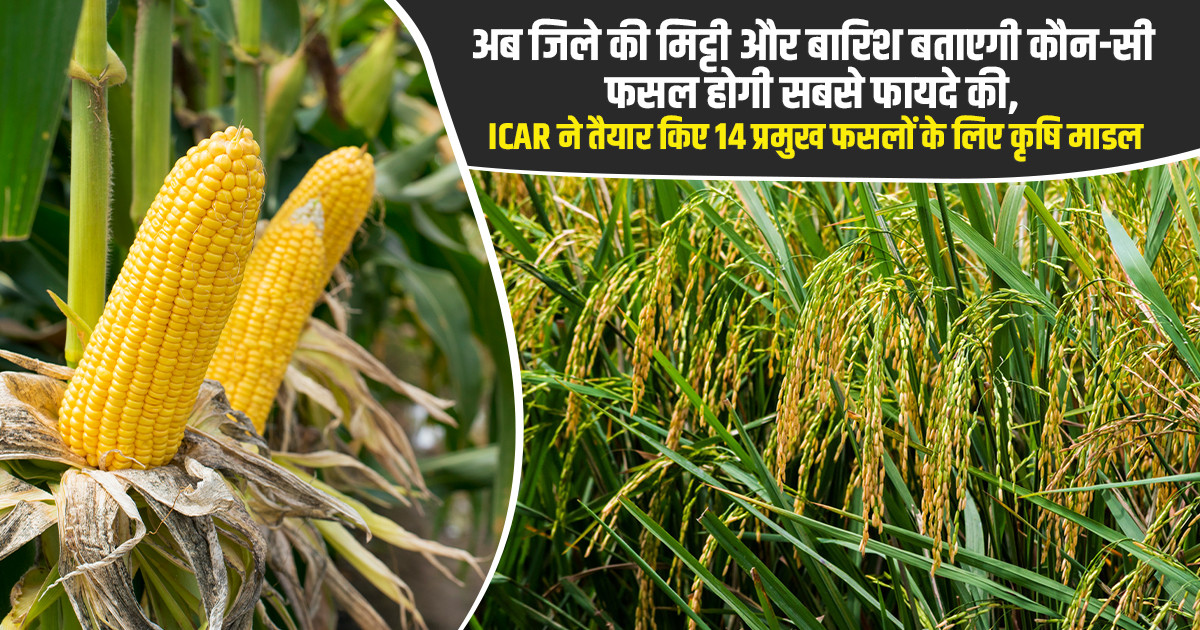
Choosing the right crop based on local soil, rainfall, water availability, and climate conditions could significantly improve farm productivity while reducing pressure on natural resources. In a major step towards sustainable agriculture, the Indian Council of Agricultural Research (ICAR) has developed district-specific crop planning models for 14 major crops. The models provide scientific recommendations to help farmers select the most suitable crops according to the agro-ecological conditions of their districts.
ICAR has prepared agro-ecology-based district-level crop models covering 14 major crops—rice, wheat, maize, pearl millet, sorghum, pigeon pea, chickpea, soybean, mustard, groundnut, cotton, sugarcane, potato, and onion. The recommendations are based on multiple scientific parameters, including soil quality, rainfall patterns, water availability, climatic conditions, local resources, and crop production potential. The objective is to encourage farmers to adopt crops that are better suited to their local environment, thereby improving yields while conserving natural resources.
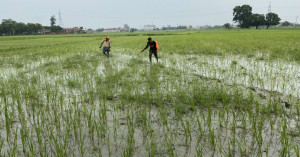
According to the study, water-intensive crops such as rice, sugarcane, cotton, and jute occupy nearly 62.7 million hectares, accounting for approximately one-third of India's gross cropped area. The assessment found that around 2.89 million hectares of rice are cultivated across 68 districts receiving less than 650 mm of average annual rainfall. Similarly, nearly 0.721 million hectares of sugarcane are grown in 91 districts where annual rainfall remains below 700 mm.
Experts believe that shifting suitable areas toward diversified cropping systems could play a significant role in conserving water resources while improving the resilience and sustainability of Indian agriculture.
To reduce dependence on water-intensive crops, the government is promoting pulses, oilseeds, millets (Shree Anna), and horticultural crops. Supporting this strategy, ICAR has implemented location-specific crop diversification projects in 47 selected districts. The initiative also encourages efficient irrigation practices, including drip irrigation, drip fertigation, and scientifically planned irrigation scheduling to maximize water-use efficiency across different cropping systems.
Capacity Building through Farmer Training:
To accelerate the adoption of sustainable farming practices, ICAR organized 457 training programmes between 2023-24 and 2025-26. These programmes trained 8,749 farmers and 4,592 agricultural extension officers on modern crop production technologies, climate-smart farming practices, and water conservation techniques. The training aims to strengthen knowledge transfer and support the wider adoption of scientific farming methods at the grassroots level.
Climate-Resilient Agriculture Remains a National Priority:
India is also strengthening climate-resilient agriculture through the National Innovations in Climate Resilient Agriculture (NICRA) programme. The initiative supports the development of crop varieties that can better withstand drought, floods, salinity, and heat stress. In addition, climate-resilient villages have been established across 151 vulnerable districts, while district-level agricultural contingency plans have been prepared for 651 districts. Farmers are also receiving weather-based agro-advisories, technical guidance, and extension support through Krishi Vigyan Kendras (KVKs) and other agricultural outreach programmes.
(FAQs):
1. What are ICAR district-specific crop models?
ICAR district-specific crop models are scientific recommendations that help farmers choose the most suitable crops based on soil, rainfall, climate, water availability, and local resources.
2. Which crops are covered under the ICAR crop planning models?
The models cover 14 major crops: rice, wheat, maize, pearl millet, sorghum, pigeon pea, chickpea, soybean, mustard, groundnut, cotton, sugarcane, potato, and onion.
3. Why is crop diversification important?
Crop diversification reduces dependence on water-intensive crops, conserves water, improves soil health, and increases farm sustainability.
4. What is the NICRA programme?
NICRA (National Innovations in Climate Resilient Agriculture) is an ICAR initiative that develops climate-resilient crop varieties and promotes farming practices that can withstand drought, floods, heat, and salinity.
5. How does Khetivyapar help farmers?
Khetivyapar provides the latest agriculture news, government scheme updates, weather information, crop advisory, market prices, and scientific farming knowledge to support informed farming decisions.