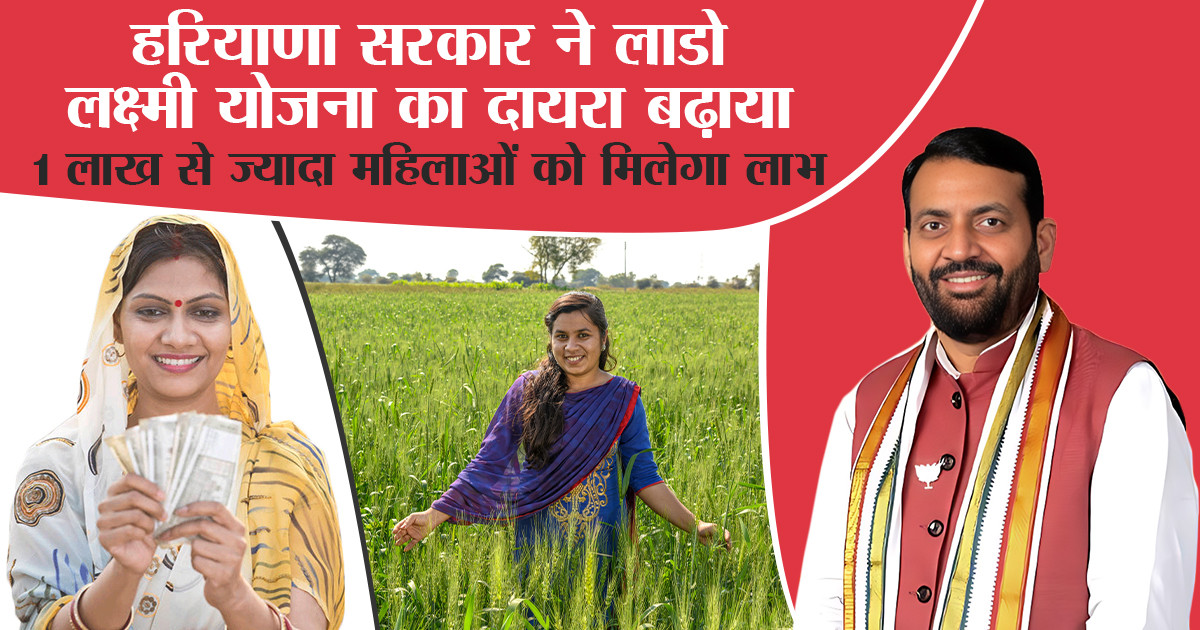
The Haryana government has taken a significant and forward-looking step to further strengthen women empowerment in the state. By expanding the scope of the Deen Dayal Lado Lakshmi Scheme, the government has introduced three new beneficiary categories. This decision will enable over one lakh additional women to join the scheme and receive monthly financial assistance of ₹2,100. The government believes this move will help economically weaker women become self-reliant and improve the socio-economic condition of their families.
According to an official spokesperson, the expansion has been designed to encourage women associated with key sectors such as education, nutrition, and health. The government has also assured that the benefits of the scheme will be delivered to eligible women through a transparent and fair process.
The Haryana government has clarified that women who are already availing benefits under the Lado Lakshmi Scheme will not be affected in any way. Eligible beneficiaries will continue to receive ₹2,100 per month as before. Women whose annual family income was within the earlier limit of ₹1 lakh will remain covered under the scheme. This ensures continuity and relief for current beneficiaries.
The expanded framework, the annual family income limit has been raised to ₹1.80 lakh, and three new categories have been added. The scheme’s benefits will be applicable for a maximum of three children per family. These new categories aim to make women more aware and responsible toward their children’s education, health, and nutrition.
The first category covers families with an annual income below ₹1.80 lakh whose children study in government schools. If such students score more than 80 percent marks in Class 10 or 12, their mothers will be eligible for ₹2,100 per month under the scheme. This initiative is expected to promote education and motivate students to achieve better academic results.
The second category is associated with the NIPUN Bharat Mission of the central government. Mothers of children from families earning less than ₹1.80 lakh annually, whose children in Classes 1 to 4 achieve grade-level proficiency, will be eligible for scheme benefits. This initiative will strengthen early education and promote foundational literacy and numeracy skills.
The third category focuses on children’s nutrition and health. If a child who was earlier malnourished or suffering from anemia becomes healthy and moves into the green zone due to the mother’s efforts, the mother will receive ₹2,100 per month. The income limit for this category is also set at ₹1.80 lakh, encouraging mothers to prioritize their children’s health and well-being.
To make the scheme more impactful, the government has introduced a new financial structure. The monthly assistance of ₹2,100 will be divided into two parts: ₹1,100 will be credited directly to the beneficiary woman’s bank account. ₹1,000 will be deposited by the state government as a recurring deposit or fixed deposit. This deposited amount, along with interest, will be paid to the beneficiary woman. In the unfortunate event of her untimely death, the entire amount will be immediately transferred to her nominated beneficiary.
Strong Foundation for Women Empowerment: The government believes that these changes in the Lado Lakshmi Scheme will not only provide immediate financial relief to women but also ensure long-term financial security. By linking the scheme with education, nutrition, and health, the government has further strengthened the role of women in society. Overall, these reforms are being seen as a major step toward women empowerment and social upliftment in Haryana.
Q1. What is the monthly benefit under the Lado Lakshmi Scheme?
Women receive ₹2,100 per month.
Q2. What is the new income limit for eligibility?
The revised annual family income limit is ₹1.80 lakh.
Q3. Will existing beneficiaries lose benefits?
No, existing beneficiaries will continue to receive benefits without any change.
Q4. How is the ₹2,100 amount distributed?
₹1,100 is credited to the bank account and ₹1,000 is deposited as savings.
Q5. How many children are covered under the scheme?
Benefits are applicable for a maximum of three children per family.