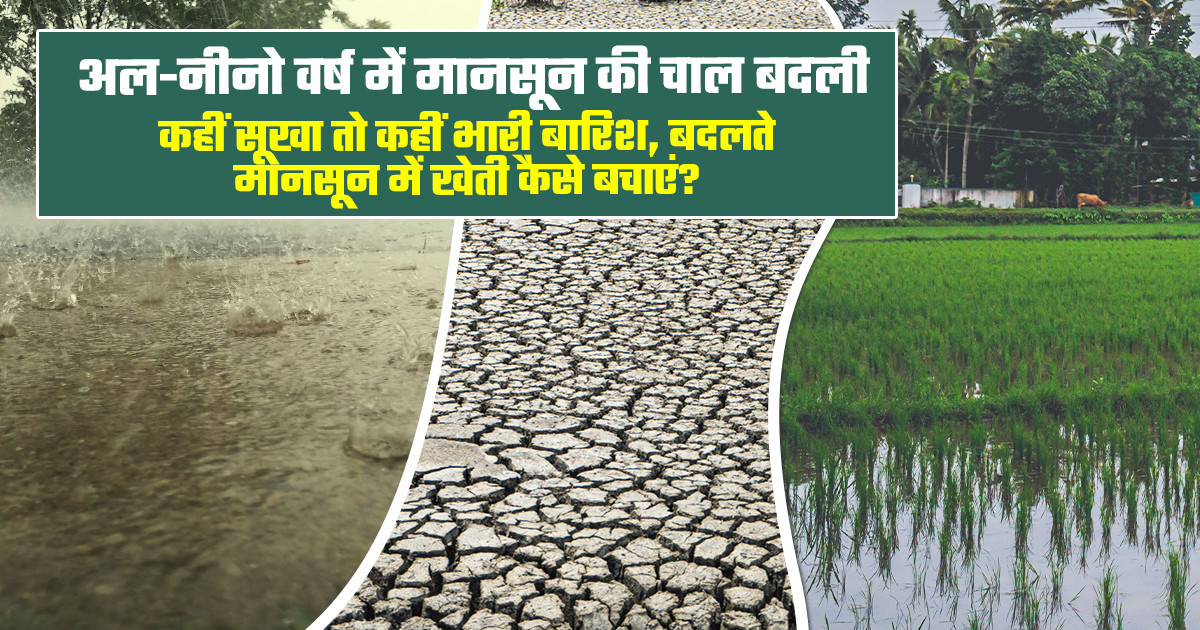
The southwest monsoon has become active across several parts of the country and is expected to advance further into central India, Uttar Pradesh, Bihar, and the remaining parts of Rajasthan over the coming days. According to weather forecasts, rainfall activity may intensify in many states during the next three to five days, while some regions could continue to experience below-normal rainfall. In view of the changing weather conditions, agricultural experts are advising farmers to adopt climate-smart farming practices instead of relying solely on the arrival of the monsoon.
El Niño is a naturally occurring climate phenomenon associated with the warming of sea surface temperatures in the central and eastern Pacific Ocean. Although it develops far from India, it can significantly influence the Indian monsoon system. During El Niño years, India often experiences delayed monsoon progress, uneven rainfall distribution, prolonged dry spells, and occasional episodes of intense rainfall in certain regions. These weather variations can directly affect agricultural production and increase farming risks.
El Niño can weaken or disrupt normal monsoon patterns, leading to uneven rainfall distribution. Some areas may receive excessive rainfall and flooding, while others may face drought-like conditions and moisture stress. Because of this uncertainty, agricultural experts recommend risk-based farming strategies that help reduce crop losses and improve resilience during adverse weather conditions.
Farmers are encouraged to adopt crop diversification instead of relying on a single crop across the entire farm. Different portions of the field can be allocated to crops such as soybean, maize, pulses, or other short-duration varieties. Livestock farmers should also ensure adequate fodder availability to minimize risks arising from adverse weather conditions.
Early rainfall often encourages farmers to begin sowing immediately. However, if dry conditions return after the initial rains, seed germination and crop establishment may be affected. Agricultural experts suggest waiting until the field receives adequate and consistent rainfall and sufficient soil moisture before undertaking sowing operations.
Maintaining soil moisture is one of the most important practices during El Niño years. Ridge-and-furrow planting, timely weeding, intercultural operations, and the use of crop residues or organic matter help conserve moisture in the soil. In many situations, one effective irrigation can provide greater benefits than scattered light rainfall.
Farmers in low-rainfall areas should use certified seeds and carry out proper seed treatment before sowing. Maintaining an optimum plant population is essential for achieving good crop growth. Where plant gaps occur, timely gap filling can help reduce yield losses.
During periods of low rainfall, farmers should focus on conserving moisture and harvesting rainwater. In contrast, areas receiving heavy rainfall should ensure proper drainage to prevent waterlogging. Field bunding, farm ponds, rainwater harvesting structures, and drainage channels can play a significant role in managing weather extremes.
Adopt Balanced Nutrient Management:
Excessive nitrogen application during low-rainfall years can negatively affect crop performance. Farmers should apply fertilizers based on soil test recommendations. Balanced use of nitrogen, phosphorus, and potassium helps improve crop tolerance to weather stress and enhances productivity.
Keep Alternative Crops Ready:
If adequate rainfall is not received within the normal sowing window, farmers should consider short-duration and low-water-requiring crops. Pigeon pea, green gram, black gram, sesame, mustard, and chickpea can serve as suitable alternatives in many regions.
Key Advice for Farmers:
During El Niño years, minimizing losses becomes more important than maximizing production. Farmers who follow weather forecasts, seek scientific guidance, and make decisions based on local conditions are better prepared to face changing monsoon patterns and climate-related risks.
FAQs:
1. What is El Niño?
El Niño is a climate phenomenon in which sea surface temperatures in the Pacific Ocean become warmer than normal, affecting weather patterns worldwide, including the Indian monsoon.
2. How does El Niño affect Indian agriculture?
El Niño can cause delayed monsoon, uneven rainfall, dry spells, and occasional heavy rain, increasing crop production risks.
3. Which crops are suitable during El Niño?
Short-duration and low-water crops like pigeon pea, green gram, black gram, sesame, mustard, and chickpea are suitable alternatives.
4. How can farmers reduce El Niño-related crop losses?
Farmers should diversify crops, conserve soil moisture, manage water efficiently, use certified seeds, and apply balanced fertilizers based on soil tests.
5. Why does Khetivyapar recommend climate-smart farming during El Niño?
Khetivyapar recommends climate-smart farming because it helps farmers reduce weather-related risks, improve resilience, and maintain stable crop production despite uncertain monsoon conditions.