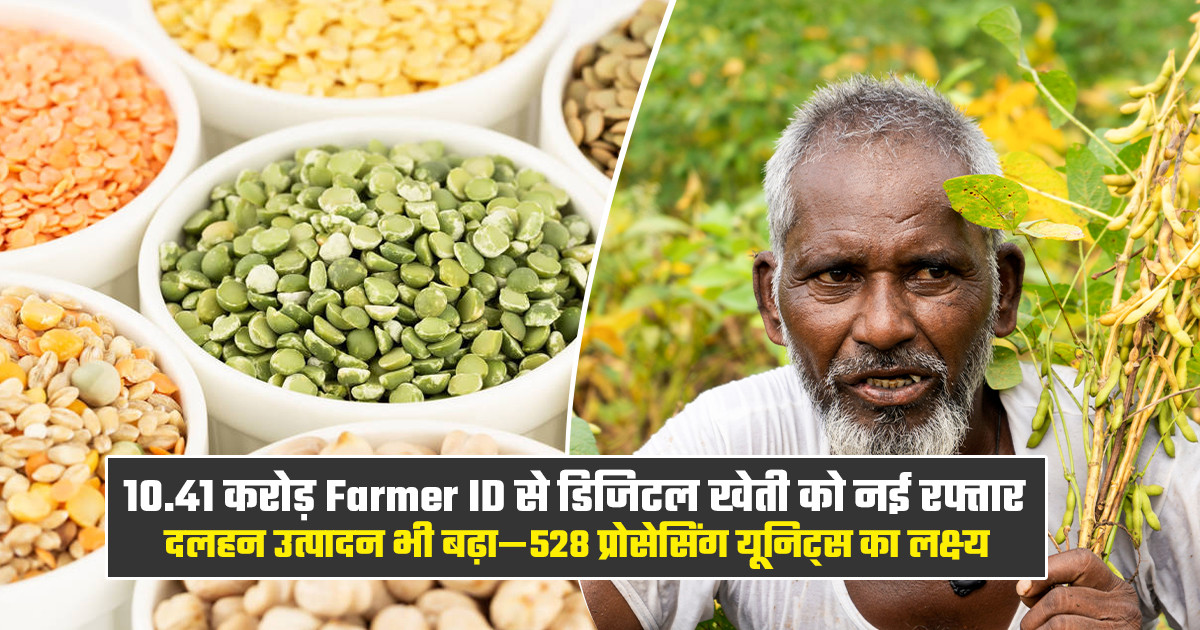
India’s agriculture sector is moving rapidly toward a more digital, data-driven and farmer-centric system. With 10.41 crore Farmer IDs already created across 26 states and Union Territories, the government is strengthening the digital infrastructure needed to deliver agricultural schemes and services more efficiently and transparently. At the same time, progress in digital crop surveys, village georeferencing and land-data integration is creating a stronger foundation for location-specific farm services. Alongside this digital transformation, the country is also making progress toward pulses self-reliance, with gains in production, cultivated area and productivity. The next priority is to strengthen processing, storage and market linkages so that higher farm output translates into better value for farmers.
The progress of AgriStack and the Digital Agriculture Mission has emerged as a key national priority. So far, 10.41 crore Farmer IDs have been generated across 26 states and Union Territories. This represents around 84.68% of PM-KISAN beneficiaries and approximately 77% of estimated operational agricultural holdings.
The Farmer ID is being developed as an important digital foundation for delivering government schemes and agricultural services. By creating a reliable digital identity for farmers, authorities aim to ensure that the right benefit reaches the right farmer at the right time.
A successful digital agriculture ecosystem requires more than farmer identification. Accurate land and crop data are equally important for delivering targeted services. Under the Digital Agriculture Mission, significant progress has been made in land mapping, dereferencing and data verification. Nearly 5.9 lakh villages have been georeferenced, covering around 93.05% of the identified villages.
The Digital Crop Survey is also expanding rapidly across the country. Its coverage increased from 290 districts in 2024-25 to 650 districts during Rabi 2025-26. For Kharif 2026-27, the government has planned to extend the survey to 692 districts. The geographical coverage has expanded significantly as well. The area covered by the digital crop survey increased from 3.87 crore hectares in 2024-25 to 9.18 crore hectares in 2025-26. For Kharif 2026-27, the target has been set at 13.4 crore hectares.
India’s efforts to increase domestic pulses production are also showing positive results. Pulses production increased from 256.83 lakh metric tonnes in 2024-25 to 274.09 lakh metric tonnes in 2025-26. During the same period, the area under pulses cultivation increased from 277.20 lakh hectares to 286.46 lakh hectares. Productivity also improved, rising from 926 kg per hectare to 957 kg per hectare.
The simultaneous improvement in production, acreage and productivity indicates growing momentum in the pulses sector and suggests that interventions under the Pulses Self-Reliance Mission are beginning to deliver measurable results.
Lower Imports Signal Progress Toward Pulses Self-Reliance:
The rise in domestic production has also contributed to a reduction in India’s dependence on imported pulses. Pulses imports declined from 72.56 lakh metric tonnes in 2024-25 to 59.64 lakh metric tonnes in 2025-26. However, increasing production alone will not be enough to achieve long-term self-reliance. Farmers also need efficient processing facilities, storage infrastructure and reliable market linkages to ensure that higher production creates greater economic value at the farm level.
528 Pulses Processing Units Targeted for 2026-27:
To strengthen the post-harvest value chain, the government has set a target of establishing 528 pulses processing units across states during 2026-27. The focus is shifting from simply increasing production to building an integrated seed-to-market value chain. Better processing capacity can improve the value of pulses, while stronger storage and market connections can help reduce post-harvest losses and provide farmers with better opportunities to market their produce.
FAQs:
1. What is a Farmer ID?
A Farmer ID is a digital identity being developed to connect farmers with agricultural schemes and services.
2. How many Farmer IDs have been created?
Around 10.41 crore Farmer IDs have been generated across 26 states and Union Territories.
3. What is the Digital Crop Survey?
It is a technology-based system for collecting digital information about crops and cultivated areas.
4. How much did pulses production increase?
Pulses production rose to 274.09 lakh metric tonnes in 2025-26 from 256.83 lakh metric tonnes in 2024-25.
5. How many pulses processing units are targeted?
The government has targeted 528 pulses processing units for 2026-27.