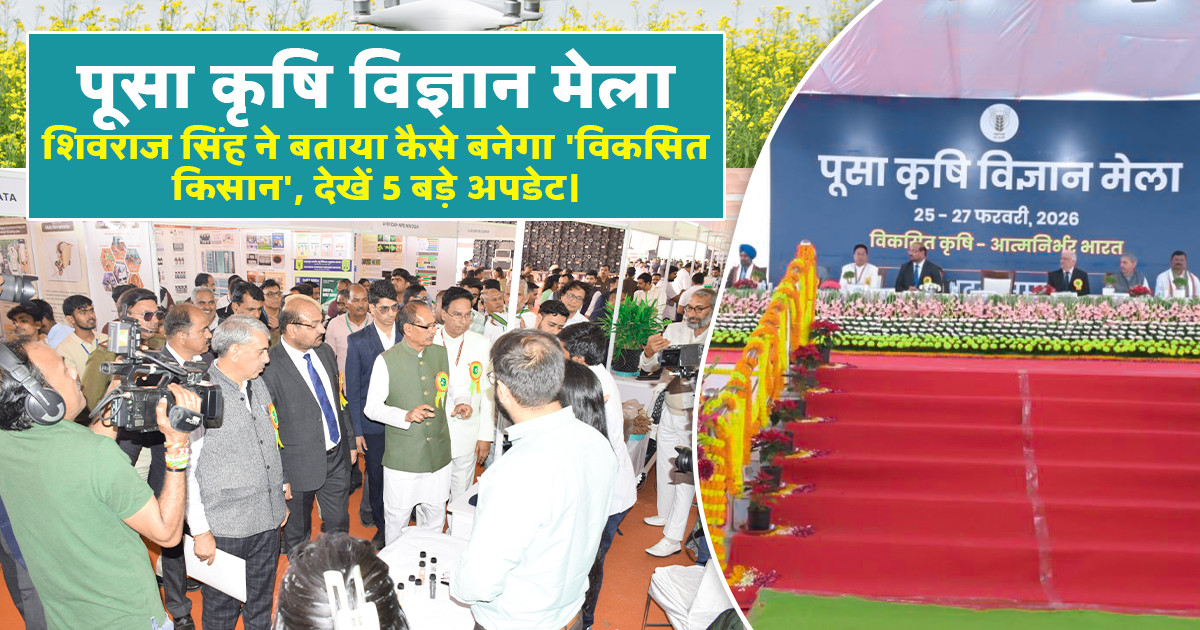
Shivraj Singh Chouhan inaugurated the three-day National Pusa Agricultural Science Fair at the Indian Agricultural Research Institute (IARI), Pusa, in New Delhi. On the occasion, he unveiled a comprehensive roadmap of agricultural reforms aimed at advancing farming towards the vision of “Developed Agriculture–Self-Reliant India.”
Union Minister made it clear that delays in farmers’ payments will no longer be tolerated. From MSP procurement and Kisan Credit Card (KCC) loans to pesticide licensing and the functioning of Krishi Vigyan Kendras (KVKs), transparency, accountability, and strict timelines will be enforced at every level.
Addressing key reform measures, Chouhan warned that any agency or state government withholding farmers’ payments will be required to pay 12 percent interest on the pending amount. He assured that the central government will not delay its share of payments and is exploring options to transfer the Centre’s portion directly into farmers’ bank accounts in case of delays at the state level.
Referring to support provided for farm mechanisation, drip and sprinkler irrigation, polyhouses, and greenhouses, the Minister said that merely allocating funds is not enough. A robust monitoring mechanism will be established to ensure that benefits reach eligible farmers.
He announced that Krishi Vigyan Kendras will be strengthened as key district-level units, serving as a bridge between research and field extension. KVKs will be tasked with disseminating new crop varieties, advanced farming practices, and successful agricultural models to villages across the country.
Zero Delay in KCC Loans:
Highlighting that nearly 75 percent of small farmers are benefiting from Kisan Credit Card loans at an effective interest rate of 4 percent, Chouhan emphasized that any delay in loan disbursement is unacceptable. Banks and financial institutions will be held accountable for timely processing without unnecessary paperwork.
Simplification of Pesticide Licensing:
The Minister stressed the need to simplify and streamline the pesticide licensing process, making it transparent and time bound. He noted that the current complex system often delays the availability of quality products and creates hurdles for genuine companies, while stricter controls will help curb counterfeit and substandard products.
MSP Procurement to Be Completed Within a Month:
Calling the existing three-month MSP procurement timeline impractical, he suggested that the process should be completed within a maximum of one month. This would ensure farmers receive prompt payments and prevent misuse of the system.
Fertiliser Subsidy Directly to Farmers:
Chouhan also referred to the nearly ₹2 lakh crore fertiliser subsidy provided by the Centre and proposed examining the possibility of transferring it directly into farmers’ accounts through Direct Benefit Transfer (DBT). This would empower farmers to make independent purchasing decisions and ensure that the subsidy benefits the actual cultivators.
‘Viksit Krishi Sankalp Abhiyan’ to Resume:
He announced that the “Viksit Krishi Sankalp Abhiyan” will be relaunched in April. Under this initiative, teams of scientists will visit villages to directly engage with farmers, sharing knowledge on new research developments, pest and disease management, integrated farming models, and improved seed varieties—ensuring that innovations move from laboratories to fields.
A National Confluence for Agricultural Progress: Describing the Pusa Agricultural Science Fair as a national congregation of farmers, scientists, entrepreneurs, and policymakers, Chouhan said the event is more than an exhibition it is a platform for shaping the roadmap for modern, developed, and self-reliant agriculture in India. He also directed that the fair be expanded further in scale and scope from next year onward.
FAQs:
Q1. What is the main goal of the Pusa Agricultural Science Fair?
The fair aims to bridge research and farming, promote modern agricultural practices, and advance India toward self-reliant, developed agriculture.
Q2. How will delayed payments to farmers be handled?
Any delays in payments will attract a 12% interest, and the Centre plans to ensure its share is transferred directly to farmers’ accounts.
Q3. What reforms are planned for KVKs?
KVKs will become district-level reform centres, sharing crop varieties, farming innovations, and advanced practices with local farmers.
Q4. How will Kisan Credit Card (KCC) loans be improved?
Banks and financial institutions will be strictly monitored to prevent delays, ensuring that nearly 75% of small farmers continue to benefit at a 4% effective interest rate.
Q5. What is the Viksit Krishi Sankalp Abhiyan?
It is a government initiative where teams of scientists visit villages to share research, improved seeds, pest management techniques, and integrated farming practices directly with farmers.