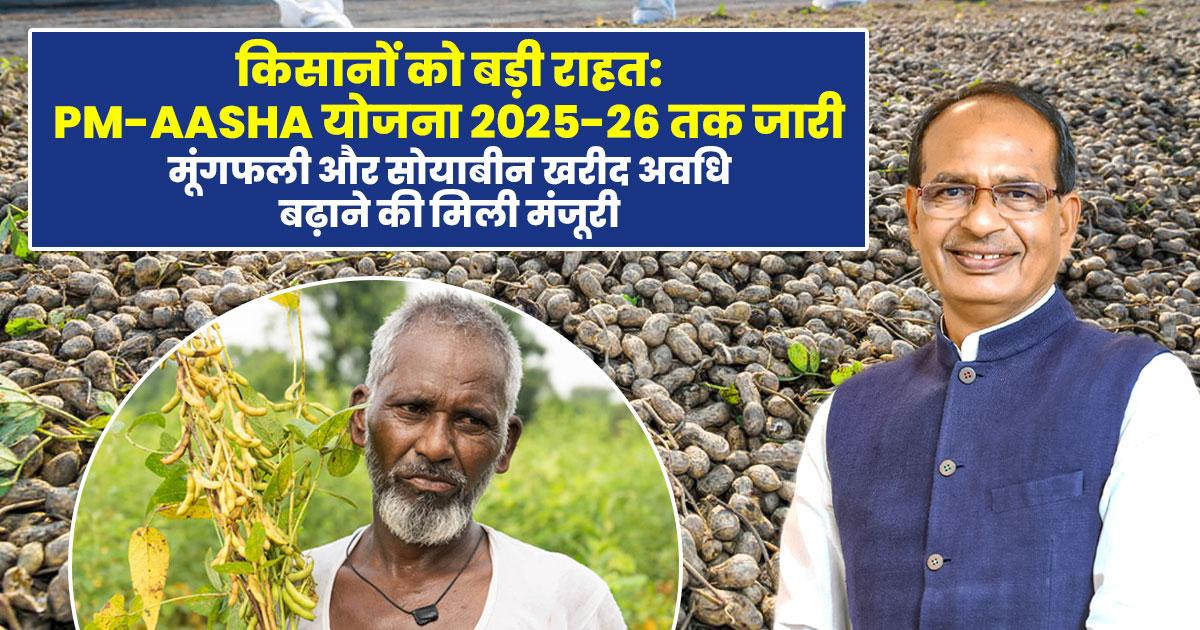
Government of India is implementing a series of key initiatives under the Pradhan Mantri Annadata Aay Sanrakshan Abhiyan (PM-AASHA) to ensure farmers receive fair and remunerative prices for their produce. Under this umbrella scheme, the Price Support Scheme (PSS) enables the procurement of pulses, oilseeds, and copra at the Minimum Support Price (MSP) through central nodal agencies, based on requests from State and Union Territory governments. This intervention comes into effect when market prices fall below MSP, safeguarding farmers from losses during peak harvest periods.
To promote domestic production and ensure better price realization, the government is procuring pulses such as tur (arhar), urad, and masur directly from pre-registered farmers through central agencies. This initiative, aligned with the mission for self-reliance in pulses, will continue until 2030–31.
PDPS, farmers receive the difference between MSP and the prevailing market price directly into their bank accounts. This scheme, primarily applicable to oilseeds, eliminates the need for physical procurement and ensures transparency through a structured auction-based system.
The announcement of MSP and active procurement operations help stabilize market prices, often keeping them at or above MSP levels. Farmers benefit both from government procurement and open market sales, retaining the flexibility to sell wherever they receive better prices.
The scheme covers a wide range of crops, including oilseeds such as groundnut, soybean, and mustard; pulses like gram, moong, urad, arhar, and masur; and copra. Additionally, the Market Intervention Scheme (MIS) supports perishable agricultural and horticultural commodities not covered under MSP.
Transparency and Farmer Protection:
To protect farmers from exploitation, adequate procurement centers are established, and detailed information regarding quality standards, procurement schedules, and locations is widely disseminated. Payments are made directly into farmers’ bank accounts, ensuring transparency and efficiency.
Technology-Driven Procurement:
From the 2025–26 season onwards, farmer authentication at procurement centers has been made mandatory through Aadhaar-enabled biometric systems or facial recognition via mobile applications. This step ensures that only genuine farmers benefit from procurement operations.
Support for Storage and Transportation:
The government is also providing assistance for the storage and transportation of TOP crops—Tomato, Onion, and Potato—to ensure smooth supply from producing to consuming regions, thereby minimizing price volatility.
Strengthening Infrastructure and Digital Markets:
Through the Agriculture Infrastructure Fund (AIF), the government is facilitating affordable financing and credit guarantees to strengthen farm-gate and post-harvest infrastructure. So far, loans worth ₹84,681 crore have been sanctioned for over 1.71 lakh projects.
Meanwhile, the National Agriculture Market (e-NAM) platform has integrated 1,656 mandis across the country, enabling transparent price discovery and improved market access. The platform has recorded trade worth ₹4.82 lakh crore to date.
Promotion of Farmer Producer Organisations (FPOs):
To enhance collective bargaining and market access, the government is promoting the formation of 10,000 Farmer Producer Organisations (FPOs). Thousands of FPOs are already leveraging digital platforms for better marketing and improved returns.
Expansion of Storage Capacity:
The Agricultural Marketing Infrastructure (AMI) scheme, nearly 49,796 warehouses have been approved so far, with a total storage capacity of 982.94 lakh metric tonnes. Additionally, thousands of other agri-marketing infrastructure projects have also been sanctioned.
FAQs:
Q1. What is PM-AASHA Scheme?
PM-AASHA Scheme is a government initiative to ensure farmers get fair prices for their crops.
Q2. What is MSP?
MSP (Minimum Support Price) is the guaranteed price at which the government buys crops from farmers.
Q3. What is PDPS?
PDPS provides farmers the difference between MSP and market price directly in their bank account.
Q4. Which crops are covered under PM-AASHA Scheme?
Pulses, oilseeds, and copra are mainly covered under the scheme.
Q5. How does Khetivyapar help farmers?
Khetivyapar provides updates on MSP, market prices, and government schemes to help farmers make better decisions.