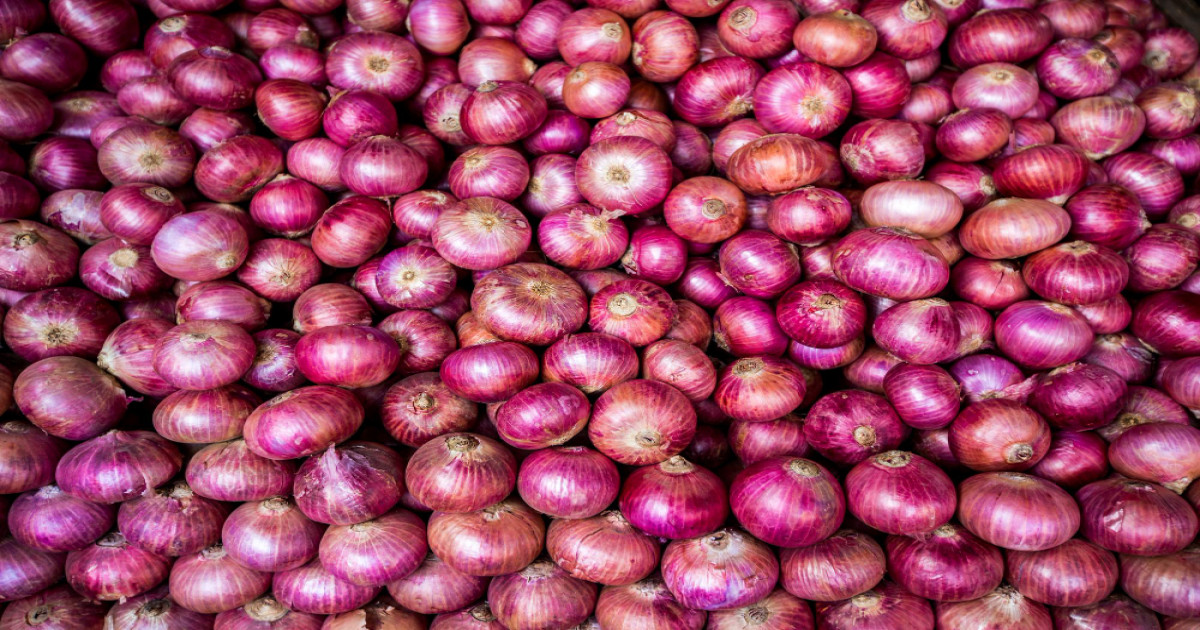
Onion prices are coming under pressure across several parts of India just ahead of the festive season, raising concerns for both consumers and policymakers. With retail prices reportedly reaching around ₹50 per kg in some markets, the government is considering releasing its available Price Stabilisation Buffer stock directly into the retail market to contain further price increases. Lower-than-targeted government procurement, uncertain monsoon conditions and the possibility of delayed Kharif onion arrivals have added to market concerns. The focus is now on maintaining adequate supplies and preventing a sharp rise in retail prices during the high-demand festive period.
The government had set a target of procuring 2 lakh tonnes of onions for the buffer stock this year. However, procurement has so far reached only around 1.20 lakh tonnes through agencies including NAFED and NCCF. One of the key reasons for the shortfall is the higher prices reportedly being offered by private traders. Despite an increase in the government’s procurement price, many farmers have preferred selling their produce to private buyers, leaving the government with a smaller-than-targeted buffer.
To encourage farmers to sell onions for the Price Stabilization Buffer, the government increased the procurement price by around 13% in July 2026. The procurement rate was raised from ₹1,875 per quintal to ₹2,125 per quintal, with the revised price coming into effect from July 4, 2026. Despite the higher rate, procurement has remained below the government’s target, increasing the importance of using the available buffer stock strategically.
According to the second advance estimates for 2025-26 from the Department of Agriculture and Farmers Welfare, onion production is projected at around 307.37 lakh metric tonnes, compared with 307.67 lakh metric tonnes in 2024-25. This indicates that overall production has remained broadly stable. However, several market factors are influencing prices. Monsoon uncertainty, the possibility of delayed Kharif onion arrivals and seasonal demand have increased concerns about near-term price movements.
The government, however, maintains that overall onion availability is currently not a major concern and that some increase in prices could be part of normal seasonal market fluctuations.
According to government assessments, onion stocks in Maharashtra, Madhya Pradesh and Gujarat are currently considered adequate. Daily onion arrivals across the country's mandis are reportedly remaining above 50,000 metric tonnes, while Maharashtra alone is recording arrivals of more than 30,000 metric tonnes. The average modal price in Maharashtra is reported at around ₹18 per kg. The government also expects good-quality onions currently in storage to become increasingly important during periods of lower market arrivals.
Why Could the Government Release the Entire Buffer Stock into Retail Markets?
With government procurement falling short of the original target, the available buffer stock is relatively limited. Releasing large quantities into wholesale markets may not necessarily translate into equivalent relief for consumers at the retail level. As a result, the government is considering a more targeted approach—releasing onions directly into retail markets in major consumption centres. The objective would be to increase availability where retail prices are rising rapidly and prevent further escalation.
Relief Could Come by Late August or Early September:
If prices remain elevated, the government could consider releasing buffer onions into retail markets towards the end of August or in early September. The final decision, however, is expected to depend on prevailing market prices, available stocks and the arrival pattern of fresh Kharif onions. A larger retail release could provide short-term relief to consumers and help prevent a sharp price spike ahead of the festive season. At the same time, policymakers will need to maintain a balance between consumer affordability and remunerative prices for farmers.
FAQs:
1. Why are onion prices rising?
Monsoon uncertainty, delayed Kharif arrivals and seasonal demand are putting pressure on onion prices.
2. What is the government onion procurement target?
The target is 2 lakh tonnes for the Price Stabilisation Buffer.
3. How much onion has been procured so far?
Around 1.20 lakh tonnes has been procured by government agencies.
4. When could buffer onion be released?
The government may consider retail releases by late August or early September, depending on market conditions.
5. Will releasing buffer stock reduce onion prices?
A targeted retail release could increase availability and help prevent a sharp rise in onion prices in major consumption centres.