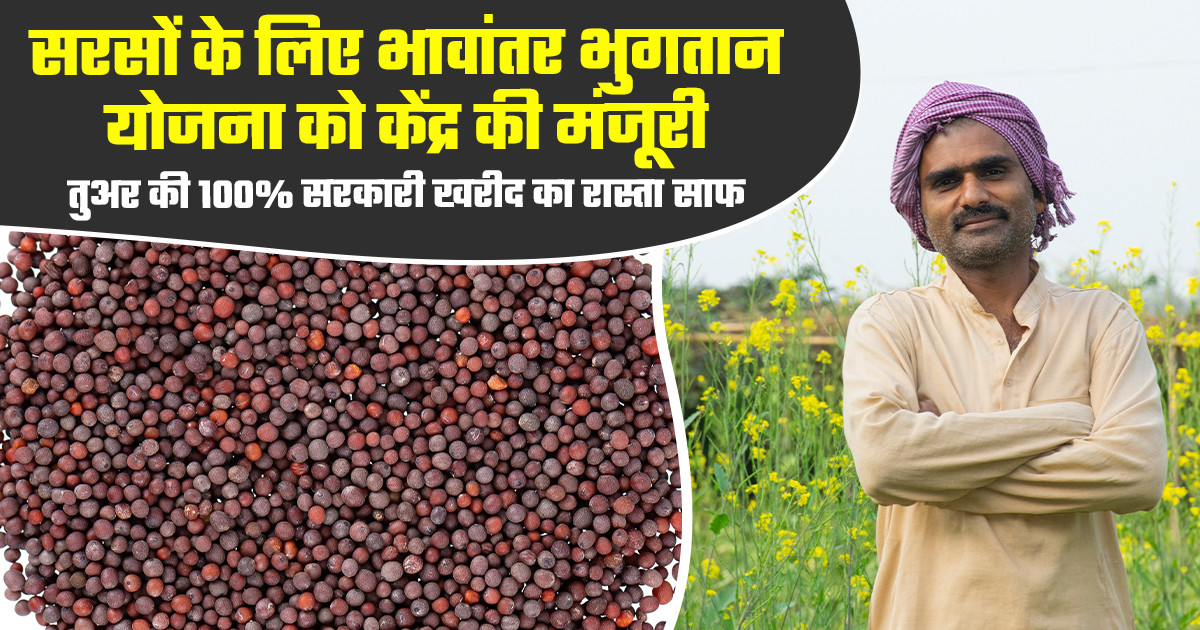
Farmers in Madhya Pradesh have received significant relief as the central government has approved several key proposals aimed at strengthening agricultural support in the state. Following consistent efforts by Chief Minister Mohan Yadav, the Centre has cleared the Price Deficiency Payment Scheme for mustard procurement and granted approval for 100 percent government procurement of tur (arhar). The decisions are expected to provide stability and better income assurance to farmers across the state.
During a meeting held in New Delhi on Thursday, Chief Minister Mohan Yadav met Union Agriculture and Farmers’ Welfare Minister Shivraj Singh Chouhan to discuss a range of issues related to agriculture and rural development in Madhya Pradesh. Panchayat and Rural Development Minister Prahlad Singh Patel and senior officials were also present at the meeting. Several important decisions benefiting the state were discussed, including matters related to rural roads and agricultural support programs.
Acting on the request of the Chief Minister, the Centre approved Madhya Pradesh’s proposal under the Price Deficiency Payment Scheme for mustard procurement. Union Minister Shivraj Singh Chouhan directed the concerned departments to expedite the payment process.
This scheme, mustard farmers will receive compensation for the difference between the market price and the Minimum Support Price (MSP). This mechanism is expected to reduce income volatility for farmers and ensure they receive a fair return for their produce.
During the meeting, the Union Agriculture Minister also handed over the official approval letter for 100 percent government procurement of tur (arhar). This decision ensures that the entire produce of tur farmers in Madhya Pradesh can be procured by government agencies. With this assurance in place, farmers will be better protected from sudden price drops in the open market and will have greater confidence that their produce will fetch a remunerative price.
Chief Minister Mohan Yadav emphasized the need to develop Madhya Pradesh as a leading hub for pulses and oilseeds production. In response, both the central and state governments agreed to formulate a long-term strategy to enhance the cultivation of crops such as moong, urad, gram, sesame, mustard and palm oil.
The initiative aims to strengthen domestic production, improve farmers’ incomes and support India’s broader goal of achieving self-sufficiency in edible oils and pulses.
The meeting also included discussions on improving the implementation of the Pradhan Mantri Fasal Bima Yojana. The Chief Minister raised concerns about ensuring better protection for farmers under the crop insurance framework.
Union Minister Shivraj Singh Chouhan instructed officials to rely not only on satellite-based assessments but also on crop cutting experiments and remote sensing technologies when evaluating crop damage, particularly in crops like soybean. This approach is expected to provide more accurate estimates and ensure fair compensation for farmers.
Review of Key Agriculture and Rural Development Schemes:
Several important issues concerning Madhya Pradesh were reviewed during the meeting. These included price deficiency payments for mustard and soybean, additional targets for moong and urad under the national pulses mission, implementation of the crop insurance scheme, soil health and fertility programs, and wage and material payments under Mahatma Gandhi National Rural Employment Guarantee Act.
Discussions also covered the progress of Pradhan Mantri Awas Yojana – Gramin and Pradhan Mantri Gram Sadak Yojana. The Union Minister directed officials to resolve pending matters related to Madhya Pradesh on a priority basis so that farmers, rural workers and economically weaker sections receive timely benefits.
Momentum for Rural Development in “Farmer Welfare Year”:
Chief Minister Mohan Yadav stated that under the leadership of Narendra Modi, the central government remains committed to farmers’ welfare. He highlighted that Madhya Pradesh has declared 2026 as the “Farmer Welfare Year,” with a focus on increasing farm incomes and accelerating rural development initiatives.
Union Agriculture Minister Shivraj Singh Chouhan welcomed the initiative and remarked that Madhya Pradesh holds a special place for him. He assured that during the Farmer Welfare Year, farmers cultivating mustard, tur, moong, urad and other oilseed crops will receive every possible support, helping the state achieve new milestones in agriculture and rural development.
FAQs:
1. What is the Price Deficiency Payment Scheme for mustard?
It is a scheme where farmers receive compensation for the difference between the market price and the Minimum Support Price (MSP).
2. What does 100% government procurement of tur mean?
It means government agencies can purchase the entire tur crop from farmers if market prices fall.
3. Which crops will get promotion in Madhya Pradesh?
Crops like mustard, tur, moong, urad, gram and sesame will receive special focus.
4. How will crop insurance improve for farmers?
Crop loss assessment will use satellite data, crop cutting experiments and remote sensing technology for accurate compensation.
5. Why has Madhya Pradesh declared 2026 as Farmer Welfare Year?
The state aims to increase farmers’ income and accelerate rural development initiatives.